

Imagine finding a 400-year-old brass padlock on a windswept Welsh beach, spinning its tiny lettered dials for twenty years, and never once hearing it click open. That exact frustration haunted metal detectorist Peter Hughes until biomedical engineers aimed a bone-scanning machine at the relic in late 2026. Using non-destructive micro-CT imaging, researchers finally mapped the corroded guts of the Ann Francis shipwreck padlock and cracked its Elizabethan password without breaking a single gear.
The 1583 Storm Off Margam Beach
To understand why a tiny piece of Tudor engineering ended up buried in Welsh sand, you have to look at the violent night of December 28, 1583. The Ann Francis, an English merchant ship hailing from King’s Lynn in Norfolk, was fighting its way home from Spain. Heavy southerly gales and a fatal navigational blunder shoved the vessel wildly off course, driving it straight into the treacherous waters of the Bristol Channel instead of the English Channel.
The ship broke apart violently along Margam Beach near Port Talbot in South Wales. Fourteen sailors drowned in the freezing surf. Local parish registers in Norfolk later blamed the tragedy on a King’s Lynn woman named Mother Gabley, accusing her of summoning the deadly storm through witchcraft by boiling eggs in a pail of cold water.
Superstition aside, the wreck immediately triggered an all-out feeding frenzy on the shore. Local landowners and over a hundred armed townsfolk swarmed the beach to plunder the spilled cargo, sparking a bitter legal battle that eventually reached the royal Star Chamber in London. An official sixteenth-century inventory of the impounded loot lists cannon, anchors, bolts of calico, nutmeg, cloves, two boxes of marmalade, and three wooden chests whose locks had been smashed open.
Shaxton Family Smuggling Ties
Why was an English wheat ship carrying Spanish silver, Portuguese gold, and early colonial coins minted in Mexico? Because the ship’s owner wasn’t exactly playing by the royal rulebook.

Francis Shaxton of King’s Lynn owned the Ann Francis, and historical court records show he officially told English port authorities the vessel was simply making a routine domestic run up the coast to Hartlepool. In reality, the Shaxton family were notorious Elizabethan smugglers running lucrative, off-the-books trade routes straight into Spain.
When Shaxton showed up in Wales in March 1584 to claim his wrecked property, he walked straight into a legal buzzsaw between rival local lords Sir Edward Mansell and the Earl of Pembroke. While looters and lawyers fought over the obvious cargo on the sand, shifting tides swallowed hundreds of smaller coins and personal belongings. Those remnants stayed hidden beneath the seabed for more than four centuries — until Peter Hughes metal detectorist Wales started walking the shoreline after heavy winter storms.
Two Decades of Manual Failure
Between 1996 and 2017, Hughes made over a thousand trips to Margam Beach whenever storms or coastal dredging stripped away the top layers of sand. His persistence paid off massively. Over 21 years, he pulled roughly 870 gold and silver coins from the beach alongside navigational compasses, a boatswain’s whistle, pewter spoons, a brass candlestick, and two specialized weights used to verify gold currency.
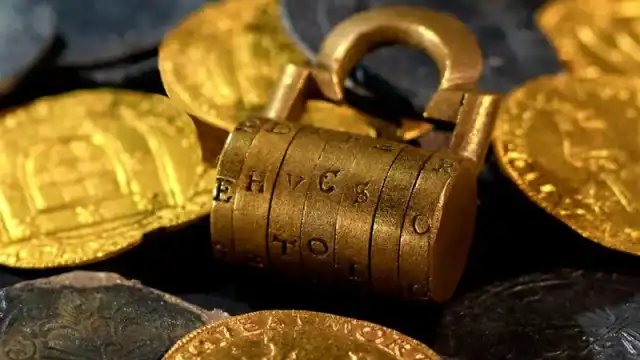
In 1999, Hughes unearthed the crown jewel of his personal puzzle: a miniature copper-alloy combination lock measuring just 1.25 inches (31.8 millimeters) tall and weighing roughly one ounce (28.5 grams). Astonishingly, after four centuries submerged in saltwater and sand, the four rotating brass rings still spun smoothly between his fingers.
Each of the four movable dials featured six engraved capital letters, accompanied by ten additional letters stamped onto the two fixed end plates. Hughes spent the better part of twenty years casually spinning those dials in his living room, hoping to stumble upon the magic word. He never got close.
Why didn’t museum curators just sit down and try every combination once Amgueddfa Cymru (Museum Wales) acquired the hoard? Let’s look at the math and the risk:
- The Math: Four independent rings with six letters each create possible permutations. Testing one combination every 30 seconds would take nearly 11 straight hours of non-stop twisting.
- The Risk: Four centuries of microscopic sand, salt crust, and marine grit had packed tightly inside the lock’s narrow tolerances. Spinning those ancient brass rings over a thousand times by hand would act like liquid sandpaper, grinding down the internal teeth and potentially snapping the mechanism forever.
Engineering Breakdown: How Micro-CT Cracked the Code
When brute force threatens to destroy an irreplaceable artifact, archaeologists turn to non-destructive testing. Senior curator Alastair Willis and his colleagues at Museum Wales reached out to Dr. David Williams at the Musculoskeletal Biomechanics Research Facility inside Cardiff University’s School of Engineering.
Dr. Williams normally uses high-resolution X-ray computed tomography to inspect human bone fractures, mouse knees, pig eyes, and fossilized remains. Aiming a medical-grade biomechanical scanner at a Tudor-era shipwreck padlock unlocked ct scan project was uncharted territory. The team worried the dense copper alloy might scatter the X-rays and turn the digital readout into a useless, blurry gray blob.
The first scan immediately proved their doubts wrong — the external engraved letters popped clearly on the computer monitor. After adjusting their imaging parameters on a third scan, the engineering team generated a crystal-clear, three-dimensional digital twin of the lock’s hidden interior.
Inside the Nuremberg Mechanism
If you slice a modern padlock open, you usually find spring-loaded pins. Sixteenth-century combination locks — often called Nuremberg locks after the German metalworking hub where many were crafted — rely on pure mechanical geometry:
- The Slotted Spindle: Running down the center of the lock is a central metal shaft attached to the removable shackle/key piece, fitted with four protruding teeth or lugs.
- The Notched Rings: Each of the four exterior lettered rings has a solid inner wall broken by a single precisely filed notch.
- The Alignment: When the rings are scrambled, those solid inner walls block the spindle’s teeth from sliding out. Only when all four internal notches line up in a straight channel can the central key-like spindle slide free of the cylinder.
By rotating the 3D micro-CT model on his screen, Dr. Williams visually peered straight through the solid brass walls. He mapped the exact physical position of the hidden internal notch on each ring and matched it directly to the corresponding letter stamped on the outside rim.
The Verdict: A Four-Letter Mystery
Dr. Williams sent the four-letter sequence over to Museum Wales later that afternoon. Standing at the conservation bench, curator Alastair Willis carefully aligned the four rings to spell out the 400 year old combination lock code: A-N-C-E.

The tension in the room disappeared instantly. Willis felt the mechanism loosen slightly in his hands, and the grit-covered internal key slid free for the first time since Elizabeth I sat on the English throne.
Cracking the mechanical engineering solved a 443-year-old physical puzzle, yet it immediately opened an even weirder historical riddle. What on earth does ANCE actually mean?
It isn’t an obvious English word, though curators and linguists have tossed around a few compelling theories:
- A Phonetic Abbreviation: Could it be a playful phonetic shortening of the ship’s own name — Ann Francis — or a sailor’s nickname for a sweetheart named Anne or Nancy?
- A Partial Word: Some researchers point out that the two fixed end plates carry ten additional letters, meaning ANCE might just be the movable middle chunk of a longer word like CHANCE, DANCE, or FRANCE.
- Continental Origins: Since Nuremberg-style locks circulated heavily through German, French, and Dutch merchant ports, the letters could reflect a foreign abbreviation — such as the old French word ançe (meaning a chest handle) — picked up during Shaxton’s illicit trading voyages.
What Was the Lock Protecting?
Because Peter Hughes found the padlock loose in the sand near a cluster of Spanish silver pieces of eight and two brass coin weights, historians suspect it once secured a small personal strongbox or a merchant’s travel coffer. Any leather, parchment letters, or fine textiles inside that box dissolved in the salty surf centuries ago.
Could this tiny brass lock have originally belonged to one of the three broken-open chests recorded in Sir Edward Mansell’s 1583 plunder inventory? Nobody can prove it beyond a shadow of a doubt. Still, seeing the Cardiff University shipwreck lock sitting intact today inside the Tides of Treasure exhibition at Swansea’s National Waterfront Museum proves just how far modern science has come. Archaeologists no longer have to smash open the past to read its secrets — sometimes, all it takes is a bone scanner and a little patience.
Want to see the exact moment curators aligned the dials and pulled the 443-year-old shackle free? Watch the Museum Wales announcement video to see the 3D micro-CT scans and the unboxing in action.

