

World Water Day 2026: Why Safe Drinking Water Is Still a Global Crisis
Imagine turning on your kitchen tap and nothing comes out. Alternatively, picture the water that does flow being brown, foul smelling, and loaded with deadly bacteria. For most parents and tech enthusiasts reading this from a comfortable living room, that scenario sounds like a dystopian movie plot. However, for billions of people, this is simply Tuesday.
As we mark World Water Day in March 2026, the harsh truth is staring humanity right in the face. Safe drinking water remains an unimaginable luxury for a staggering chunk of the global population. But why exactly are we still fighting this battle? we break down the facts, the systemic failures, and the smart solutions that might just pull us back from the brink.
Key takeaways
- A New Era: The United Nations officially declared a state of “Global Water Bankruptcy” in early 2026, warning that we are living far beyond our ecological means.
- The Shocking Stats: According to WHO and UNICEF data, 2.1 billion people currently lack access to safely managed drinking water.
- The 2026 Theme: This year’s focus is “Water and Gender,” highlighting the disproportionate physical and social burden placed on women and girls.
- The Tech Hope: From AI-driven leak detection to graphene filtration, smart technology is actively fighting the global water crisis.
What does “Water Bankruptcy” actually mean?
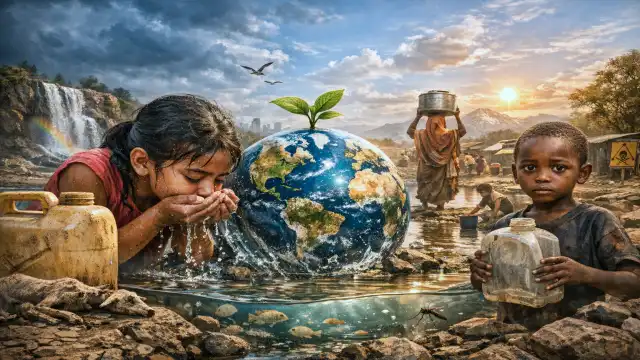
In January 2026, researchers dropped a massive bombshell. Specifically, scientists at the United Nations University (UNU-INWEH) officially moved past familiar terms like “water stressed” or “in crisis.” Instead, they defined our current post crisis reality as Global Water Bankruptcy.
What does that terrifying phrase actually mean for you and your kids? Simply put, the earth’s water bank is heavily overdrawn. We are aggressively withdrawing groundwater from ancient aquifers and draining rivers much faster than rainfall can possibly refill them. Consequently, major hydrological systems are reaching a point of irreversible, permanent damage.
We literally broke the bank. The water bank, that is.
Furthermore, the data backing this up is absolutely gut wrenching. Roughly 4 billion people nearly two thirds of the global population face severe water scarcity for at least one month every single year. Meanwhile, 106 million folks are forced to drink directly from untreated surface sources. Therefore, they consume water straight from muddy puddles, contaminated lakes, and polluted streams. Ultimately, we are not just managing a temporary dry spell; we are actively cannibalizing the natural capital required for our children’s future.
“Water and Gender”: The core theme for world water day 2026
If you dig into the mechanics of poverty, you will find a glaring inequality. The official theme for World Water Day 2026 is “Water and Gender,” operating under the powerful slogan: “Where water flows, equality grows.” Why do we need to focus on gender when discussing infrastructure? Because, frankly, the global water crisis does not hit everyone equally.

When a rural village lacks a functional well, the men rarely walk miles to fetch daily hydration. Instead, that back breaking burden falls almost entirely on the shoulders of women and adolescent girls. Globally, females spend an estimated 250 million hours every single day collecting water. Just pause and let that massive number sink in.
- Stolen Education: Those are millions of hours stolen directly from classrooms. If a young girl is walking six kilometers a day hauling a 40 pound jerrycan, she isn’t learning math.
- Physical Danger: Furthermore, walking long distances to remote water sources exposes women to severe risks of harassment and gender based violence.
- Systemic Exclusion: Despite bearing the brunt of the labor, women hold only 26% of leadership positions in water organizations across the Global South.
Consequently, policies get drafted by men who have never once carried a heavy bucket across the arid dirt. Thus, empowering women within the water management sector is essentially a proven cheat code for long term sustainability. When women sit on local utility boards, systems simply last longer.
Why can’t we just fix the pipes? (Root causes)
As tech enthusiasts, we naturally want to hack the problem. Can we not just engineer our way out of this mess? Unfortunately, the reality is a tangled, messy web of climate chaos, bureaucratic inertia, and systemic underfunding.
1. Hydrological overshoot and climate change
First off, our weather patterns are entirely out of whack. Historically, farmers knew exactly when the seasonal rains would arrive. Today, those same agricultural communities face crippling mega droughts followed immediately by devastating flash floods. Ultimately, parched, baked soil becomes too hard to absorb rapid floodwaters. Therefore, the water simply washes away vital topsoil instead of slowly refilling underground aquifers.
2. The massive agricultural thirst
Here is a wild statistic to chew on. Roughly 72% of all global freshwater withdrawals go straight toward agriculture. Naturally, humanity needs to eat. However, the exact way we grow our food remains incredibly inefficient. Old school flood irrigation techniques lose billions of gallons to simple evaporation. Consequently, the local communities located downstream are left entirely high and dry.
3. Failing infrastructure vs rapid urbanization
In wealthy nations, municipalities lose trillions of gallons annually because of ancient, leaky pipes hidden beneath the asphalt. Meanwhile, in rapidly growing developing nations, the baseline infrastructure never existed in the first place. Interestingly, the latest UNICEF reports show that while rural water access has slowly improved to 60%, urban coverage has completely stagnated. Because millions of people are migrating to crowded city slums every year, urban planners simply cannot lay pipes fast enough to keep up.
Human cost: More than just thirst
As a parent, nothing is more terrifying than an active, invisible threat to your child’s health. Now, imagine if that daily threat came from the very substance keeping them alive.

According to the World Health Organization, a staggering 3.4 billion people currently lack safely managed sanitation services. Furthermore, nearly 354 million individuals still practice open defecation due to a total lack of toilets. When raw, untreated sewage inevitably mixes with local drinking water sources, the resulting health consequences are swift and deadly.
Waterborne diseases like cholera, typhoid, polio, and dysentery run absolutely rampant in these vulnerable communities. Specifically, babies and toddlers bear the heaviest toll because their tiny, developing immune systems cannot handle the massive bacterial load. Consequently, diarrheal diseases kill over 1,000 children under the age of five every single day. Let that harsh reality settle into your mind. We are losing a child every two minutes to dirty water. Therefore, solving this global water crisis isn’t merely an engineering project; it is a literal rescue mission.
Can AI save our water?
Fortunately, the situation isn’t entirely doom and gloom. Smart technology is finally stepping up to the plate. For tech savvy readers tracking industry trends, the stagnant water sector is officially ripe for massive disruption.
- AI-Powered Leak Detection: Generative AI models are currently analyzing acoustic sound wave data from municipal pipe networks. Consequently, these smart algorithms can predict exactly where a pipe will burst weeks before it actually happens. This proactive approach saves millions of gallons daily.
- Precision Agriculture: Farmers are now using flying drones and underground soil sensors to feed real time moisture data to smart irrigation systems. Therefore, crops receive precisely the exact amount of hydration they need, right down to the microscopic drop.
- Atmospheric Water Generators (AWGs): Imagine a sleek machine that pulls fresh drinking water straight out of thin air. Amazingly, solar powered AWGs are currently being deployed in remote, off grid communities. Thus, they provide safe drinking water without requiring a deep well or a flowing river.
- Nanotechnology Filtration: Scientists are aggressively developing advanced, graphene based filters that strip salt and bacteria at a molecular level. Ultimately, this specific breakthrough could make ocean desalination vastly cheaper and far more energy efficient.
What can you actually do about it?
It is incredibly easy to feel paralyzed by the sheer, daunting scale of global water bankruptcy. However, you are absolutely not powerless in this fight. Even if you reside in a highly water secure neighborhood, your daily habits ripple across the global supply chain.
1. Audit Your Virtual Water Footprint
You probably turn off the bathroom tap while brushing your teeth. That is fantastic. However, did you know it requires roughly 1,800 gallons of water to produce one single pair of blue jeans? Consequently, buying secondhand clothing or wearing items longer drastically reduces your invisible water footprint.
2. Support Gender-Focused Charities
Because the 2026 theme is “Water and Gender,” try putting your charitable dollars where the social impact is highest. Organizations like UNICEF and Water.org specifically fund grassroots projects that place local women in direct leadership roles.
3. Adjust Your Plate
Industrial beef production is notoriously thirsty work. Therefore, swapping out just one heavy beef meal a week for a plant based alternative actively saves thousands of gallons of freshwater over the course of a year.
4. Advocate for Smart Infrastructure
If you are an engaged voter, demand that your local city council invests heavily in smart grids and AI-based leak detection. Ultimately, building strong local resilience directly contributes to broader global stability.

Frequently Asked Questions (FAQs)
What is the official World Water Day 2026 theme?
The United Nations designated “Water and Gender” as the theme for 2026. Specifically, the campaign focuses on the unequal burden women face regarding water collection, and it advocates for female empowerment in water governance.
How many people lack safe drinking water globally?
As of the latest reports, approximately 2.1 billion people or 1 in 4 humans do not have access to safely managed drinking water at home.
What exactly is “Global Water Bankruptcy”?
Coined by UN scientists in 2026, this term describes a severe post crisis state. It means regions are overdrawing surface and groundwater so aggressively that the natural hydrological systems are suffering permanent, irreversible ecological damage.
Why do women carry the burden of the water crisis?
In many developing nations, deeply entrenched social norms dictate that domestic chores are strictly female responsibilities. Consequently, women and girls spend 250 million hours daily walking to fetch water, directly robbing them of educational and economic opportunities.
Bottom line
Water is the undeniable baseline of human existence. Yet, as we observe World Water Day 2026, the global safe drinking water crisis remains a glaring stain on our collective progress. We have officially pushed our planet into a state of water bankruptcy. Meanwhile, billions of vulnerable people particularly women and young children pay the ultimate price for our systemic failures.
Nevertheless, hope still floats. Armed with cutting edge artificial intelligence, resilient community planning, and a renewed focus on gender equality, we possess the precise tools needed to turn the tide. Now, we just need the collective political willpower to actually deploy them.
Don’t let the conversation dry up here. Share this article with your network to raise awareness about the 2026 “Water and Gender” theme, and consider calculating your own virtual water footprint today. Every single drop truly counts!

