

Imagine a star that does not shine because of nuclear fusion, but rather because it is being devoured from the inside by a massive black hole. Sounds like pure science fiction, doesn’t it? Well, as of this week, it is science fact. In a truly mind-bending revelation, astronomers using the James Webb Space Telescope (JWST) have confirmed the discovery of the first-ever “Black Hole Star,” a mythical object also known as a Quasi-Star. This object, officially designated MoM-BH-1*, was found shining at the very edge of time, and its existence fundamentally alters our understanding of how the first galaxies and supermassive black holes formed.
What is a Black Hole Star? Meet the Quasi-Star
To understand what is a black hole star, we first need to look at how a normal star, like our Sun, works. Standard stars are essentially cosmic engines powered by nuclear fusion. Gravity pulls an immense cloud of hydrogen together until the pressure in the core is so intense that hydrogen atoms fuse into helium, releasing a tremendous amount of energy. This energy creates outward pressure, pushing against gravity. It’s a delicate, beautiful balance that keeps the star stable for billions of years.
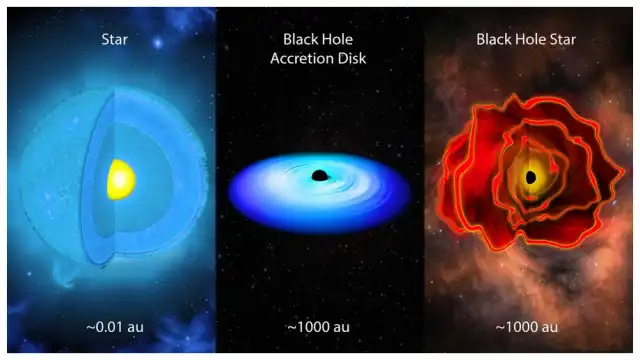
Now, throw that model out the window for the Quasi-Star.
A Black Hole Star is a completely different beast. These monstrous objects are theorized to have formed only in the extremely dense, pure-gas environment of the very early universe, just after the first stars began to ignite. Here’s the mechanism: Instead of a gas cloud collapsing into many small stars, a colossal cloud of pristine hydrogen and helium collapses directly into a single, massive black hole seed, skipping the standard stellar lifecycle entirely.
However, the collapse is so massive that a huge envelope of gas surrounds the newly formed black hole. This black hole immediately begins to feed on the inner layers of this envelope. This process of “accretion” — gas spiraling into the black hole — is incredibly violent and efficient. It generates an absolutely ridiculous amount of energy, far more than standard fusion. This pure, radiant energy pushes the outer gas layers outward, creating a stable, hyper-luminous “star” powered by the accretion engine at its core, not fusion. It’s a star that lives to feed its own internal void. Is that not terrifyingly beautiful?

JWST’s discovery: Unveiling MoM-BH*-1
The hunt for these elusive objects has been a primary mission goal for the JWST. Its unique ability to see the universe’s first light in infrared is the only reason we found it.
As reported by MIT News on August 12, 2026, astronomers identified a specific candidate, now named MoM-BH-1* (or simply MoM-1). The European Research Council (ERC) later confirmed that this object dates to Cosmic Dawn, a period less than 500 million years after the Big Bang.
What the JWST actually saw: “Little Red Dots”
You might expect a discovery this big to look like a massive, swirling anomaly. In reality, the evidence is much more subtle. For the last year, astronomers have been puzzled by a brand-new class of objects found in JWST’s deep-field images. They are affectionately known as “little red dots.”
These dots are incredibly faint, appearing as tiny, distinct crimson specks. Why red? Because they are so unbelievably distant that the universe’s expansion has stretched their light from visible or ultraviolet (where they are blindingly bright) all the way into the infrared spectrum, which JWST can detect. For a long time, we didn’t know if they were extremely distant, dust-obscured galaxies or the seeds of the first quasars.
The groundbreaking MoM-BH-1 Nature study* used JWST’s Near-Infrared Spectrograph (NIRSpec) to perform detailed spectral analysis on one such dot. The spectrum revealed unique signatures: it was far too small to be a galaxy, yet its immense brightness in a specific pattern matched only the theoretical models of a central accretion disk surrounded by a massive, cool hydrogen envelope. The “little red dot” was the signature of a Black Hole Star.

How this rewrites early universe physics
This is not just another exotic star discovery. It is a fundamental shift. Finding MoM-BH*-1 at Cosmic Dawn completely explodes our previous models of cosmic origins.
The Problem: Early supermassive black holes
For decades, astronomers have faced a perplexing mystery. We know that supermassive black holes (SMBHs), with millions or billions of times the Sun’s mass, live in the center of almost all large galaxies today. We have also seen very mature quasars — the blindingly bright accretion disks of SMBHs — operating as early as 500 million years after the Big Bang.
Here was the puzzle: How did they get so big, so fast?
Standard theories were too slow. If you start with a normal “stellar-mass” black hole (created when a standard 100 M☉ first-generation star explodes as a supernova), and have it merge with others or grow at the maximum theoretical rate, it still takes billions of years to reach billions of solar masses. There simply wasn’t enough time in the young universe to make these behemoths. We were missing a critical step.
The Solution: Black hole stars as the missing seed
The discovery of MoM-BH*-1, as highlighted in the MIT story on direct collapse, provides the exact missing link we needed.
Black Hole Stars validate the “direct collapse” model. Instead of starting with small, stellar seeds, the universe could, under unique, dense conditions, jumpstart black hole formation by skipping the star phase. When a 5,000 M☉ cloud collapses directly into a Black Hole Star, it instantly creates a 1,000 M☉ “heavy seed.” This seed then powers the quasi-star and can merge with others. It provides a massive 1,000-year head start on growth, allowing the first supermassive black holes to exist right when we observe them.

This discovery moves the origin story of our cosmic heavyweights from hypothetical math to observed reality.
Rewriting cosmic dawn
This validation forces a complete review of our cosmological timeline. We must now model the very first “stellar” generation (Population III stars) as including these direct-collapse giants. This changes the timing of first light, the process of reionization (when the universe’s gas became energized and transparent), and the fundamental understanding of how initial galaxy seeds formed. We are not just adding a new chapter to the cosmic history book; we are rewriting the entire first chapter.
The Future of Quasi-star research
The confirmation of MoM-BH*-1 is just the beginning. The floodgates are now open. We expect JWST to identify many more “little red dots” that are actually Black Hole Stars. Follow-up observations will aim to map the distribution of these objects across the early sky, helping us understand the initial gas density that allowed them to form.
Future surveys will use this data to refine models of reionization, pushing our observational knowledge of the universe closer and closer to the Big Bang.
The discovery of MoM-BH*-1, the first observed Black Hole Star, is one of the most significant astronomical achievements of the 21st century. James Webb has once again delivered on its promise, providing the critical piece of evidence that resolves the “early supermassive black hole” puzzle. It is a profound, beautiful, and slightly terrifying reminder of our cosmic origins. We now know that before galaxies like our Milky Way emerged, the first light of our universe was dominated not by gentle stars, but by monstrous, self-devouring engines that paved the way for all that came after.

