

10 Biggest Unsolved Mysteries of the Universe (Scientists Still Can’t Explain)
Space is bizarre. You look up at the night sky and see total, peaceful serenity. Yet, behind that calm cosmic curtain, absolute chaos reigns. Astronomers possess brilliant minds and massive, billion dollar telescopes. Still, the cosmos refuses to give up its deepest secrets easily.
Have you ever wondered what actually keeps astrophysicists awake at night? We confidently map our solar system and send rovers to Mars, but when it comes to the grand scale of reality, we are essentially clueless. From invisible forces ripping galaxies apart to eerie radio signals flashing from the dark, our universe is packed with mind bending space anomalies.
Key Takeaways
- The Expansion Crisis: The universe is visibly expanding at two entirely different speeds, and nobody knows why.
- Shifting Dark Energy: Brand new data suggests dark energy isn’t a constant force, totally flipping modern physics on its head.
- The Great Cosmic Pull: Something incredibly massive is dragging our entire Milky Way galaxy through space at 600 kilometers per second.
- Bizarre Signals: Astronomers are catching insanely bright, ultra fast radio flashes from dead galaxies where they mathematically shouldn’t exist.
1. The Invisible Scaffolding: What is Dark Matter?
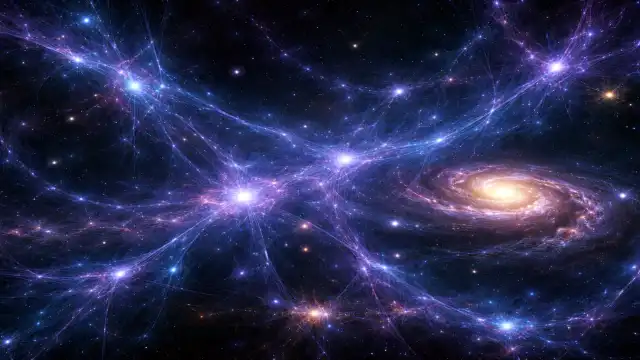
Here is a very humbling fact. Everything you can clearly see stars, planets, black holes, and humans makes up barely 5% of the entire universe. So, what is the rest made of?
Roughly 27% of reality consists of something called dark matter. It completely ignores light. We cannot see it, touch it, or directly detect it with any current technology. However, we absolutely know it is there. Because galaxies spin incredibly fast, their visible gravity isn’t nearly strong enough to keep them together. Without a massive, invisible web of dark matter holding everything tightly in place, galaxies would literally fling themselves apart.
Scientists desperately built massive underground detectors, hoping to catch a single stray dark matter particle. Unfortunately, the traps remain completely empty today. Is it made of undiscovered particles called WIMPs or Axions? Or do we fundamentally misunderstand how gravity works on a massive scale? The hunt tirelessly continues.
2. The Dark Energy Crisis: Is It Evolving?
If dark matter pulls the universe together, dark energy actively pushes it apart. This mysterious anti gravity force makes up the remaining 68% of the cosmos. For decades, scientists confidently believed dark energy was a cosmological constant. Essentially, they thought its strength never, ever changed.
Recently, that comforting assumption completely shattered.
In late 2024 and early 2025, the Dark Energy Spectroscopic Instrument (DESI) dropped a massive scientific bombshell. By creating the largest 3D map of 15 million galaxies, researchers tracked how the universe expanded over the last 11 billion years. Shockingly, the DESI dark energy evolving data suggests this mysterious force might actually be weakening over time.
If this mind blowing data holds up, the standard model of cosmology needs a total rewrite. Consequently, our universe might not end in a permanent, freezing expansion. Instead, the ultimate fate of the cosmos is entirely up for debate again.

3. The Hubble Tension (The Physics Crisis)
How fast is the universe expanding? Honestly, that depends entirely on how you measure it. This glaring contradiction is formally known as the Hubble tension, and it is a massive headache for modern physics.
If you look at the cosmic microwave background (the ancient, fading afterglow of the Big Bang), space seems to expand at about 67.4 kilometers per second per megaparsec. Meanwhile, if you measure the distance to nearby exploding stars, the universe is expanding much faster around 73 km/s/Mpc.
For years, scientists secretly hoped this was just a simple telescope error. Enter the James Webb Space Telescope (JWST). Astronomers expected JWST’s ultra sharp lenses to finally correct the older Hubble telescope data. Surprisingly, JWST explicitly confirmed the original Hubble measurements in 2024 and 2025. Therefore, the measurement error excuse is officially dead. The Hubble tension JWST updates prove the universe genuinely operates on two conflicting sets of rules.
4. The Fast Radio Burst (FRB) Enigma
Imagine a random radio flash that completely outshines an entire galaxy, yet only lasts a fraction of a millisecond. Welcome to the perplexing world of Fast Radio Bursts (FRBs).
Who, or what, is broadcasting these insane energy spikes? Astronomers initially blamed magnetars, which are hyper magnetic, spinning dead stars. However, recent discoveries threw a massive wrench into that theory. In 2025, scientists detected the brightest FRB ever recorded, cleverly nicknamed RBFLOAT (Radio Brightest Flash Of All Time). It flashed from a galaxy 130 million light years away.
Even weirder, another recent burst (FRB 20240209A) was traced perfectly to an ancient, dead elliptical galaxy. Because magnetars only form in young, active star forming regions, finding one inside a dead galaxy completely breaks the current astrophysical rules. Therefore, astronomers are back to scratching their heads over these fast radio bursts 2025 anomalies.
5. The Great Attractor (And The Great Repeller)
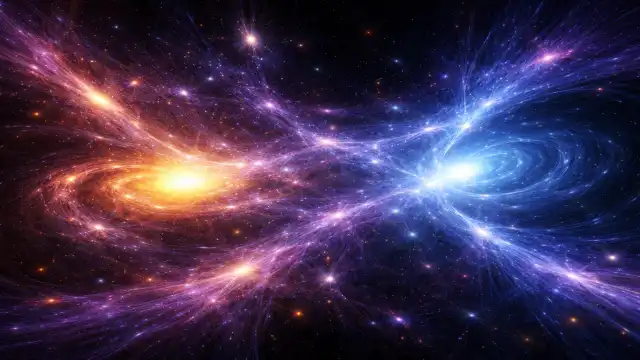
Grab onto your seat. Right now, our Milky Way galaxy is hurtling through the universe at a terrifying speed of 600 kilometers per second. Something incredibly heavy is actively reeling us in.
Scientists dubbed this unseen gravity well The Great Attractor. For decades, we couldn’t see what was pulling us because the Milky Way’s own thick band of stars blocked our view. Fortunately, modern radio telescopes recently peered straight through the dust, discovering hundreds of hidden galaxies hiding behind our own.
Yet, even this massive new cluster isn’t heavy enough to pull us that intensely. Furthermore, researchers recently analyzed the opposite side of the sky and found something equally terrifying: a massive, empty cosmic void dubbed The Great Repeller. Apparently, we aren’t just being pulled; we are actively being violently pushed away by nothingness.

6. The Matter-Antimatter Asymmetry
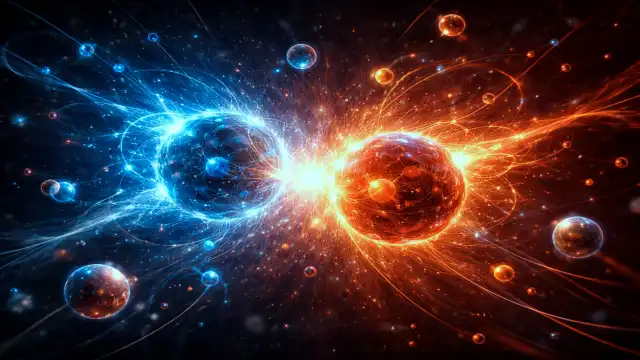
Let us take a trip back to the very beginning. When the Big Bang instantly kicked off reality, it mathematically should have created perfectly equal amounts of matter and antimatter.
Here is the underlying problem. Whenever matter and antimatter violently touch, they instantly annihilate each other, leaving nothing behind but pure energy. Logically, the early universe should have destroyed itself immediately. The cosmos should be a boring, completely empty void filled only with radiation.
Miraculously, it isn’t. Roughly one extra matter particle survived for every billion antimatter particles. Thanks entirely to that tiny, unexplained mathematical imbalance, every star, planet, and human exists today. Why did matter ultimately win the greatest cosmic war? Frankly, nobody has a clue.
7. The Fermi Paradox (The Great Silence)

There are hundreds of billions of stars in our galaxy alone. Many of them host rocky, Earth like planets sitting directly in the habitable zone. Statistically speaking, intelligent alien civilizations should be absolutely everywhere.
Yet, we haven’t heard a single cosmic peep. They are completely ghosting us.
This eerie, unsettling silence is called the Fermi Paradox. Are we simply the incredibly early first borns of the universe? Alternatively, is there a terrifying Great Filter ahead of us? A Great Filter is a theoretical evolutionary hurdle that easily wipes out advanced civilizations before they can colonize the stars. Honestly, both potential answers are incredibly terrifying to ponder.
8. The Black Hole Information Paradox
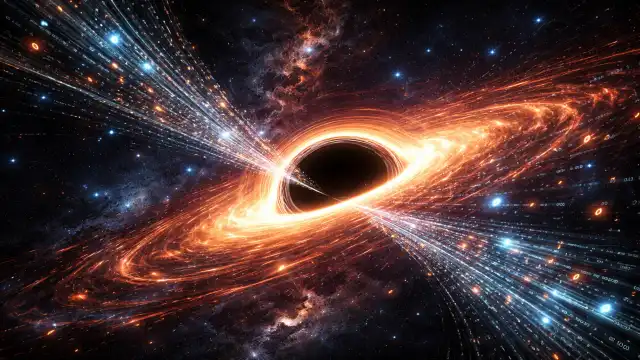
Black holes are the ultimate cosmic trash cans. Their gravity is so intense that not even light can escape. For a long time, physicists assumed whatever fell inside was simply trapped forever.
Then, brilliant physicist Stephen Hawking proved that black holes actually leak radiation (Hawking Radiation) and eventually evaporate completely. This brilliant discovery accidentally birthed a massive physics nightmare.
Quantum mechanics strictly dictates that information cannot be permanently destroyed. However, if a book falls into a black hole, and the black hole eventually completely evaporates into random, chaotic radiation, where did the specific information inside that book go? Did the universe just illegally delete data? Currently, scientists are fiercely debating whether the information escapes through the radiation, or if we fundamentally misunderstand gravity itself.
9. The Cosmic Axis of Evil
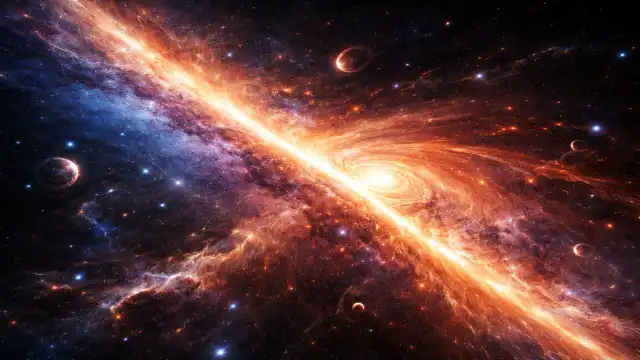
According to the golden rules of cosmology, the universe should look exactly the same in absolutely every direction. It shouldn’t have a distinct top, bottom, left, or right.

However, the cosmic microwave background (CMB) holds a very dark, confusing secret. When scientists mapped this ancient radiation, they found a strange, unexplained temperature alignment stretching massively across the entire cosmos. Astrophysicists jokingly dubbed it the Axis of Evil.
Does this strange alignment mean our universe actually has a distinct structural axis? If so, it directly violates the foundational, core laws of modern cosmology. Some researchers blame the anomaly on simple statistical flukes. Others believe it heavily hints at an incredibly complex, undiscovered physical law guiding the cosmos.
10. What Happened Before the Big Bang?
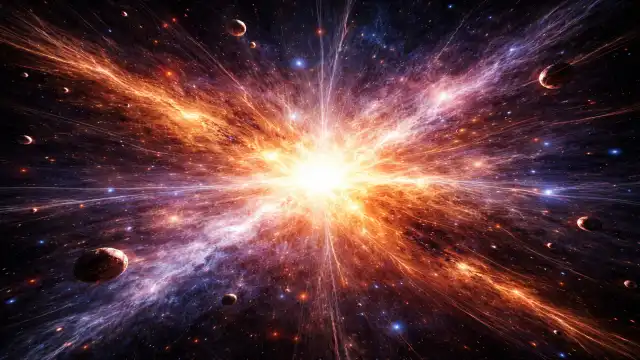
Time itself supposedly started precisely with the Big Bang. Thus, asking what happened before it is basically like asking what lies physically north of the North Pole. It is geographically impossible.
Still, raw human curiosity inherently demands a better answer. Did our specific universe spontaneously bubble up from a vast, infinite multiverse of other realities? Or perhaps an older, dying universe collapsed endlessly in on itself, creating a violent Big Bounce that birthed ours?
Since we cannot physically see past the cosmic wall of the Big Bang, this remains the ultimate, untestable philosophical mystery. It represents the absolute edge of human knowledge.
Takeaway
We humans genuinely love to pretend we have everything neatly figured out. We carry supercomputers in our pockets and casually launch rockets that land themselves backward. Yet, the universe continuously humbles us.
Whether it is the evolving nature of dark energy, the terrifying speed of the Great Attractor, or the bizarre radio flashes from dead galaxies, space remains wildly unpredictable. Every single time we build a bigger telescope, we don’t just find new answers. Consequently, we usually just uncover infinitely more complicated questions.
What do you personally think is the most terrifying mystery on this list? Are we completely alone in the universe, or is dark energy actually preparing to rip reality apart? Drop a comment below, share this article with your favorite space enthusiast, and let’s keep looking up!
Sources help:
- lbl.gov
- https://www.ukri.org/news/desi-results-suggest-dark-energy-may-evolve-over-time/
- https://news.fnal.gov/2025/03/new-desi-results-strengthen-hints-that-dark-energy-may-evolve/
- https://cerncourier.com/desi-hints-at-evolving-dark-energy/
- https://physicsworld.com/a/cosmic-conflict-continues-new-data-fuel-the-hubble-tension-debate/
- https://science.nasa.gov/missions/hubble/nasas-webb-hubble-telescopes-affirm-universes-expansion-rate-puzzle-persists/
- https://news.mit.edu/2025/astronomers-detect-all-time-brightest-fast-radio-burst-0821

