

Before the Chip: The Ancient “Computers” That Built Our World
Look at the supercomputer in your pocket. Yeah, your smartphone. It’s a sleek slab of glass and metal that connects you to the whole of human knowledge. Now, picture a wooden frame with beads strung on wires. Could these two objects possibly be related?
You bet they are.
Before we had electricity, silicon, or even the number zero in many parts of the world, humans were building sophisticated devices to calculate, predict, and process information. These weren’t “computers” in the electronic sense, but they were the original hardware. They are the forgotten ancestors of every device you use today.
So, let’s blow the dust off some ancient history and explore the ingenious tech that laid the foundation for modern computing.
First Off, What Is a Computer, Really?
Let’s get real. When we say “computer,” we think of circuits and code. But at its core, a computer is simply a device that does three things:
- Takes an input (you type a number).
- Processes that information based on a set of rules (you hit the ‘+’ key).
- Delivers an output (it shows you the answer).
By that definition, the abacus isn’t just a toy. It was one of the first, most successful, and longest-lasting computers in human history.
The Abacus: The OG Data Processor
The abacus is so ancient, we don’t even know for sure who invented it. Its name comes from the Greek word abax, meaning “slab” or “tablet.” Early versions were literally just trays of sand where people drew symbols or placed pebbles (calculi in Latin—sound familiar?) in grooves to count. It was a game-changer.

Ever tried multiplying Roman numerals? Go ahead, try multiplying CLXVI by DCI. It’s a nightmare. The abacus made complex math intuitive and visual.
Over millennia, this simple idea was refined and perfected across different cultures, leading to a few distinct and brilliant designs.
The Chinese Suanpan (The Power User’s Abacus)
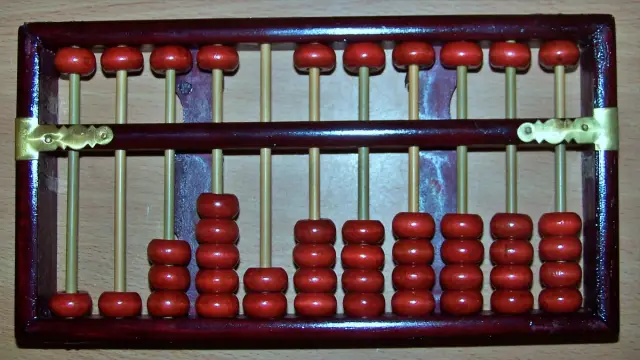
Many historians believe the Chinese developed their abacus, the suanpan, independently. This thing was a beast. With two beads on the top deck and five on the bottom of each rod, it wasn’t just a simple counter.
Here’s the kicker: The suanpan was designed for both decimal (base-10) and hexadecimal (base-16) calculations.
Why does that matter? In ancient China, many measurements were in base-16. For example, 16 liang made one jin—a unit of weight, much like 16 ounces make a pound today. The suanpan could handle these calculations effortlessly. An experienced user could perform addition, subtraction, multiplication, division, and even find square and cube roots faster than a person with a modern electronic calculator.
It wasn’t just a tool; it was an extension of the mind.
The Japanese Soroban (The Optimized Model)
The Japanese took the suanpan and asked, “How can we make this faster and more efficient?” They streamlined it into the soroban, which has just one bead on top and four on the bottom.

By removing the “extra” beads, they optimized it purely for base-10 calculations. This simplification made it less cluttered and even quicker for everyday math. The soroban is a perfect example of minimalist design improving performance—a principle that drives tech innovation to this day. It is still taught in Japanese schools as a way to improve mental math skills.
The Russian Schoty (The Merchant’s Friend)
The Russian schoty took a different approach. It features a single frame with ten beads on each wire (except for one wire with four beads for calculating quarter-rubles). There’s no central bar. You just slide the beads from right to left.
Its design was incredibly simple and visual, making it the perfect tool for merchants and traders adding up sums in a bustling market. It was less about complex math and more about fast, reliable, real-world accounting.
Napier’s Bones: The 17th-Century Multiplication Machine
While the abacus was a global phenomenon, a Scottish mathematician named John Napier was cooking up something different in 1617. Enter Napier’s Bones.
This wasn’t one device but a set of rods (often made from bone or ivory, hence the name) inscribed with multiplication tables. To multiply large numbers, you’d select the rods corresponding to the digits, lay them side-by-side, and read the answer off the diagonal entries. It was essentially a clever, physical multiplication algorithm.
Napier himself was a fascinating character. A true polymath, he dabbled in astronomy and physics and was so brilliant that some of his neighbors suspected him of being a sorcerer. One famous story alleges he used a black cockerel to identify a thief among his servants. He coated the bird in soot and told the servants to pet it in the dark, claiming the magical bird would crow when the thief touched it. The real thief, afraid of being exposed by magic, was the only one who didn’t touch the bird—and came out with clean hands.
Psychological trickery from a mathematical genius. You gotta love it.

The Antikythera Mechanism: The Device That Shouldn’t Exist
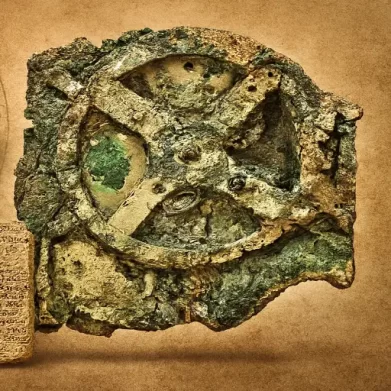
Now for the showstopper. If the abacus is the ancestor of the calculator, the Antikythera Mechanism is the ancestor of the analog computer. It is, without a doubt, the most technologically sophisticated artifact we have from the ancient world.
Discovered in a Roman-era shipwreck in 1901, this shoebox-sized device of interlocking bronze gears was a mystery for decades. After extensive analysis, including X-ray tomography, researchers figured out what it was: an astonishingly complex astronomical calculator.
Dating back to around 100 B.C.E., this Greek machine could:
- Predict the positions of the sun, moon, and visible planets.
- Track the phases of the moon.
- Forecast lunar and solar eclipses.
- Indicate the year of the next Olympic Games.
The complexity of its gear trains was unparalleled and would not be seen again in human technology for over a thousand years, until the astronomical clocks of medieval Europe. As the National Archaeological Museum in Athens notes, it demonstrates a level of mechanical engineering that completely rewrites our understanding of ancient Greek capabilities. It is, quite literally, a 2,000-year-old computer.
The Bridge to Modern Computing
These ancient devices weren’t just historical curiosities. They established the fundamental principles that every modern computer is built on.
- The abacus introduced the concept of representing numbers by position, a core idea behind our digital systems. A bead is either up or down—a binary state, like a 1 or a 0.
- Napier’s Bones and his subsequent invention of logarithms led directly to the slide rule, the essential tool for scientists and engineers for over 300 years, right up until the electronic calculator took over.
- The Antikythera Mechanism proved that complex, gear-based computation was possible. Its intricate design is a direct mechanical ancestor of the calculating machines built by Pascal and Leibniz, and later, the analytical engines designed by Charles Babbage—the “father of the computer.”
These inventors and their tools prove that the desire to calculate, predict, and understand our universe is a fundamental human drive. We’ve been building computers for millennia; we just got better at making them smaller and faster. The logic running on your laptop has roots in pebbles lying in the sand.
What piece of today’s cutting-edge tech do you think will look like a simple abacus to people 2,000 years from now? Drop your thoughts in the comments below!

