
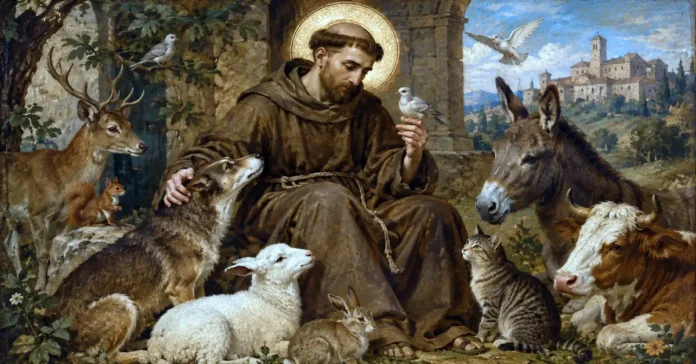
Before he became a haloed icon, Francis was an ordinary, hard-partying kid named Giovanni di Pietro di Bernardone. Born around 1181 in the central Italian town of Assisi, he grew up swimming in privilege. His father was a wealthy silk merchant who dressed him in French finery and bankrolled his nights on the town. Francis dreamed of knighthood, glory, and polished armor.
War ruined those daydreams fast.
During a bloody clash between Assisi and the neighboring city of Perugia, Francis was captured and thrown into a damp, freezing dungeon for nearly a year. He returned home broken, sick, and deeply shaken by human brutality.
When he finally recovered, his values took a sharp turn. He walked away from his family fortune, stripped naked in the public square to return his father’s clothes, and swore an oath of total poverty.
He didn’t retreat into a secluded, quiet monastery to read parchment in silence. Instead, he lived out on dusty country roads, begging for scraps and tending to people with leprosy.
That gritty, barefoot lifestyle changed how he viewed the natural environment. While the medieval aristocracy saw land and livestock as assets to exploit, Francis saw birds, foxes, and wild plants as companions sharing the struggle for survival. He treated the open landscape not as a property map, but as a living household.
Miracle or Moral protest?
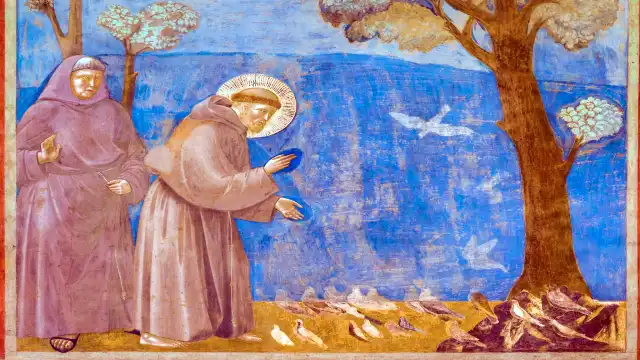
If you search for art of Saint Francis, you will almost certainly find him talking to a flock of feathered listeners. The story comes straight from his first official biography, written around 1228 by a friar named Thomas of Celano.
According to the tale, Francis was walking near the town of Bevagna when he spotted a massive congregation of doves, crows, and sparrows gathered on the grass. Instead of walking past, he jogged over, greeted them warmly, and gave them a full sermon. He told the birds they owed endless thanks to their Maker for giving them feathers to wear, wings to roam the sky, and mountain streams to drink from without ever having to spin cloth or plant crops.
Did a flock of wild birds actually stand at attention and bow their beaks? Skeptics dismiss it as pious fantasy, while believers see it as a divine sign.
Historians, however, point to something much sharper: a public protest.
In the 13th century, wealthy townsfolk and corrupt clergy frequently shut their doors on Francis and his scruffy followers. Preaching to common birds was a stinging critique of human arrogance.
He was essentially telling the local elite that wild sparrows possessed more spiritual gratitude than educated, greedy men sitting in stone palaces. By kneeling in the grass, Francis demonstrated that humility meant putting yourself on the same physical level as the smallest creature in the dirt.
The Wolf of Gubbio

Of all the folk legends surrounding the saint, none packs the dramatic punch of the Wolf of Gubbio.
The story takes place around 1220, recorded in the beloved 14th-century anthology known as the Fioretti (The Little Flowers of Saint Francis).A massive, ferocious wolf began stalking the outskirts of Gubbio, a walled hill town in Umbria. The animal didn’t stop at devouring livestock; it began hunting humans who ventured past the city gates. Panic gripped the population. Citizens refused to leave their fortifications, treating the countryside like an active war zone.
Francis heard the screams and decided to step in.
Against the frantic warnings of the guards, he walked out of the heavy gates without a shield or sword.As he approached the woods, the wolf charged with open jaws. Francis didn’t run. He made the sign of the cross and called out:
“Come here, Brother Wolf. I command you on behalf of Christ not to harm me or anyone else.”

According to the text, the predator stopped in its tracks, lowered its ears, and trotted over like a gentle sheepdog.
Notice the brilliant conflict resolution that followed. Francis didn’t kill the animal, nor did he scold it for being a monster. He recognized the biological motive behind the violence.
“Brother Wolf,” he explained, “you have done great harm out of hunger.”
He brokered an actual peace treaty. If the wolf agreed never to hurt another villager or guard dog, the people of Gubbio would provide daily meals for the creature directly from their kitchens. The wolf placed its right forepaw into the open hand of Francis to seal the pledge.
For the next two years, the beast strolled freely through the cobblestone streets of Gubbio, knocking on doors for bread and scraps without biting a soul until it died of old age.
Was this a literal carnivore or a clever metaphor? Many historians suggest the “wolf” represented a ruthless local bandit or an outlaw militia raiding the town’s trade routes.
Yet an astonishing physical discovery complicates that easy explanation.
In 1872, workers renovating the historic Church of San Francesco della Pace in Gubbio pulled up floorboards near the sanctuary wall. Buried beneath a heavy stone slab lay the complete skeleton of an unusually large wolf.The townsfolk had given an actual predator a reverent Christian burial inside their house of worship. Whether the legend was embellished or not, the community’s memory tied peace directly to an animal’s belly.
The Canticle of the Sun

To understand why Francis mattered so deeply, you have to realize just how strange his theology felt to his contemporaries.
Medieval European Christianity leaned heavily on the writings of Saint Augustine and, later, Thomas Aquinas. The mainstream doctrine viewed animals strictly through a utilitarian lens: they were soulless resources created by God solely for human utility. If an animal couldn’t plow a field, pull a cart, or fill a cooking pot, it held zero intrinsic value. Humans stood at the absolute top of the pyramid, looking down with total dominion.
Francis flipped that pyramid on its head.
In the winter of 1224, near the end of his life, Francis stayed at the convent of San Damiano. He was nearly blind from an eye disease, racked with pain, and sleeping on rough straw mats infested with field mice.
Instead of writing a bitter lament about suffering, he dictated one of the most famous poetic hymns in world literature: the Canticle of the Sun (also known as the Canticle of the Creatures).
He chose not to write in high-brow Latin, the language of court scholars and bishops. He wrote in the Umbrian vernacular, the rough, colorful Italian spoken by everyday peasants.
Listen to the revolutionary vocabulary he chose:
- “Sir Brother Sun, who brings the day and through whom You give light.”
- “Sister Moon and the stars, in heaven You have formed them clear and precious and beautiful.”
- “Brother Wind, and through air and cloudy and serene and every kind of weather, through which You give sustenance to Your creatures.”
- “Sister Water, who is very useful and humble and precious and chaste.”
- “Brother Fire, through whom You light the night, and he is handsome and playful and robust and strong.”
- “Sister Mother Earth, who sustains and governs us, and produces varied fruits with colored flowers and herbs.”
Notice what missing from this poem? Human supremacy.
Francis did not position mankind as master, owner, or king over creation. He painted humanity as just one sibling sitting among an enormous, rowdy cosmic family.
Because God created the rabbit, the cricket, the river, and the farmer from the exact same dust, they shared a genuine biological and spiritual brotherhood. His early followers documented him sweeping earthworms off muddy roads so passing carts wouldn’t crush them, and setting honey out during freezing winter nights to keep bees from starving. This wasn’t shallow sentimentality; it was a radical theological claim that every living thing possessed rights granted directly by its Creator.

Heinrich Zimmermann 1925
Francis died on the evening of October 3, 1226, making October 4 his official feast day on the Catholic liturgical calendar. For centuries, his kinship with wildlife stayed tucked inside devotional art and church murals.
That changed during the chaotic, industrialized roar of 1920s Europe.
Meet Heinrich Zimmermann (1887–1942), an outspoken German writer, editor, and dedicated animal protection campaigner.
Living in Berlin, Zimmermann was sickened by the casual, systematic cruelty inflicted on animals during the early 20th century. Draft horses dropped dead from exhaustion in smoggy streets, stray dogs were beaten without consequence, and factory farms were rapidly turning living beings into mechanical assembly-line commodities.
Zimmermann founded a bi-weekly advocacy magazine titled Mensch und Hund (Man and Dog). He used the publication as a megaphone, arguing that human society was morally bankrupt if it refused to grant basic legal rights and physical safety to non-human lives.
He realized that articles alone wouldn’t shift the cultural needle. He needed a mass public movement — a unifying annual holiday that could rally thousands of citizens together to demand government reform.
Where did he find his anchor? He looked straight back to the 13th-century monk from Assisi. Zimmermann saw Saint Francis not as a stuffy church painting, but as history’s premier philosopher of universal compassion. He decided to launch a global celebration pinned directly to the friar’s feast day.
World Animal Day Origins and the Sportpalast Rally
The World Animal Day origins hit an unexpected logistical roadblock right out of the gate.
Zimmermann targeted October 4, 1925, for the grand launch. The only venue in Berlin big enough to accommodate the massive crowd he envisioned was the legendary Berlin Sportpalast, a cavernous indoor arena normally reserved for professional bicycle races, political rallies, and boxing matches.
When Zimmermann tried to book the hall for October, the managers turned him away: the arena was completely booked.
Unwilling to shelve his campaign for another twelve months, the activist took the first open weekend he could grab.
On March 24, Heinrich Zimmermann 1925 organized the inaugural event, drawing over 5,000 passionate attendees to the Sportpalast. The crowd passed resolutions demanding tougher animal abuse penalties and cheered speeches connecting human decency to the ethical treatment of pets and wildlife.
Even though the event succeeded, the March date bothered Zimmermann. It lacked the historical soul he wanted.
For the next four years, he worked tirelessly across Germany, Switzerland, Austria, and Czechoslovakia to promote the cause.Finally, on October 4, 1929, the celebration landed on its true home: the feast day of Saint Francis.
Zimmermann pushed the initiative onto the international stage in May 1931 during the International Animal Protection Congress in Florence, Italy. Standing just a couple hours’ train ride north of Assisi, he presented his motion to delegates from across the globe.
The assembly voted unanimously.They officially adopted October 4 as an international holiday dedicated to raising the status of animals worldwide.Today, coordinated through animal welfare charities like the Naturewatch Foundation and the official World Animal Day organization, the celebration spans hundreds of events across more than one hundred countries every single year.
Global Decrees and Ecology
For centuries, popular affection drove Francis’s connection to wildlife. Popes and bishops tolerated the stories about sparrows and wolves, but official church pronouncements remained cautious.
That dynamic shifted dramatically in the late 20th century as global environmental crises escalated.

On November 29, 1979, Pope John Paul II issued an official papal bull titled Inter Sanctos.The pontiff formally proclaimed Saint Francis of Assisi the heavenly patron saint of ecologists.John Paul II cited Francis’s unique ability to look at nature without the urge to dominate or despoil it, holding him up as a moral compass for modern scientists and conservationists.
The ripples grew larger in 2013 when Cardinal Jorge Mario Bergoglio was elected pope. For the first time in Catholic Church history, a bishop of Rome chose the papal name Francis.
When Pope Francis published his landmark 2015 environmental encyclical, he titled it Laudato Si’ — the exact opening words of Francis of Assisi’s ancient hymn. The official document drew directly on Franciscan philosophy, arguing that the destruction of wildlife habitats and the neglect of vulnerable human populations stem from the exact same moral failure: treating living creation as disposable trash.
The Blessing of the Animals Ceremony

How does this centuries-old intellectual history manifest in our everyday neighborhoods?
Step onto the grounds of an Episcopal, Lutheran, Methodist, or Catholic parish around the first Sunday in October, and you will witness the Blessing of the Animals ceremony.
It is one of the few days when normal church decorum completely disintegrates into glorious, joyful anarchy.
Dozens of nervous dogs sniff each other while straining on leashes. Cats meow anxiously inside padded carriers. Kids hold out plastic containers holding bearded dragons, goldfish, hamsters, and rescue guinea pigs.
A priest or minister stands wearing an embroidered stole, offering individual prayers over every creature:
“May you be blessed in the name of God, who created you and placed you in our care.”
A brisk flick of the aspergillum sends cold droplets of holy water flying through the air. Dogs shake off the spray, owners laugh, and everyone trades stories about their pets’ quirks.
Why do millions of families participate in this ritual year after year?
It touches something profound. Pet ownership is rarely about cold utility anymore. Companion animals sit with us through grief, alleviate crushing loneliness, and celebrate our small daily victories without demanding a single resume credential.
By bringing a rescue mutt or an aging cat to church steps, owners publicly acknowledge that their animal companions possess spiritual and emotional dignity. The ceremony confirms what pet owners already know in their bones: these bonds are sacred.
The Franciscan Ripple
Looking across eight hundred years of history, Francis stands apart because he refused to compartmentalize compassion.
Many people love their private dogs while ignoring the factory farms down the road. Others champion wild forests while ignoring the impoverished humans picking crops on the edges of town.
Francis saw through those false boundaries. To him, you could not claim to love the Creator while abusing His handiwork.
- Practical Solidarity: He didn’t write policy memos; he touched the sores of lepers and pulled worms from cart ruts.
- Structural Humility: He abandoned corporate wealth to prove that human greatness is measured by service, not accumulation.
- Shared Vulnerability: He saw that both humans and animals share the same basic needs: shelter, food, safety, and kindness.
Heinrich Zimmermann recognized that brilliance in 1925. By hitching the modern animal protection movement to an Italian mystic who died in the dirt in 1226, he ensured that animal rights would never be dismissed as a fleeting lifestyle fad.
Whether you are an atheist volunteering at a local dog shelter, an ecologist fighting to preserve wetland biodiversity, or a family cheering as holy water hits your beagle’s nose, you are walking in Francis’s footsteps. The gentle statue in the garden turns out to be the quietest mask of a fierce historical firebrand. He challenged our greed, invited a terrifying wolf to breakfast, and reminded us that the earth is not our kingdom—it is our shared family home.

