
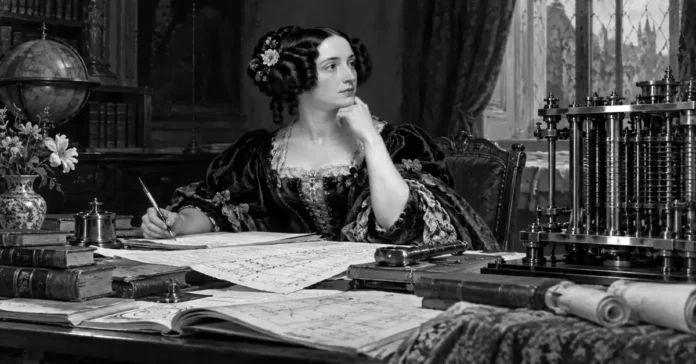
To understand how Ada Lovelace became the ada lovelace first computer programmer, you have to look at the tug-of-war that shaped her childhood. Born Augusta Ada Byron in December 1815, she was the only legitimate child of the famous Romantic poet Lord Byron and his reform-minded wife, Lady Anne Isabella Milbanke. Her father was flamboyant, emotionally turbulent, and notorious across Europe. Her mother, by contrast, was cool, disciplined, and utterly fascinated by geometry — so much so that Lord Byron sarcastically dubbed her his “Princess of Parallelograms.”
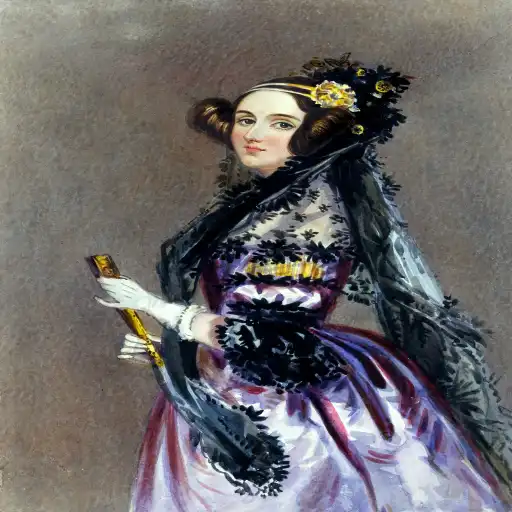
The marriage imploded just weeks after Ada was born. Lord Byron fled England, never to see his infant daughter again. Lady Byron spent the next two decades terrified that Ada might inherit her father’s wild, moody temperament. Her solution? A hyper-strict education heavy on geometry, algebra, astronomy, and classical logic. Victorian aristocratic girls were usually taught embroidery, singing, and French. Ada spent her days mastering differential calculus and dissecting mechanical drawings.
Something unexpected happened along the way. Instead of choosing between cold logic and wild imagination, Ada fused them into a single philosophy she called “poetical science.”
Why did this matter so much? Most mathematicians of her era treated numbers as rigid accounting tools. Ada saw mathematics as poetry written in symbols. She believed that looking closely at mathematical patterns revealed the underlying machinery of the physical universe. When she finally met a machine capable of physicalizing those symbols, her imagination caught fire.
Meeting Charles Babbage
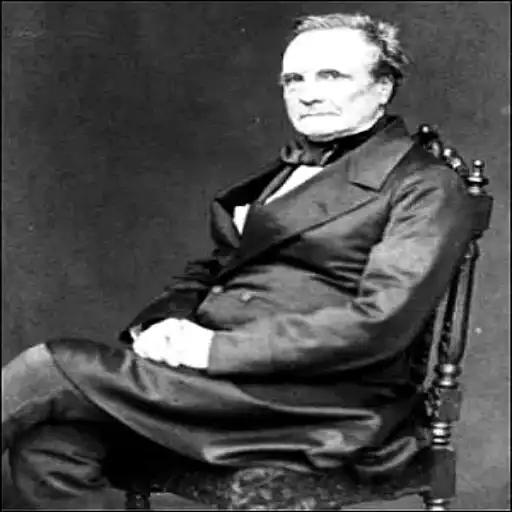
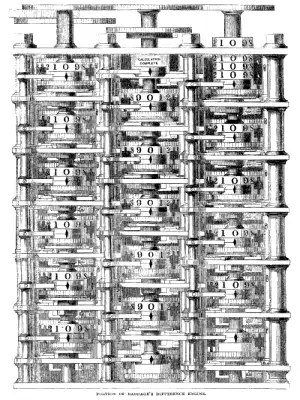
In June 1833, seventeen-year-old Ada attended a bustling London salon hosted by Charles Babbage, the Lucasian Professor of Mathematics at Cambridge. Babbage was displaying a brass contraption known as the Difference Engine.
Have you ever wondered what early computers actually looked like? The Difference Engine was essentially a massive hand-cranked calculator, packed with interlocking toothed cogs and stepped drums. Its sole purpose was calculating polynomial functions using finite differences. Babbage built it because human clerks — literally called “computers” back then — made frequent errors when hand-calculating astronomical tables for sea voyages. One stray decimal could send a royal navy vessel crashing into a reef.
While other guests stared at the machine like it was a carnival trick, Ada stepped forward. She grasped its mechanical logic instantly. Sophia De Morgan, a close family friend who attended the party, recalled that Ada seemed to be the only person present who understood the machine’s true workings and perceived its beauty.
Babbage was charmed by her brilliance and began mentoring her. Soon, however, Babbage realized his Difference Engine had a fatal limitation: it was single-purpose hardware. It could crunch finite differences, but it could never pivot to solve a different kind of mathematical problem.
That realization pushed Babbage toward an infinitely more daring ambition: the Charles Babbage Analytical Engine.
The Machine That Anticipated Modern Hardware
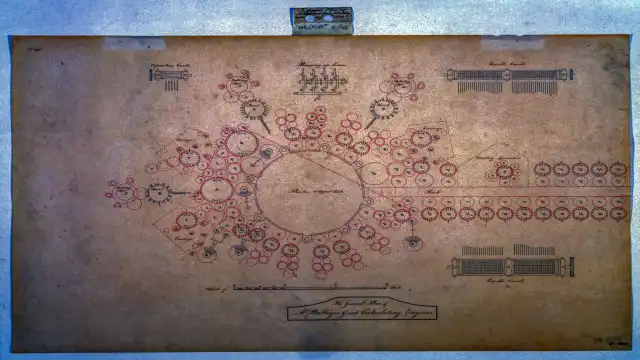
The Analytical Engine was not just a bigger calculator; it was the blueprint for the modern computer. Powered by steam and built from iron and brass, it separated processing from storage for the first time in history:
- The Store: The equivalent of modern RAM or register memory. It was designed to hold up to 1,000 numbers, each up to 50 decimal digits long, stored as positions on columns of geared brass wheels.
- The Mill: The heart of the machine, acting as a modern CPU or Arithmetic Logic Unit (ALU). It pulled numbers from the Store, executed additions, subtractions, multiplications, or divisions, and shuttled the new results back into the Store.
- Punched Card Readers: Borrowed directly from the Jacquard loom, an automated textile machine invented in France in 1804. The Jacquard loom used stiff paper cards with punched holes to guide needles and weave complex tapestries automatically. Babbage adopted this exact mechanism to feed instructions into the Mill.
The machine had the hardware architecture figured out on paper. But hardware without software is just an expensive pile of metal. Someone needed to explain how humans could systematically program this beast to solve non-trivial mathematical problems.
That person was not Charles Babbage. It was Ada Lovelace.
The Turin Seminar and the Luigi Menabrea Connection
By 1840, the British government had run out of patience with Babbage. He had burned through thousands of pounds of public funding on the unfinished Difference Engine, and politicians refused to fund the Analytical Engine.

Desperate for academic validation, Babbage traveled to Turin, Italy, to present his new machine to an international gathering of scientists. Among the attendees was a gifted young Italian military engineer and mathematician named Luigi Menabrea. Menabrea took meticulous notes during Babbage’s lectures and published an overview in a French journal in Geneva in October 1842 under the title “Notions sur la machine analytique de M. Charles Babbage”.
When the paper reached London, Charles Wheatstone — a pioneer of the electric telegraph and a friend of the Lovelace family — suggested that Ada translate it into English for publication in Richard Taylor’s prestigious journal, Scientific Memoirs.
Ada accepted the challenge. When Babbage learned of her project, he asked an obvious question: Why not add some of your own explanatory notes to the translation?
Ada threw herself into the task with volcanic energy. Between the autumn of 1842 and the summer of 1843, she translated Menabrea’s text and penned seven extensive essays, labeling them Note A through Note G. Her completed Note G translation and accompanying commentary ended up being three times longer than Menabrea’s original essay. She published the work in August 1843, signing modestly with her initials, “A.A.L.” (Augusta Ada Lovelace), because aristocratic women of her era rarely attached their family names to scientific publications.
Those seven notes represent the birth certificate of computer science.
Numbers vs Symbols
Why do historians celebrate Ada Lovelace instead of treating her as a footnote to Babbage? The answer lies in the fundamental difference between how Babbage and Lovelace viewed the machine.
Babbage was a mechanical engineer and an applied mathematician. He designed the Analytical Engine to crunch raw numbers faster, more reliably, and on a grander scale than human mathematicians ever could. To Babbage, the machine was an ultimate number mill.
Ada saw something far deeper. In Note A, she made an intellectual leap that would take the rest of humanity another century to replicate:
“The Analytical Engine weaves algebraical patterns just as the Jacquard-loom weaves flowers and leaves.”
Ponder that sentence for a moment. Ada realized that the operational cards didn’t care whether the numbers on those brass wheels represented quantities, temperatures, or stellar distances. Numbers could stand for abstract symbols.
She wrote that if the fundamental relations of pitched sounds in musical science could be expressed mathematically, the machine could manipulate those rules to “compose elaborate and scientific pieces of music of any degree of complexity.”
Think about what that implies. In 1843, while Queen Victoria sat on the British throne and horse-drawn carriages rattled through London, Ada Lovelace conceived of digital media. She understood that any machine capable of manipulating symbols according to rules is not just a calculator; it is a general-purpose processor of information. Babbage built the engine for math; Ada saw the software universe.
Note G: The Bernoulli Numbers Algorithm
Now we come to the centerpiece of her historic achievement: Note G.

Ada did not want to end her commentary with airy philosophical claims. She wanted to prove the engine’s power with a practical, hard-hitting mathematical demonstration. She deliberately bypassed simple arithmetic tricks like calculating factorials or summing integers. Instead, she chose to construct an algorithm that calculates the Bernoulli numbers algorithm.
What on earth are Bernoulli numbers?
Discovered by the Swiss mathematician Jakob Bernoulli in the late seventeenth century, Bernoulli numbers are a sequence of rational numbers (fractions) that pop up all over advanced mathematics, including trigonometry, calculus, and number theory. They are notoriously annoying to calculate by hand because they are defined recursively.
What does “recursive” mean in plain English? Think of building a stone staircase. To lay step four, you have to build step three first. To lay step three, you must know the exact dimensions of step two and step one. Every single Bernoulli number depends on the mathematical values of all the Bernoulli numbers that came before it.
Ada wanted to calculate what she designated as (which corresponds to in modern textbook notation, yielding the value ).
To pull this off on an unbuilt mechanical computer, she had to invent the foundational concepts of software engineering from scratch.
How Note G Works
In Note G, Ada published an enormous, fold-out diagram titled “Diagram for the computation by the Engine of the Numbers of Bernoulli”. Programmers today call this a trace table or an execution trace. It breaks the calculation down into 25 discrete mathematical operations.
She organized the process into three functional types of punched cards:
- Operation Cards: These instructed the Mill which arithmetic operation to perform ().
- Variable Cards: These functioned like memory addresses, telling the machine which registers in the Store should supply the input numbers, and which specific register should catch and store the output.
- Number Cards: These provided static constants directly to the machine, such as the initial integers 1 and 2.
Look closely at how she managed system state. In her execution table, she used variable designations like . Whenever an operation changed the value inside a memory register, she tracked it using an upper index (superscript notation). For instance, became after receiving a new value.
Does that look familiar to anyone who writes code? It is the exact equivalent of variable reassignment:
V4 = V4 - V1
She didn’t stop at linear steps. A straight list of 25 calculations is impressive, but real software requires control flow. Ada introduced two game-changing mechanisms into Note G:
- Loops (or “Cycles”): The algorithm contains an inner loop spanning operations 13 through 23. Rather than punching dozens of identical cards to calculate successive terms, she designed the card reader to physically advance a set of cards, execute the sequence, back up the cards, and repeat the cycle with updated parameters.
- Conditional Branching: The machine had to know when to stop looping. Ada specified that after each pass through the cycle, an internal counter variable decreased by one. When that counter reached zero, a mechanical trigger altered the path of the card reader, breaking out of the loop and advancing to the final calculation.
She also demonstrated a software engineer’s most relatable skill: debugging. Babbage had drafted a set of preliminary algebraic calculations to help her with the initial equations. While working through the step-by-step logic, Ada spotted a glaring algebraic error in Babbage’s notes and corrected it herself before publication.

Why Ada Lovelace, and Not Charles Babbage?
A debate sometimes flares up among modern critics: Did Ada Lovelace really invent programming, or was she just Babbage’s publicist?
Some skeptics point out that Babbage had scribbled simple operational sequences in his private notebooks years before 1843. That is true. Babbage created short operational sequences to verify that specific gear trains would turn without jamming.
Those private scribbles were hardware diagnostics, not general software. Comparing Babbage’s test sequences to Note G is like comparing an electrician checking a circuit with a voltmeter to a software architect writing an entire operating system routine.
Consider the distinct boundaries between their roles:
- Hardware vs Software Separation: Babbage focused on physical kinematics — cams, levers, ratchets, and steam power. Lovelace focused on algorithmic abstraction — the flow of data, memory management, and procedural logic.
- Publication and Rigor: Ada published the very first complete, end-to-end algorithm designed for a general-purpose programmable computer, fully documented with inputs, working variables, loops, and outputs.
- The Philosophical Vision: Babbage saw his engine as a super-calculator. Ada was the sole individual who recognized that the engine had stepped beyond pure mathematics into the realm of general information processing.
Babbage himself openly acknowledged her unique mastery. In his autobiography, Passages from the Life of a Philosopher, he wrote that Ada had completely mastered the engine’s conceptual potential, calling her the “Enchantress of Numbers.”
Her Place in the History of Women in STEM
Ada Lovelace’s life was tragically brief. She battled chronic illnesses for years and died of uterine cancer in November 1852 at just thirty-six years old — the exact same age at which her father, Lord Byron, had died. At her request, she was buried beside him in the Byron family vault in Nottinghamshire.
For nearly a century, her work slipped into relative obscurity. The Analytical Engine was never fully constructed during Babbage’s lifetime due to machining limitations, financial disputes, and political indifference. Her notes were filed away in university libraries, gathering dust.
Then came World War II and the dawn of modern electronic computing.
Alan Turing, the father of modern theoretical computer science, discovered Ada’s notes while working on early machines like the Manchester Mark 1. In his landmark 1950 paper, Computing Machinery and Intelligence — the paper that introduced the famous Turing Test — Turing dedicated an entire section to what he named “Lady Lovelace’s Objection.” Ada had written that the Analytical Engine had no pretensions to originate anything, meaning it could only do whatever humans knew how to order it to perform. Turing spent pages engaging with her century-old philosophical question, validating her status as a foundational thinker in computation.
Her recognition exploded in the late twentieth century. In 1980, the United States Department of Defense named its newly standardized, high-integrity programming language Ada in her honor. Today, people around the globe celebrate Ada Lovelace Day every October, honoring her legacy and highlighting the achievements of women in STEM history.
Lesson of Note G
Why does Ada Lovelace’s story still resonate so powerfully with modern programmers and tech innovators?
She proved that the real power of computing does not originate in silicon, copper wires, or mechanical gears. Those are just the physical containers we use to carry out calculations. The true soul of computing lives in the algorithms, the conceptual abstractions, and the rules of transformation that turn simple inputs into meaningful outputs.
Ada looked at a room-sized apparatus of churning brass wheels and saw the future: a world where machines could translate thoughts, process language, weave symphonies, and solve the mysteries of science. She did not just write the first program; she imagined the software age a century before the world was ready to build it.

