
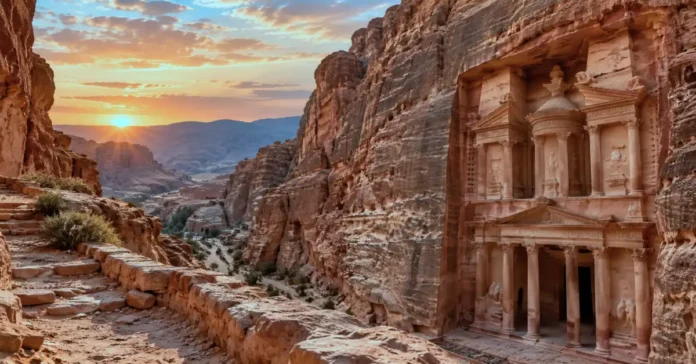
Planning your journey down south to the Rose City is thrilling, but choosing how to travel can make or break your Jordanian adventure. You essentially face a classic choice between an air-conditioned tourist coach and a rental car that hands you total freedom across dramatic desert canyons. Here is the honest breakdown of routes, budgets, transit times, and road conditions so you can pick the ride that fits your travel style.
Amman to petra bus vs rental car
Are you trying to decide between public transit and driving yourself? When weighing an Amman to Petra bus vs rental car, your travel priorities dictate the right answer.
Riding the bus lets you kick back, listen to a podcast, and completely ignore local driving habits. You do not have to stress over unmarked speed bumps, mountain drop-offs, or finding parking in hilly neighborhoods. Solo travelers on a shoestring budget will find the bus nearly impossible to beat on price.
Grabbing a rental car flips the script. Driving turns a routine transit leg into an unforgettable road trip through biblical landscapes and sweeping canyons. You can pause whenever you spot a roadside tea stand, detour to ancient crusader fortresses, and arrive at your hotel on your own timetable. Couples and groups often discover that renting a car costs almost the same as buying individual bus tickets once local taxi fares are factored in.
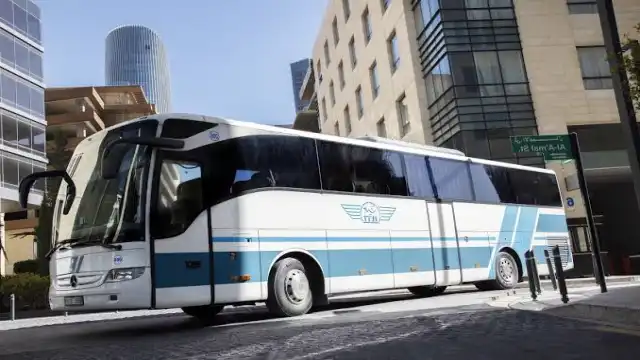
JETT bus: schedule, cost, and booking steps
The primary bus operator in Jordan is JETT (Jordan Express Tourist Transport). They run dedicated, air-conditioned coach buses between Amman and Wadi Musa, the bustling hub right outside Petra’s gates.
The bus runs via the Desert Highway, meaning you reach Petra without tedious local stops. Expect the ride to take roughly 3.5 to 4 hours, which includes a scheduled 20-minute rest stop at a highway cafeteria where you can stretch, grab a snack, or use the restroom.
Ticket prices are fixed and straightforward. A one-way ticket costs 11 JOD (around $15.50 USD) per passenger. Round-trip booking runs 22 JOD ($31 USD).
Most departures leave early in the morning. Typically, the coach departs from the JETT bus Abdali station in downtown Amman around 6:30 AM, with another morning pickup operating out of the JETT 7th Circle terminal at 7:00 AM. During the afternoon, usually around 5:00 PM, the coach makes its return journey from the Wadi Musa parking lot back to Amman.

Booking your seat ahead of time avoids disappointment, especially between March and May or September and November.
- Visit the official JETT booking portal or download their mobile app.
- Set your origin to either “Amman Abdali” or “Amman 7th Circle” and pick “Petra / Wadi Musa” as your destination.
- Pick your travel date and select your preferred seats on the digital bus layout.
- Input your passport number and contact information, then pay securely using a credit card.
- Download your digital ticket or save the QR confirmation code on your phone to present during boarding.
Remember to arrive at the station at least 30 minutes before wheels roll. Your heavy backpacks and suitcases go into the luggage compartment underneath, while you carry your daypack into the cabin.
Renting a car: queen alia airport car rental to wadi musa
Hiring a vehicle offers flexibility that no bus schedule can match. Arranging a Queen Alia airport car rental to Wadi Musa is usually far easier than picking up a vehicle in central Amman.
Why start at the airport? Queen Alia International Airport sits roughly 35 kilometers south of Amman. Picking up your car there means you bypass the capital’s chaotic urban traffic, crazy roundabouts, and narrow hills. You pull straight onto the open southbound highways within five minutes of leaving the terminal.
Budget car hire in Jordan is affordable. A standard economy sedan, like a Hyundai Accent or Nissan Sunny, typically costs between 20 and 32 JOD ($28 to $45 USD) per day when reserved in advance. Comprehensive insurance with zero deductible adds roughly 7 to 10 JOD per day. Local rental outfits will place a temporary hold on your credit card for a security deposit, usually between 250 and 350 JOD, which gets refunded after drop-off.
Fuel prices across the Kingdom are strictly government-regulated and updated monthly. Ninety-octane gasoline sits around 0.86 JOD ($1.21 USD) per liter, while 95-octane hovers closer to 1.10 JOD ($1.55 USD). Driving one way from Amman to Petra consumes roughly 18 to 24 liters depending on your vehicle and chosen route, putting your one-way gas bill around 16 to 22 JOD ($23 to $31 USD).
Desert highway vs kings highway
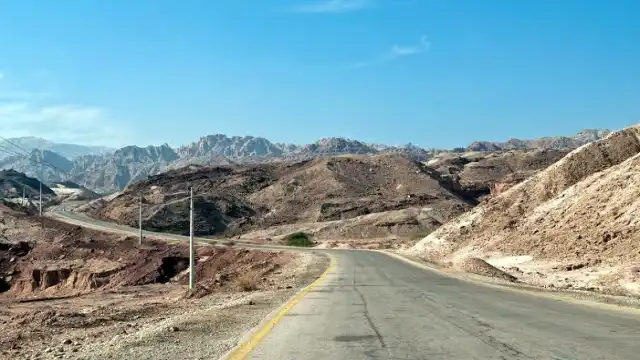
If you choose to drive, you face an unforgettable navigational dilemma: Desert Highway vs Kings Highway. Both take you to Wadi Musa, but they could not be more different in scenery, road design, and travel time.
Route 15, commonly called the Desert Highway, is the direct artery connecting Amman to Aqaba. It spans approximately 235 kilometers from Amman down to the Petra turnoff. The trip takes 3 to 3.5 hours of straightforward driving.
Jordan recently completed major multi-year reconstruction across Route 15, turning most of it into a smooth, divided multi-lane highway. You cruise alongside freight trucks through flat, arid scrubland. It is not pretty, but it gets the job done quickly. If your primary goal is checking into your Wadi Musa hotel before dinner, this is the route to take.
Route 35, the legendary King’s Highway, is an ancient trading corridor etched into biblical history.spanning roughly 260 kilometers, this winding road carves through deep river canyons, sleepy agricultural towns, and craggy mountains.
Driving the King’s Highway takes anywhere from 5 to 7 hours. Why does it take so long? The road is a single lane in each direction, featuring dramatic hairpin bends, heavy elevation changes, and plenty of tractors.
The scenery along Route 35 easily justifies every extra minute. You can explore the Byzantine mosaic maps in Madaba, pull over at the rim of Wadi Mujib to gaze into a massive canyon often called the Grand Canyon of Jordan, wander through the stone corridors of Kerak Castle, and admire the stone architecture in Dana Biosphere Reserve.
A smart travel strategy used by many experienced road-trippers is driving south via the scenic King’s Highway when you have all day to sightsee, and later returning north to Amman via the quick Desert Highway.
Road conditions, fuel stops, and driving in jordan safety
A common question first-time visitors ask is about driving in Jordan safety.Jordan is an exceptionally welcoming country with low crime rates, but local roads demand your complete attention.
Speed bumps, known locally as “sleeping policemen,” are your biggest road hazard. Rural villages place these bumps at town entrances and near pedestrian crossings to slow vehicles down. Many of them are painted with faded yellow stripes, but plenty are bare asphalt mounds with zero reflective warnings. Hit one at 80 km/h and you will damage your rental car’s undercarriage. Treat every village approach with extreme caution.
Police checkpoints are common along both highways. Do not panic when you spot armed officers waving vehicles toward a designated lane. These stops are routine security measures. Slow down, roll your window down, smile, and say hello. The officers will ask to inspect your passport, your home country driver’s license, and your rental contract. Once they confirm you are a visitor, they almost always smile, hand back your papers, and greet you with a genuine “Welcome to Jordan”.
Fuel stations are plentiful along the Desert Highway, featuring modern service plazas run by TotalEnergies, Manaseer, and JoPetrol. Attendants pump the fuel for you, and card machines are standard, though keeping cash handy is sensible for small purchases.
On the King’s Highway, gas stations are clustered around major towns like Madaba, Dhiban, and Kerak. The remote canyon stretches between towns have no fuel services. Fill your tank completely before descending into the dramatic valleys so you never have to watch your fuel gauge nervously during steep uphill climbs.
Avoid driving on rural Jordanian roads after dark. Stray donkeys, roaming camels, pedestrians crossing without lights, and unmarked potholes become nearly invisible at night. Plan your daytime drives so you reach your hotel well before sunset.
Real cost comparison
Let’s break down realistic travel budgets for different types of groups so you can see where your money goes.
For a solo traveler, the bus is an undeniable bargain:
- JETT bus ticket: 11 JOD one-way
- Taxis to/from bus terminals: 10 JOD
- Total solo bus transit cost: ~21 JOD ($30 USD)
- Contrast this with a solo car rental, where two days of vehicle hire, full insurance, and gas will run around 85 to 105 JOD ($120 to $148 USD).
For a traveling couple, the numbers balance out:
- Two JETT tickets plus local station taxis: ~32 JOD ($45 USD) one-way
- One-way share of a two-day car rental plus gas: ~45 to 55 JOD ($63 to $78 USD)
- Paying roughly 20 JOD extra per person for a rental car gives you total freedom to explore roadside castles and natural viewpoints.
For families or groups of three to four:
- Four JETT bus tickets plus multiple taxis: ~55 to 65 JOD ($77 to $91 USD)
- Rental car hire and fuel split four ways: ~20 to 25 JOD ($28 to $35 USD) per person
- For small groups, renting a car is cheaper than public transit and infinitely more comfortable for hauling multiple suitcases.
If you are a solo traveler looking to keep expenses low, book a morning ticket on the JETT bus and enjoy the effortless ride down the Desert Highway. You will arrive refreshed and ready to hike the trails of Petra. If you are traveling with a partner or family and want to soak up ancient mosaics, canyon viewpoints, and roadside castles, pick up your rental car at the airport and hit the historic turns of the King’s Highway. Both journeys bring you to the same timeless wonder of Petra.

