

Jules Verne: Biography, Best Books & Facts (The Father of Sci-Fi)
Jules Verne (1828–1905) was a French author who basically predicted the modern world — submarines, space travel, video calls, helicopters — all while writing adventure novels. He became the second most translated author in history, wrote 54+ novels, and got shot by his own nephew. Here’s everything worth knowing about him.
What kind of person writes about submarines, moon landings, and video communication — a full century before any of those things exist?
Jules Verne was that person. And calling him just a “novelist” is like calling Einstein just a “physicist.” Technically accurate. Completely insufficient.
Need to know
- Jules Verne is commonly cited as one of the “fathers of science fiction,” alongside H.G. Wells, and is remembered for pioneering the science adventure genre
- Verne is the second most translated author in the world, behind Agatha Christie but ahead of Shakespeare
- He wrote 54 novels as part of his Voyages Extraordinaires series, published between 1863 and 1905
- His works predicted electric submarines, space travel, video communication, helicopters, and news broadcasts — all of which materialized in the 20th century
- He got shot by his own nephew in 1886 and still kept writing
Who Was Jules Verne? A Quick Intro
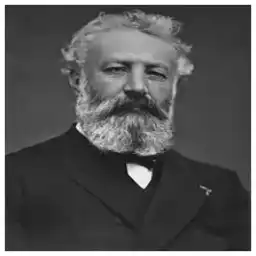
Jules Verne was born on February 8, 1828, in Nantes, France — a busy maritime port city — and died on March 24, 1905, in Amiens.
His mother, Sophie, was the daughter of a prominent Nantes family of ship owners. His father, Pierre Verne, was a lawyer. Growing up on a small artificial island called Île Feydeau, surrounded by ships and sailors and stories of far-off destinations, young Jules absorbed it all. The sea wasn’t just a backdrop for him. It was practically a character.
He was supposed to become a lawyer — the classic parental plan. His father sent him to Paris to study law, though Verne was already planning a literary career. He fell in love with literature and theatre, causing his father to stop financially supporting him. So Verne became a stockbroker to pay the bills. He hated every minute of it.
The real turning point came when he met publisher Pierre-Jules Hetzel in 1862. His Voyages Extraordinaires were launched, starting with Five Weeks in a Balloon in 1863 — a beautifully illustrated work of “scientific fiction.” Verne promptly quit the stock exchange, announced to his colleagues that he had invented a new genre, and never looked back.
He was right.
The Two Sides of Jules Verne

Most people know the optimistic Verne — the one whose heroes race around the globe, dive beneath oceans, and blast into space with wide-eyed wonder. But there’s a second Verne that doesn’t get enough attention.
Verne’s writing career had two distinct phases. In the first, his outlook was optimistic — some say shallowly so. In the post-1886 period, a variety of pro-environment and critical social themes emerged in his works, including the oppression of the Québécois in Canada, the ignorance and superstition of humans, and a concern for the imminent extinction of whales.
The second phase, from 1886 until his death in 1905, might be considered Verne’s pessimist period. Increasingly, he turned away from pro-science tales in favour of exploring the dangers of technology wrought by hubris-filled scientists.
What changed in 1886? A lot. More on that shortly.
The Voyages Extraordinaires: His Life’s Work
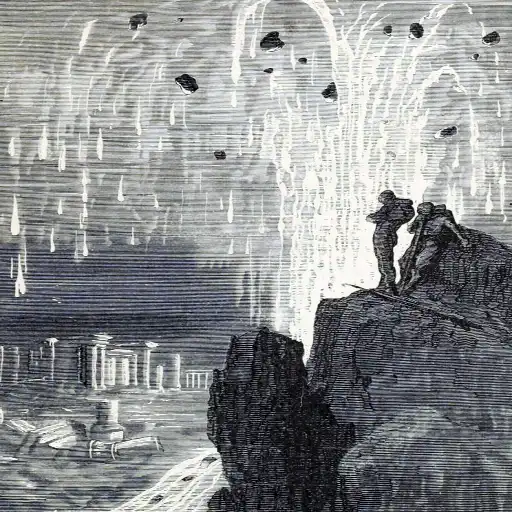
The Voyages Extraordinaires is a collection of 54 novels and short stories published between 1863 and 1905. The series features some of Verne’s best-known titles — Journey to the Center of the Earth, From the Earth to the Moon, Twenty Thousand Leagues Under the Sea, Around the World in Eighty Days, and The Mysterious Island.
Verne and his editor Hetzel commissioned illustrations from no fewer than eight artists for the series, producing around 4,000 illustrations across the volumes. These weren’t just books. They were visual experiences — lavish hardcovers marketed for Christmas and New Year’s, packed with artwork that made readers feel like they were actually there.
Think of it as the Netflix of the 1860s. Serialized, addictive, visually rich. Subscribers eagerly waited for each new installment. Verne delivered, almost every single year, for over four decades.

Top 10 Jules Verne Books (Ranked & Reviewed)
Not all 54 novels were created equal. These are the ones that actually matter — and why.
1. Twenty Thousand Leagues Under the Sea (1870)
This science fiction adventure novel tells the story of Captain Nemo and his submarine Nautilus, as seen from the perspective of Professor Pierre Aronnax after he, his servant Conseil, and Canadian whaler Ned Land are stranded at sea. The book was highly acclaimed on release and is still regarded as one of the finest adventure novels ever written. It’s also the one that directly inspired real submarine engineers. Start here if you’ve never read Verne.
2. Around the World in Eighty Days (1872)
The one most people know. Phileas Fogg bets his fortune that he can circumnavigate the globe in 80 days. It blends humor, suspense, and global exploration into one relentless race against the clock. The character of Fogg — precise, stoic, oddly endearing — is one of fiction’s great creations.
3. Journey to the Center of the Earth (1864)
A German professor, his nephew, and an Icelandic guide descend into a volcano and discover a prehistoric world underground. It showcases Verne’s knack for grounding wild ideas in science. Part geology lecture, part pure adventure. Surprisingly readable for a 160-year-old novel.
4. From the Earth to the Moon (1865)
Verne imagined humans travelling to the moon decades before the Apollo missions made it possible. His spacecraft, the Columbiad, was launched from Florida — just like Apollo 11. It carried three crew members, just like Apollo 11. The coincidences go on, and they’re genuinely eerie.
5. The Mysterious Island (1874)
Five American Civil War prisoners escape captivity in a balloon and land on an uncharted island. They build a civilization from scratch using only their knowledge. It’s a slow burn, but it’s Verne at his most philosophically rich. Captain Nemo makes a surprise reappearance.
6. Paris in the Twentieth Century (written 1863, published 1994)
Here’s the wild one. Verne’s 1863 novel predicted glass skyscrapers, high-speed trains, and a worldwide communications network. His publisher thought the predictions too pessimistic and it was not published until 1994 — over 130 years after it was written. The manuscript sat in a safe, forgotten. When it finally appeared, readers were stunned by how accurate it was. Verne described what sounds almost exactly like the internet.
7. Five Weeks in a Balloon (1863)
The book that launched everything. Three explorers cross Africa in a hydrogen balloon. It’s lighter in tone than his later works, but it’s where Verne first figured out his formula — real science + impossible adventure = compulsive reading.
8. Michael Strogoff (1876)

A Russian imperial courier races across Siberia on a vital mission, facing impossible odds. Less famous outside Europe but enormously popular in Verne’s own time. It was one of his most commercially successful works and was frequently adapted for stage and screen.
9. Robur the Conqueror (1886)
An engineer builds a heavier-than-air aircraft and terrorizes the skies. Verne described a machine with high-speed rotors that propelled the aircraft upward — essentially a helicopter, invented on paper 17 years before the Wright Brothers flew at Kitty Hawk. It reads as a warning about technological arrogance, which fits his darker second phase perfectly.
10. Master of the World (1904)
Verne’s final major novel. A villain builds an unstoppable land-sea-air vehicle and uses it to terrorize governments into submission. Dark, prescient, and unsettling — it reads less like 1904 and more like something written after seeing the 20th century’s wars. A fitting, sobering conclusion to his career.
Jules Verne’s Predictions: Things He Got Right
This is where Verne stops being a novelist and starts being something harder to explain.
The submarine. In Twenty Thousand Leagues Under the Sea, the Nautilus featured electric propulsion, a self-contained oxygen system, and a streamlined metal hull — remarkably similar to modern nuclear submarines. When Simon Lake, one of the pioneers of modern submarine technology, built his first functional submarine, he openly admitted that Verne’s book had been his inspiration.
Space travel. Verne’s spacecraft in From the Earth to the Moon was launched from Florida — just like the Apollo missions — with a crew of three, just like Apollo 11. He even calculated the necessary velocity to escape Earth’s gravity and estimated costs that were, humorously, close to early NASA budgets.
Video calls. In Paris in the Twentieth Century, Verne described “phototelegraphy” allowing people to see each other over distances — a clear foreshadowing of video calls like Zoom or Skype.
News broadcasts. He also imagined that instead of being printed, news would be spoken to subscribers every morning — essentially radio and podcasts, described in 1863.
The helicopter, solar sails, and more. He envisioned helicopters, solar sails, and news broadcasts, all of which materialized in the 20th century. His vision directly inspired inventor Wernher von Braun, the rocket scientist behind NASA’s Saturn V.
How did he do it? Verne obsessively read scientific journals, attended lectures, and corresponded with scientists. He wasn’t guessing. He was extrapolating — taking real emerging science and asking: what comes next? Nobody else was doing this so systematically, so publicly, and so readably.
8 Fascinating Facts About Jules Verne
1. He was shot by his own nephew. On March 9, 1886, Verne’s twenty-five-year-old nephew Gaston, who was suffering from mental illness, shot at him twice with a pistol. The first bullet missed. The second struck Verne’s left leg, leaving him with a permanent limp. Gaston was sent to a mental asylum. Verne never fully recovered — his diabetes complicated the injury, and the limp stayed with him until his death in 1905.
2. The worst year of his life was 1886. The shooting wasn’t even the worst of it. His longtime publisher and collaborator Hetzel died a week after the shooting. The following year, his mother passed away as well. Three devastating blows in quick succession. His writing got darker after this. Honestly, that’s understandable.
3. He’s the second most translated author on Earth. According to UNESCO, Jules Verne is the second most translated author in the world — behind Agatha Christie but ahead of Shakespeare. Let that sink in for a second. Ahead of Shakespeare.
4. He once tried to run away to sea as a boy. There is a tale, probably somewhat exaggerated, that at age 11 he tried to sail to the Indies as a cabin boy. His father stopped him before the ship reached open water. Jules had to promise he would “only travel in his imagination.” He kept that promise for the rest of his life — mostly.

5. He owned three yachts. In 1867 he bought a small ship, the Saint-Michel, which he successively replaced with the Saint-Michel II and Saint-Michel III as his financial situation improved. On board the Saint-Michel III, he sailed around Europe. The guy who dreamed about the sea eventually got to actually sail it.
6. His 1863 manuscript was lost for over a century. Paris in the Twentieth Century was written in 1863, rejected by his publisher as “too pessimistic and unrealistic,” and locked in a safe. It was not published until 1994. When readers finally got their hands on it, they found detailed descriptions of gas-powered cars, electric street lighting, calculated machines (computers), and a global communications network — all from a man writing before the lightbulb existed.
7. He received the Legion of Honour. In 1870, Verne was appointed as “Chevalier” (Knight) of the Légion d’honneur, France’s highest order of merit. He was elevated to Officer in 1892. The kid who was supposed to be a lawyer ended up being knighted.
8. His novels directly shaped steampunk. Verne’s body of work heavily influenced steampunk — the science fiction subgenre that takes inspiration from 19th-century industrial technology. Every steampunk aesthetic owes something to his vision of brass machinery, grand airships, and elegant submarines.
Famous Jules Verne Quotes
Verne had a gift for packaging big ideas into short, punchy lines. Here are some of his sharpest:
“Whatever one man is capable of imagining, other men will prove themselves capable of realizing.”
“Science, my lad, is made up of mistakes, but they are mistakes which it is useful to make, because they gradually lead to the truth.”
“We may brave human laws, but we cannot resist natural ones.”
“In consequence of inventing machines, men will be devoured by them.”
“Liberty is worth paying for.”
That last one carries weight when you know his life — a man who defied his father, defied convention, survived a shooting, lost his closest collaborator, and kept writing until the very end.
Remebering Jules Verne
Jules Verne wrote about the future long before the future learned to exist. Today, more than a century after his death, Verne remains not just a literary giant but a visionary whose works continue to shape how we imagine technology, exploration, and human ambition. His stories endure because they do something timeless: they transform wonder into possibility.
There’s something else, though — something that rarely gets said. Verne’s late-career turn toward pessimism about technology was also prescient. He saw the Industrial Revolution at its most optimistic, then lived long enough to see it start chewing people up. The same imagination that celebrated submarines eventually worried about what unchecked machines might do.
That tension — between wonder and caution, between possibility and responsibility — is exactly what the best science fiction has always done. Verne didn’t invent the genre alone. But he gave it its heartbeat.
Ready to pick up your first Jules Verne? Start with Twenty Thousand Leagues Under the Sea if you want his imagination at full power, or Paris in the Twentieth Century if you want to be genuinely unsettled by how much he saw coming. Either way, don’t wait — this is one legacy worth exploring.
Know someone who loves sci-fi but hasn’t read Verne? Share this with them. Some stories are too good to stay buried in the 19th century.

