

Richard Owen: The Scientist Who Named Dinosaurs and Made an Enemy for Life
Quick question: who do you picture when you think about the person who invented the word “dinosaur”?
Probably nobody, honestly. Most of us never think about it at all. The word just exists, the way “gravity” or “oxygen” exists, like it fell out of the sky fully formed. But somebody had to coin it. And that somebody was a Victorian anatomist named Richard Owen, a man who was brilliant enough to organize an entire branch of science and petty enough to wreck a colleague’s career out of pure spite.
This is the story of how one of the most important scientists of the 19th century gave us “dinosaur,” built the Natural History Museum in London, and then spent decades proving that being a genius and being a decent person are two completely separate skill sets.
Need to know
- Richard Owen coined the term “Dinosauria” in 1842, grouping Megalosaurus, Iguanodon, and Hylaeosaurus into one category for the first time.
- He’s widely credited as the driving force behind founding London’s Natural History Museum, which opened in 1881.
- Owen built his reputation partly by taking credit for work that belonged to a rival paleontologist, Gideon Mantell, and the fallout from that rivalry followed both men for the rest of their lives.
- He later clashed publicly with Charles Darwin and Thomas Henry Huxley over evolution, losing one of science history’s weirder debates: an argument about a tiny brain structure called the hippocampus minor.
- Owen’s scientific instincts were often sharp. His character, by most accounts, was not.
So Who Actually Was Richard Owen?
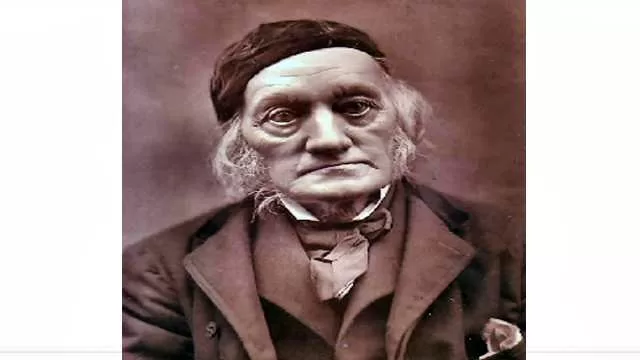
Born in Lancaster, England, in 1804, Owen started out training as a surgeon — not exactly the career path you’d expect for the guy who’d later define an entire prehistoric era. He apprenticed under local surgeons as a teenager, sat in on anatomy lectures at the University of Edinburgh, and eventually finished his training at St. Bartholomew’s Hospital in London, qualifying as a member of the Royal College of Surgeons in 1826.
That medical background mattered more than you’d think. Owen wasn’t digging up bones in a field somewhere. He got his start cataloging and identifying items in the museum collections of the Hunterian Museum at the Royal College of Surgeons, starting in 1827. Years spent dissecting and comparing the anatomy of every creature imaginable turned him into one of the sharpest comparative anatomists in Britain. He could look at a single bone fragment and tell you, often correctly, what kind of animal it came from and how it probably moved.
That skill is exactly what put him in the right place at the right time when British quarries started spitting out giant fossilized bones nobody could explain.
How “Dinosaur” Actually Got Its Name
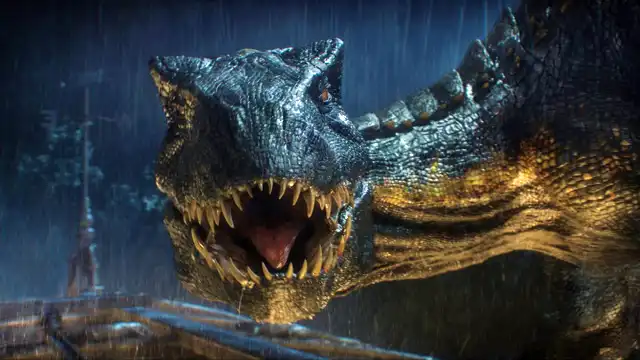
Here’s where it gets interesting. Owen didn’t discover the first dinosaur fossils. Not even close. Other scientists had already found and described several of them years before he showed up.
William Buckland, an Oxford geologist, had already described Megalosaurus back in the 1820s. A country doctor named Gideon Mantell had identified the second dinosaur genus, Iguanodon, which was reportedly discovered around 1822, with credit traditionally (though not certainly) going to his wife, Mary Ann. Mantell published his findings in 1825, correctly recognizing similarities between his giant fossil teeth and the teeth of modern iguanas.
So by the early 1840s, scientists had three separate giant fossil reptiles on their hands and no real way to talk about them as a group. That’s where Owen stepped in. In a report published in 1842, Owen proposed grouping Megalosaurus, Iguanodon, and Hylaeosaurus into a new category because they shared distinct anatomical features — stout limb bones, a particular vertebral structure, and an upright, elephant-like posture unlike anything else known at the time.
He called this new group Dinosauria, from the Greek “deinos,” meaning fearfully great, and “sauros,” meaning lizard. People usually translate this as “terrible lizard,” which sounds cool but isn’t quite right. Owen himself actually meant “fearfully great,” pointing more at their enormous size than anything monstrous about them.
Funny enough, the timing of all this is a little messy. The volume containing Owen’s paper claims to be the proceedings from a meeting in 1841, which is why some historians date the coining of the word to 1841 even though the published report didn’t actually appear until 1842. Either way, the name stuck. We’ve been using it for over 180 years now, and it’s not going anywhere.
The Part Nobody Tells You: Owen vs. Gideon Mantell
Okay, here’s where Owen the brilliant scientist starts overlapping with Owen the absolute menace.
Mantell and Owen actually started out on decent terms. They weren’t besties, but there was no blood feud — yet. They had pretty similar backgrounds too, both starting out as surgical apprentices before moving into fossil-hunting. Somewhere along the way, though, things curdled. Badly.
Mantell had discovered Iguanodon. That much isn’t disputed by anyone. But once Owen rose to prominence, he started chipping away at Mantell’s credit, piece by piece. Owen credited himself and the famous French anatomist Georges Cuvier with discovering Iguanodon, leaving Mantell — the actual discoverer — out of the story entirely. And this wasn’t a one-off mistake. Historians have pointed out that this wasn’t the first or last time Owen quietly claimed someone else’s discovery as his own.
It gets worse. Owen reportedly tried to block the Royal Society from awarding Mantell the Royal Medal, a prestigious honor Mantell absolutely deserved given how much groundbreaking work he’d done. Some historians also believe Owen used his influence within the Royal Society to keep several of Mantell’s papers from getting published at all.
Why would a man who was already famous bother sabotaging a rival who, frankly, wasn’t even competing with him for jobs or institutional power? Honestly, nobody fully knows. Jealousy, professional insecurity, plain old ego — probably some mix of all three. Whatever it was, it cost Mantell dearly.
There’s also a genuinely fascinating scientific irony buried in this fight. Mantell believed, based on the bone structure he’d examined, that Iguanodon could rear up and walk on two legs. Owen dismissed this and insisted Iguanodon walked on all fours like an oversized, sluggish iguana, and because Owen had the louder voice and more institutional clout, his version became the public’s mental image of the animal for decades. In 1849, shortly before his death, Mantell realized Iguanodon wasn’t the heavy, pachyderm-like creature Owen described — he’d worked out it actually had slender forelimbs, which lines up far better with what we know now.
So who was right? Mostly Mantell. It wasn’t until a landmark 1878 discovery of complete Iguanodon skeletons in a Belgian coal mine that scientists finally confirmed the animal’s true posture and anatomy — decades after Mantell had died and long after his reputation had taken a beating it never fully recovered from.
There’s a bittersweet detail in here too, one that often gets left out. Some historians believe it may actually have been Mantell’s wife, Mary Ann, who first spotted the unusual fossil teeth that led to the Iguanodon discovery, though the full credit went to her husband, as was typical for the era. Bias in science has always run deeper than just one feud.
A Royal Dinner Party Inside a Dinosaur
Not everything Owen did was cutthroat. Some of it was just delightfully strange.
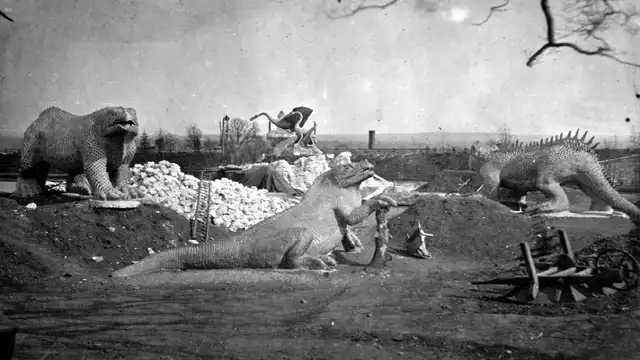
In the early 1850s, Owen partnered with a sculptor named Benjamin Waterhouse Hawkins to build the world’s first life-sized dinosaur models, originally meant for the Great Exhibition of 1851 in Hyde Park. Eventually, 33 of these models were produced and installed when the Crystal Palace itself relocated to Crystal Palace Park in south London.
And then Owen did something only a true Victorian showman would think of: he hosted a dinner for 21 prominent scientists inside the hollow body of one of the concrete Iguanodon models on New Year’s Eve, 1853. Picture two dozen distinguished gentlemen in formal wear, crammed inside a giant fake dinosaur, raising champagne glasses to ring in the new year. It’s one of the most delightfully bizarre images in the entire history of science, and it actually happened.
These sculptures, known today as the Crystal Palace Dinosaurs, opened to the public in 1854 and were an instant sensation. They were the very first attempt anywhere to reconstruct extinct animals as full-scale, lifelike sculptures. Were they accurate? Not really, by modern standards — Iguanodon got a misplaced thumb spike stuck on its nose, and Megalosaurus ended up looking suspiciously like an oversized monitor lizard. But given the handful of bone fragments scientists had to work with at the time, researchers today generally agree the reconstructions were about as good as anyone could’ve managed with the evidence available. You can still visit them today, sitting around a lake in south London, looking charmingly wrong in that specific Victorian way.
Founding the Natural History Museum
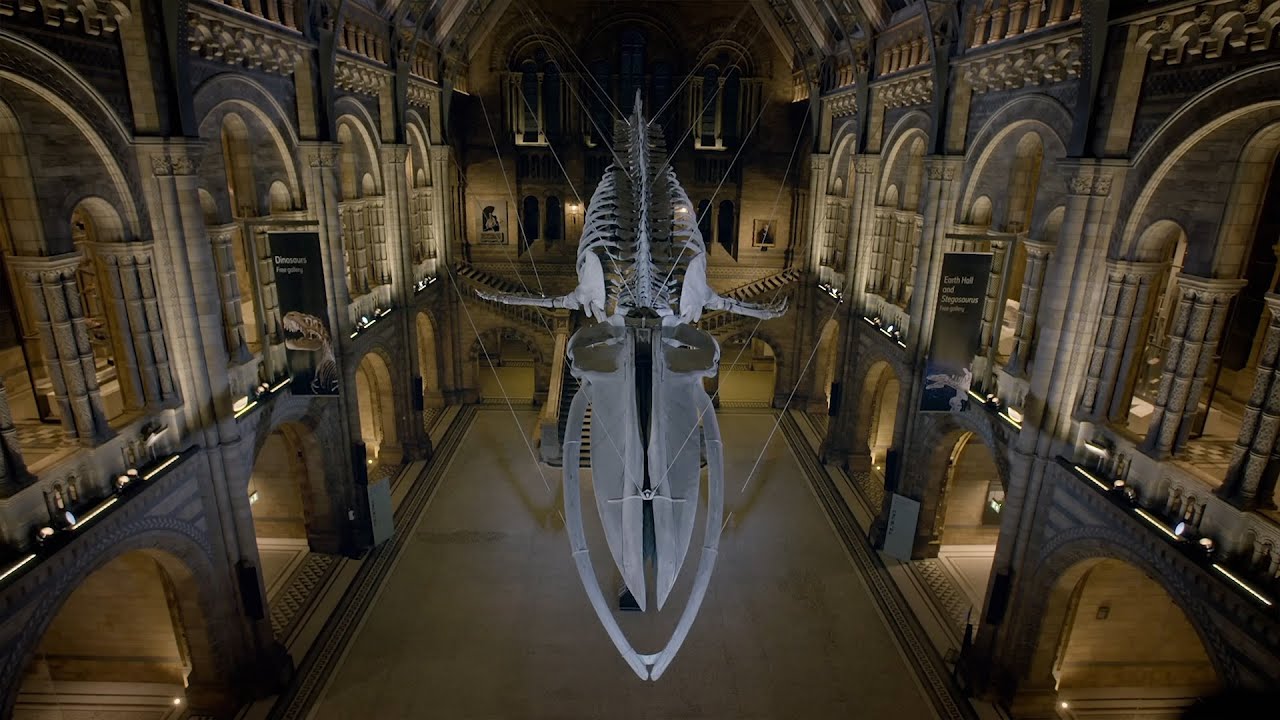
Whatever you think of Owen’s ethics, give the man this: he basically built the institution most of us picture when we imagine a natural history museum.
For years, England’s natural history specimens were jammed inside the British Museum alongside everything else — ancient artifacts, manuscripts, you name it. Owen thought this was ridiculous, and honestly, he had a point. He campaigned hard for years to get the natural history collections their own dedicated building. In 1856, he accepted a newly created position as superintendent of the natural history department at the British Museum, and he used that role to keep pushing.
It worked. The Natural History Museum in London finally opened its doors in 1881, and Owen is widely regarded as the driving force behind its existence. Today it houses something like 80 million specimens and welcomes millions of visitors every year, and a huge chunk of that legacy traces directly back to one stubborn anatomist who refused to let dinosaur bones sit in a basement somewhere.
Owen vs. Darwin (and Getting Beaten by a Brain Bump)
If you thought the Mantell feud was Owen’s only rivalry, buckle up — this next one is arguably weirder.
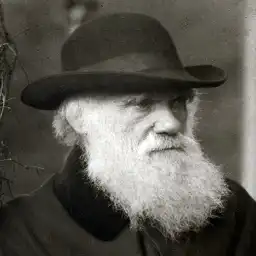
When Charles Darwin published On the Origin of Species in 1859, Owen didn’t reject evolution outright. That’s a common misconception. He actually agreed with Darwin that evolution happened, but thought the real process was far more complex than what Darwin had outlined. Where things got nasty was in how Owen handled the disagreement: he wrote a scathing, unsigned review of Darwin’s book for the Edinburgh Review, the same trick he’d reportedly pulled against Mantell years earlier with an anonymous obituary. Darwin wasn’t fooled for a second about who’d written it, and he wasn’t exactly charitable about it either, privately describing Owen as spiteful and clouded by envy over how much attention his own book was receiving.
The real showdown, though, came down to brain anatomy — specifically, one small structure called the hippocampus minor. In 1857, Owen presented a paper claiming his anatomical studies proved humans were fundamentally and uniquely separate from every other primate, arguing that only the human brain contained a posterior lobe, a posterior horn, and a structure called the hippocampus minor. If true, that would’ve been a serious blow against the idea that humans evolved gradually from ape-like ancestors.
There was just one problem: Owen was wrong, and Thomas Henry Huxley — nicknamed “Darwin’s bulldog” for his fierce defense of evolution — was determined to prove it. Huxley publicly dissected an ape brain to demonstrate that apes did, in fact, have this supposedly human-exclusive structure. Other scientists piled on too. William Henry Flower dissected sixteen different primate species and found the hippocampus minor was actually proportionally largest in marmosets and smallest in humans — basically the exact opposite of what Owen had claimed. To add insult to injury, it turned out Owen had been using a Dutch anatomical illustration of a chimpanzee brain that supported his argument, without acknowledging it had come from someone else’s research.
The whole saga became such a public spectacle that people started mocking it. It got parodied as a fight between two squabbling street vendors named “Dick Owen” and “Tom Huxley,” trading absurd Latin-sounding insults at each other in the press. Science doesn’t usually get this dramatic. This time, it did.
By most accounts, Huxley won decisively. Historians generally describe the three-year dispute as ending in Owen’s defeat, and it’s remembered today, somewhat mockingly, as the Great Hippocampus Question.
So… Was Richard Owen a Genius or a Villain?
Honestly? Both. That’s not a cop-out answer — it’s just accurate.
Owen’s scientific contributions were massive and genuinely lasting. Beyond dinosaurs, he made major contributions to the study of mollusks, correctly proposed a key classification system within that group, and even identified ancient Cambrian footprints in 1852, correctly figuring out they belonged to an extinct arthropod more than 150 years before fossils of that exact creature were finally found. That’s not a lucky guess. That’s a guy who genuinely understood anatomy at a level most of his peers didn’t.
But the pattern with Mantell wasn’t an isolated slip. In 1846, Owen accepted the prestigious Royal Medal for a paper on an extinct group of cephalopods called belemnites — without crediting an amateur biologist named Chaning Pearce, who had actually made the discovery four years earlier. Once that came to light, people started connecting the dots with how he’d treated Mantell. The fallout was serious enough that he ended up voted off the councils of both the Zoological Society and the Royal Society, and was denied the presidency of the Royal Society altogether.
Even his contemporaries struggled to separate the brilliance from the bad behavior. One historian summed Owen up as a sharp political operator who rarely took criticism well, almost never admitted his own mistakes, and frequently failed to credit other people’s work appropriately. That’s about as polite a way as you can phrase “difficult person to work with” in academic prose.
Why Any of This Still Matters
You don’t have to care about Victorian science gossip to appreciate why this story sticks with people. It’s basically a 180-year-old reminder that scientific progress doesn’t happen in a vacuum of pure logic and good intentions. It happens through actual people — ambitious, insecure, brilliant, petty people — fighting over credit, reputation, and who gets remembered.
Every time you walk past a dinosaur skeleton in a museum, or watch a kid light up over a T. rex poster, you’re looking at the legacy of a word coined by a man who also tried, repeatedly, to erase a rival from the history books. Mantell, to his credit, has slowly gotten more recognition over the decades as historians have dug back through the record. Science has a funny way of correcting itself eventually, even when individual scientists refuse to.
So next time someone casually drops the word “dinosaur” in conversation, you’ve got a pretty wild story sitting right behind it.
FAQs About Richard Owen
Did Richard Owen actually discover any dinosaurs himself?
Not really, no. He named and classified Dinosauria as a group, but the individual fossils — Megalosaurus, Iguanodon, and Hylaeosaurus — had already been found and described by other scientists, mainly William Buckland and Gideon Mantell.
Why did Owen and Mantell hate each other so much?
Mantell discovered Iguanodon and made several other major contributions to early dinosaur science, but Owen repeatedly downplayed or claimed credit for his work, reportedly blocked some of his papers from publication, and is widely believed to have written an unflattering anonymous obituary after Mantell’s death in 1852.
Is Richard Owen really considered the founder of the Natural History Museum?
Yes, he’s widely credited as the driving force behind it. He campaigned for years to give Britain’s natural history collections their own building, separate from the British Museum, and the Natural History Museum in London opened in 1881.
Did Richard Owen believe in evolution?
Sort of, in his own way. He accepted that evolution occurred but disagreed sharply with Darwin’s specific mechanism of natural selection, believing the process was more complicated than Darwin proposed.
Got thoughts on Owen, Mantell, or the wildly dramatic world of Victorian paleontology? Drop a comment below — and if you enjoyed this deep dive, share it with a fellow dino nerd who needs to hear about the Great Hippocampus Question.

