
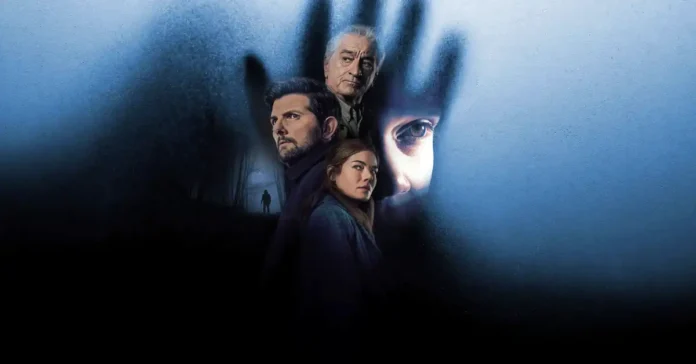
James Ashcroft’s film adaptation of The Whisper Man delivers a chilling exploration of inherited trauma, grief, and generational fracture. When young Jake Kennedy vanishes in the sleepy town of Garretton, an old nightmare resurfaces with terrifying intimacy. The final act twists a standard whodunnit into a brutal reckoning between fathers and sons that lingers well past the credits.
The dual-killer structure: francis carter jr. unmasked

The core mystery hinges on a terrifying question: how can a serial killer locked in a maximum-security cell snatch a child? Frank Carter Sr. (Michael Keaton) terrorized Garretton decades earlier by whispering outside children’s windows before taking their lives. While Frank remains firmly behind bars, a fresh wave of abductions mirrors his signature methods down to the exact rhyme.
The copycat is revealed to be Francis Carter Jr. (Owen Teague), Frank’s estranged biological son.
Living under the alias George Carringdon, Francis embedded himself into the community as a special needs teaching assistant at Jake’s school. Francis did not kill out of random bloodlust. His entire criminal scheme served as a grotesque plea for validation from a monster.
Frank Carter never showed love to his boy. To earn acknowledgment from his imprisoned father, Francis adopted the persona of “The Whisper Man,” staging identical crimes to capture Frank’s attention. Director James Ashcroft noted in interviews with Netflix Tudum that Francis represents the ultimate tragedy of the story: a broken child so starved for parental connection that he transformed himself into his father’s darkest reflection.
Frank Carter Sr. (Original Killer, Imprisoned) > (Inherited Trauma & Desperation for Approval) Francis Carter Jr. / “George” (The Copycat Abductor) > (Target: Jake Kennedy)
Pete Willis’ sacrifice: breaking the cycle of neglect

At its emotional core, the story mirrors two distinct father-son relationships. While Francis embraced his father’s cruelty, retired Detective Inspector Pete Willis (Robert De Niro) spent decades trying to undo the emotional damage he caused his own son, Tom (Adam Scott).
Pete caught the original Whisper Man years ago, but the case destroyed him. He turned to heavy drinking, emotionally abandoning Tom during his formative years. When Francis abducts Tom’s eight-year-old son Jake (Acston Luca Porto), Pete finally finds a path toward redemption.
During the climax at the Kennedy home, Pete and Tom confront Francis in the dark. Pete locates Jake hidden inside the crawlspace. Francis strikes Pete with a screwdriver, dealing a fatal wound to his stomach.
Knowing his time is up, Pete uses his dying breath to shield his grandson, shouting for Jake to run.
This moment completes Pete’s arc. Where Frank Carter exploited his son for violence, Pete gives his life to preserve the future of his family. Tom and Pete share a final, wordless understanding before Pete passes away. By the movie’s end, Tom and Jake move into Pete’s old home, honoring the man who broke his own downward spiral to save them.
The norman collins diversion: what was in the basement?
Before the killer’s true identity emerges, the investigation zeroes in on Norman Collins (Hamish Linklater). Norman appears as the textbook suspect: an unsettling loner obsessed with true crime memorabilia who frequents Frank Carter’s visitor list.

Norman is not the abductor. Instead, he operated as a sick middleman.
- The Boy in the Floor: When Pete and Tom search the basement of Tom’s new house, they discover the skeletal remains of Tony Smith — Frank Carter’s fifth and previously undiscovered victim from the 1990s.
- Dominic Barnett’s Murder: Norman had killed the home’s previous tenant, Dominic Barnett, after Barnett mocked his obsession with Frank Carter, concealing Barnett’s body inside the walls.
- The Fatal Link: Norman helped connect Francis with his incarcerated father through smuggled messages. Cornered by Detective Amanda Beck (Michelle Monaghan) and Pete, Norman takes his own life rather than face prison, leaving behind the critical clue that someone on the outside was actively coordinating with Frank.
The identity of “Mister Night”
Throughout the story, Jake talks about a mysterious presence named “Mister Night” who visits his bedside. For much of the narrative, this figure carries a sinister undertone, making audiences wonder if the killer had already invaded their home.
The reality is deeply human. Pete reveals to Tom that during Tom’s childhood, Pete would return home late after grueling homicide shifts, battling severe alcoholism. Too ashamed to face his son awake, Pete crept into Tom’s bedroom in the dark just to kiss his forehead while he slept.
Tom had childhood memories of these shadow visits, misremembering his remorseful father as an imaginary entity. That memory trickled down as a bedtime concept to Jake. Mister Night was never a monster — he was an estranged father desperate to show love from the shadows.
The girl in the blue sweater: ghost or grief?
The final frames of the film unveil a haunting twist. Throughout his ordeal, Jake speaks to an imaginary little girl in a blue sweater who offers him cryptic advice and tells him to scream when danger is near.
After the dust settles, Tom sorts through childhood mementos belonging to his late wife, Rebecca. He freezes upon finding an old photograph of Rebecca as a young child — wearing the exact blue sweater Jake described.
As author Alex North explained in discussions with TIME, this reveal works on two distinct levels:
- The Supernatural Reading: Rebecca’s spirit remained tethered to Jake, guiding him toward the right house and alerting him to scream just in time to expose Francis.
- The Psychological Reading: Jake processed the trauma of his mother’s sudden death by subconsciously constructing an imaginary guardian based on family photos he had seen years before.
North deliberately leaves both interpretations valid, giving the conclusion a tender, protective resonance amid the horror.
Novel vs Movie adaptation: key differences
While screenwriters Ben Jacoby and Chase Palmer stayed faithful to the thematic weight of Alex North’s book, the cinematic adaptation introduces notable structural adjustments:
| Element | Alex North’s 2019 Novel | James Ashcroft’s Film Adaptation |
|---|---|---|
| Pete’s Final Fate | Pete is injured earlier in the investigation, surviving his encounter with Francis to reflect on his family from afar. | Pete dies heroically during the climax inside the Kennedy home, securing Jake’s survival. |
| Reconciliation Timing | Tom and Pete begin rebuilding their bond gradually throughout the middle chapters. | Tom and Pete remain largely estranged until the high-stakes third act forces them together. |
| Pacing of Climax | Features a prolonged psychological standoff across multiple locations. | Condensed into a tightly wound home invasion thriller at the Kennedy residence. |
| Tone of Resolution | Melancholic and meditative, focusing heavily on internal monologues. | Visually stark, contrasting Pete’s ultimate sacrifice with Frank’s prison brutality. |
The final prison encounter: the ultimate irony
The film closes on a scene of brutal symmetry. Francis is arrested and placed in a holding cell within the same maximum-security facility as his father.
Francis finally gets the reunion he spent his entire life orchestrating. Frank Sr. enters the cell. There are no words of praise or fatherly embraces. Frank strips down, pulls a shirt over Francis’s head, and strangles his own son to death.
Why did Frank kill him? Throughout his original killing spree, Frank placed shirts over his young victims’ faces. Pete deduced that Frank never wanted to avoid seeing his victims; Frank was imagining killing Francis all along. By executing Francis in that cell, Frank claims his son as his final victim, shutting the door on the bloodline forever.
Frank then pens a chilling note to Detective Amanda Beck, thanking her for wrapping up loose ends. With Pete dead, Frank has found his new sparring partner on the outside, proving that evil never truly quiets down — it just lowers its voice.

