
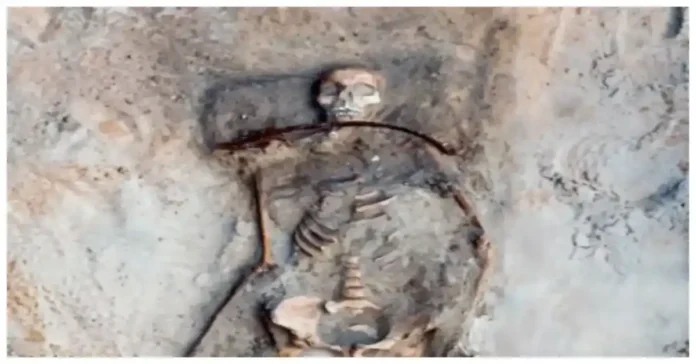
When archaeologists dug into the sandy soil of Pień, Poland, they found an iron sickle pinned tightly across a young woman’s throat. Clamped to her left big toe was a heavy iron padlock, sealing a 400-year-old fear that she might claw her way back from the grave. Today, cutting-edge forensic science, DNA profiling, and 3D facial reconstruction have finally stripped away the supernatural monster label to reveal the tragic human story underneath.
The crime scene in the dirt: Grave no. 75

In August 2022, an excavation team from Nicolaus Copernicus University in Toruń made an eerie discovery. Led by Professor Dariusz Poliński, the researchers were cataloging an unmarked 17th-century cemetery in Pień, a quiet village in northern Poland.
They did not expect to look right into the face of a community’s deepest panic.
Resting inside Grave No. 75 lay the skeleton of a young woman, believed to be between 18 and 20 years old at the time of her death. Locals now call her Zosia.
What stunned the excavators was not just her age, but the bizarre security measures installed around her bones:
- The Crescent Sickle: A rusted iron blade lay arched directly over her throat. It was positioned with the sharp edge facing downward, hovering barely a finger’s width above her vertebrae.
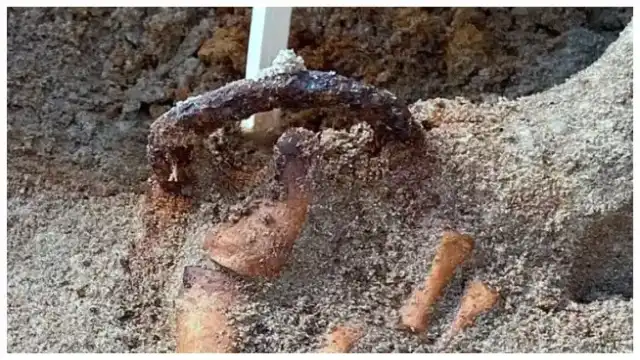
- The Triangular Padlock: Wrapped around the big toe of her left foot was an iron lock, snapped firmly shut.
- The Silk Headdress: Tangled near her skull were delicate fragments of green and gold-brocade silk thread.
Why would 17th-century villagers bury someone with precious, expensive clothing while treating her corpse like an active landmine?
As detailed in archaeological updates covered by CBS News and Live Science, this wasn’t an isolated eccentric burial. It was a calculated ritual designed to bind a suspected revenant to the dirt forever.
Why a sickle across the neck? 17th-century anti-vampiric rituals
To understand the polish vampire grave sickle neck configuration, you have to picture the raw mechanics of 17th-century anti-vampiric rituals.
The Anti-Revenant Trap
| Trap | Function |
|---|---|
| The Crescent Sickle | Sharp edge set over the throat. Decapitates if the corpse sits up or tries to climb out. |
| The Toe Padlock | Clamped to left big toe. Symbolically binds the bad soul; locks motor mobility. |
The placement of the sickle was a self-triggering execution device. If the deceased sat up in the grave, the motion would slice through her trachea and spine, severing the head. It acted as a passive mechanical guillotine.
The padlock on the toe worked on a symbolic, metaphysical level. In regional folklore, padlocks served as seals. Locking the left foot closed the cycle of life, binding the physical body so its limbs could not walk the earth again.
The two-stage burial theory
Did the villagers bury Zosia this way on day one?
Professor Poliński and his team suggest a much more dramatic sequence of events.
When Zosia initially died, she received a respectful, high-status burial. Her head rested on a soft down pillow. She wore an expensive, shimmering silk cap. Her family placed the padlock on her toe as a standard precautionary charm, tucked her into a wooden coffin, and covered her with earth.
Then, bad luck hit the village.
Perhaps livestock dropped dead overnight. Maybe an unseasonal frost ruined the rye crop, or a sudden fever swept through several households. In early modern Europe, unexplained community catastrophes were rarely blamed on bad weather or bacteria. They were blamed on the unsettled dead.
Panicked villagers marched back to Grave 75. They dug up the earth and pried open the coffin lid. Finding the padlock unlocked or simply overcome with sheer terror, they tried to mutilate or flip the corpse. Forensic examination shows post-mortem spine fractures, indicating someone twisted her body roughly inside the pit.
Unable to fully reposition her, they took out a curved harvest sickle, hammered it into the soil across her neck, and reburied her deep underground.
The demon with two souls: the slavic myth of the Striga
Modern pop culture imagines vampires as brooding aristocrats with capes and fangs. 17th-century Slavic peasants imagined something far more grounded in dread: the strzyga (or upiór).
Slavic demonology taught that certain humans were born with two souls, two hearts, or two sets of teeth.
| Concept | The First Soul | The Second Soul (The Striga) |
| Origin | Divine, mortal spirit | Demonic, shadow entity |
| At Death | Departs peacefully to heaven or the afterlife | Remains trapped inside the dead flesh |
| Behavior | Harmless memory of the person | Reanimates the corpse, hunts the living, spreads sickness |
| Countermeasure | Christian prayers and consecrated burial | Iron blades, padlocks, decapitation, prone burials |
If a person carried this dual spiritual nature, ordinary burial prayers weren’t enough. Once the good soul moved on, the dormant, malicious soul took control of the corpse. It would supposedly rise at dusk, suck the vitality from sleeping relatives, spread the plague, or strangle neighbors in their beds.

How did villagers pick out who might become a striga?
Anyone who didn’t fit the mold became a suspect. Physical abnormalities, rare chronic illnesses, foreign accents, neurodivergence, or sudden behavioral outbursts were seen as proof of a second soul lurking behind the eyes.
What the bones reveal: a modern forensic autopsy
Modern osteology, CT scanning, and chemical analysis have cracked this 400-year-old cold case wide open. When scientists examined Zosia’s skeletal remains, they found a body ravaged by physical suffering.
The forensic markers tell a harrowing medical story:
1. The chest tumor (Sternal Hemangioma)
Her sternum (breastbone) showed structural deformities consistent with a rare bone tumor — likely a vascular hemangioma. This lesion wasn’t just hidden inside the bone. It would have created a visible, tender, swollen lump or a fiery red mark right in the center of her chest. The growth would have pressed against surrounding tissue, causing persistent, stabbing thoracic pain.
2. Kimmerle’s anomaly
At the top of her neck, the first cervical vertebra (the atlas) displayed a bony bridge known as Kimmerle’s anomaly. This defect can pinch the vertebral artery and nearby nerves. What does that feel like day to day?
- Blinding, debilitating migraines
- Sudden fainting spells (syncope)
- Severe bouts of vertigo and ringing in the ears
- Sudden loss of balance and blurred vision
Imagine living in a superstitious 1600s village where a young woman frequently collapses without warning, clutches her chest in agony, or screams from unbearable head pressure. To her neighbors, these weren’t neurological symptoms — they looked like demonic possession.
Zosia’s Pathological Profile
| Finding | Details |
|---|---|
| Kimmerle’s Anomaly | Cervical spine defect; migraines & fainting |
| Sternal Hemangioma | Painful tumor in bone; visible chest lump |
| Harris’ Lines | Stress lines in tibia; childhood malnutrition |
3. Harris’ lines and dental cues
Her leg bones (tibiae) revealed multiple Harris’ lines — thin horizontal micro-calcifications that form when bone growth halts during childhood due to intense physiological trauma, high fevers, or starvation.
Her teeth also showed a prominent upper central incisor that jutted forward past the natural dental arch. In a culture obsessed with spotting the “second set of teeth” belonging to an upiór, a visibly protruding front tooth was a dangerous mark to carry.
The swedish outsider: geopolitical paranoia
As reported in New Atlas, DNA extraction and strontium isotope ratios in her tooth enamel pointed toward an origin far from the Vistula River valley: southern Scandinavia, likely Sweden.
That detail changes everything.
During the mid-17th century, Poland-Lithuania was invaded by the Swedish Empire in a catastrophic conflict known as the Swedish Deluge (Potop Szwedzki). Swedish armies burned thousands of Polish villages, plundered historic cities, and decimated more than a third of Poland’s population.
- Tensions between Catholic Poles and Lutheran Swedes were at an all-time high.
- Paranoia, religious zeal, and xenophobia were rampant throughout the countryside.
- Anyone with Swedish ancestry, a foreign accent, or atypical cultural habits was viewed with deep hostility.
Zosia was caught in a lethal crossfire of identity. She belonged to an elite, wealthy family — proven by her luxurious silk bonnet — yet she was a foreign outsider living in an empire devastated by Swedish soldiers. Add her chronic neurological seizures and physical deformities into the mix, and she became the community’s scapegoat for every stroke of bad luck.
Giving zosia her face back: Oscar Nilsson’s 3D reconstruction
For four centuries, Zosia was remembered only as an anonymous, dangerous creature pinned under iron.
Swedish forensic artist and archaeologist Oscar Nilsson set out to dismantle that narrative.
Forensic Reconstruction Workflow
| Step | Workflow |
|---|---|
| 1 | High-Precision CT Scanning — Digital acquisition of the cranium |
| 2 | 3D-Printed Skull Replica — High-density resin bone model |
| 3 | Tissue-Depth Peg Mapping — Derived from age, sex & ancestry |
| 4 | Anatomical Clay Layering — Sculpting individual muscle bands |
| 5 | Silicone Casting & Detailing — Skin texture, fair hair & clothing |
Nilsson started with a millimeter-precise 3D-printed replica of Zosia’s skull. Using forensic charts based on her age, sex, and Scandinavian genetic background, he glued small wooden depth pegs across the anatomical landmarks of the skull.
Layer by layer, he sculpted her facial musculature using specialized plasticine clay:
- Masticatory & Mimic Muscles: Recreating the masseters, temporalis, and delicate facial expression muscles based on bone attachment scars.
- Facial Contours: Accounting for her gracile, youthful bone structure, wide-set eye sockets, and gently rounded jawline.
- Skin and Features: Crafting a lifelike silicone mold with fair skin, wide blue eyes, and fair hair drawn from genomic data.
- Historical Costume: Dressing the bust in hand-sewn linen and a brocade headdress crafted by textile historian Anna Silwerulv.
The resulting reconstruction reveals a gentle, thoughtful teenager with a faint sadness in her gaze. There are no fangs. There is no demonic menace.
As Nilsson poignantly noted during the unveiling: “These people did everything they could to prevent her from coming back from the dead. We did everything we could to bring her back to life with human dignity.”
Superstition vs Science: definitive breakdown
| Historical Belief (17th Century) | Modern Forensic Reality (21st Century) |
| Vampiric Demon (Striga) | A sick 18-to-20-year-old girl suffering from a spinal defect and bone tumor. |
| Fangs of a Blood-Drinker | A natural dental variation where an incisor tooth jutted slightly forward. |
| Demonic Possession / Fits | Kimmerle’s anomaly causing vertebral artery compression, chronic migraines, and syncope. |
| Mark of the Devil’s Touch | Sternal hemangioma producing a tender, visible, red inflammatory lump on her chest. |
| Evil Spirit Causing Crop Loss | A high-status Swedish immigrant targeted by xenophobic wartime hysteria. |
Grave No. 75 in Pień isn’t proof that monsters once walked the earth. Instead, it stands as a time capsule showing how easily fear, disease, and war can twist neighbor against neighbor. With science and historical empathy working hand-in-hand, Zosia is no longer Poland’s mysterious vampire — she is finally seen for what she always was: a young girl who deserved care rather than iron blades.

