
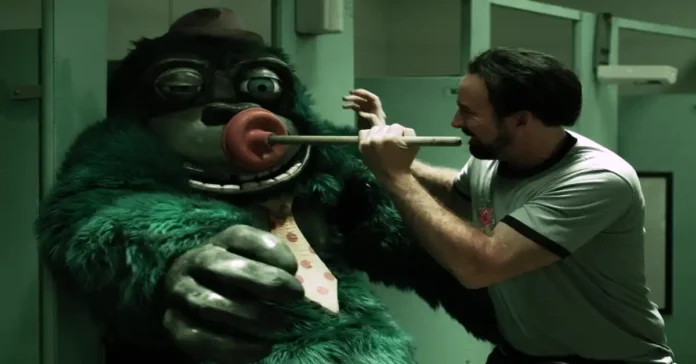
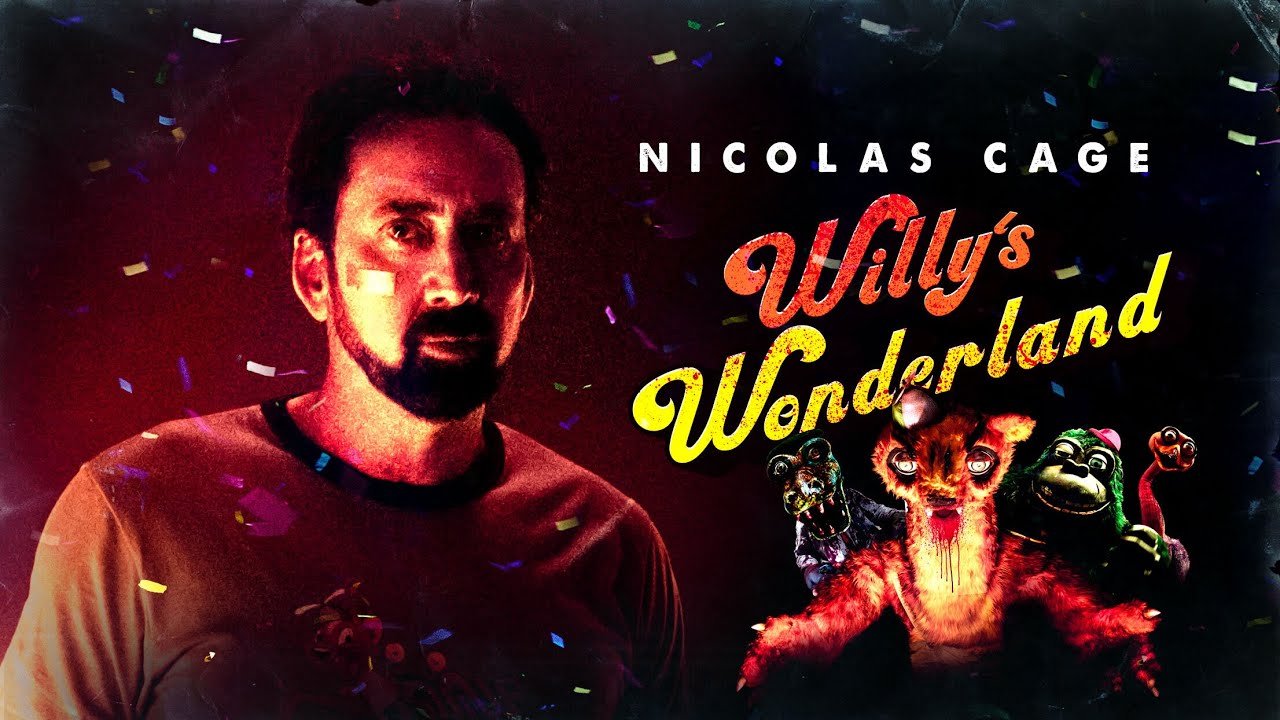
Most horror movies trap defenseless victims in a slaughterhouse with unstoppable monsters. Director Kevin Lewis flipped that formula upside down in Willy’s Wonderland by locking eight bloodthirsty animatronic demons inside a dilapidated family arcade with Nicolas Cage. What follows is not a desperate scramble for survival, but an absurd, darkly comedic demolition derby where evil learns the hard way that work breaks are strictly non-negotiable.
Willys Wonderland Cult Backstory
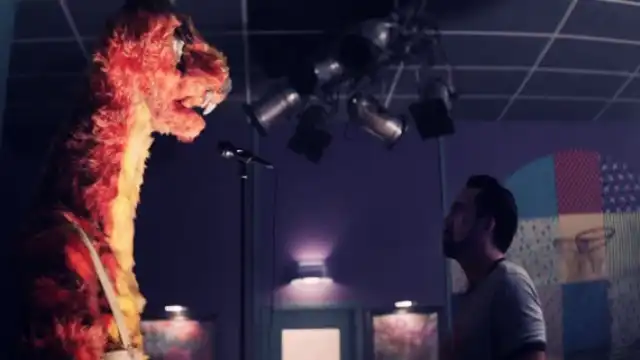
To make sense of the greasy nightmare inside the restaurant, you have to peel back decades of local carnage. The arcade looks like an abandoned clone of Chuck E. Cheese or ShowBiz Pizza. Beneath the faded neon and sticky vinyl lies a horrifying history of ritual slaughter.
During the late 1990s, the restaurant was founded by Jerry Robert Willis (played in flashbacks by producer Grant Cramer). On the surface, Jerry was an energetic entrepreneur running a fun family destination. Behind closed doors, he operated a sadistic cannibalistic syndicate. Jerry recruited seven fellow psychopaths to work as his cooks, cashiers, and costumed performers.
They created the “Super Happy Fun Room,” an off-limits birthday chamber where they quietly ambushed visiting parents and children. For years, the gang murdered patrons in secret, hiding the disappearances behind the chaos of arcade tokens and animatronic songs.
Law enforcement eventually connected the dots. When the ATF and state troopers surrounded the building to execute an arrest warrant, Jerry and his crew knew they were facing lethal injection. Surrender was never on the table.
Instead, Jerry gathered his seven followers in the main dining hall. They carved occult symbols into the floorboards, chanted dark incantations, and conducted a mass suicide blood ritual. Their souls tore free from their dying flesh and bound themselves directly to the mechanical chassis of the restaurant’s eight animal mascots:
- Willy Weasel: The ringleader, inhabited by Jerry Robert Willis himself.
- Arty Alligator: A vicious brawler fond of cornering teenagers in dark hallways.
- Cammy Chameleon: A stealthy predator who uses fake innocence to lure victims close.
- Ozzie Ostrich: A towering, foul-mouthed bird with razor-sharp beak strikes.
- Gus Gorilla: A powerhouse brute lurking inside the restrooms.
- Knighty Knight: A sword-wielding medieval mascot carrying real steel.
- Siren Sara: A seductive, winged singer with a pyromaniac streak.
- Tito Turtle: A creepy slow-mover who hides deadly agility behind a dopey shell.
The suicide was not an act of cowardly escape. It was an unholy rebirth. The killers traded fragile mortal bodies for steel endoskeletons wrapped in synthetic fur, powered by demonic rage and an insatiable hunger for living flesh.
How Sheriff Lund Fed the Meat Grinder
Hayesville, Nevada should have condemned the building and burned it to the ground. Why did the locals leave an active nest of supernatural murderers standing right off the highway?
The horrifying answer comes down to small-town self-preservation. After the animatronics woke up, they slipped out into the streets, murdering Hayesville residents in their own homes. The town was helpless. Gunfire barely scratched the mascots’ internal steel frames, and the mechanical killers showed zero mercy.
Sheriff Eloise Lund (Beth Grant) made a devil’s bargain alongside town owner Tex Macadoo (Ric Reitz) and local mechanic Jed Love (Chris Warner). They struck a formal peace treaty with Willy Weasel.
The terms were ruthlessly simple. Willy and his crew agreed to stay quarantined inside the walls of the amusement center and leave Hayesville locals alone. In return, the town leadership agreed to supply the monsters with an endless stream of fresh human cattle.
To make the system look like ordinary bad luck, Jed planted homemade spike strips along Highway 160. Whenever out-of-town drivers blew their tires, Jed towed their wrecked cars to his garage. Because Hayesville’s card readers conveniently stayed “broken,” Jed demanded a thousand dollars in crisp cash for replacement tires.
When the stranded traveler inevitably could not pay, Tex Macadoo stepped in like a benevolent Southern gentleman. Tex offered to cover the full repair bill if the traveler worked a single overnight custodial shift cleaning Willy’s Wonderland before the supposed grand reopening.
The traveler was locked inside at sundown. By sunrise, the animatronics had fed, and Tex hauled out the mangled remains. Sheriff Lund went along with this slaughter for years to protect her community. Her compliance was haunted by deep guilt; she ended up adopting Liv Hawthorne (Emily Tosta) only after personally delivering Liv’s biological parents to Willy’s meat grinder years prior.
Why Doesn’t Nicolas Cage Speak in Willys Wonderland?
One central puzzle captivates everyone who watches the film: why doesn’t nicolas cage speak in willys wonderland? Throughout the entire eighty-eight-minute runtime, Cage’s character — credited solely as “The Janitor” — does not utter a single word of dialogue. He never screams when attacked. He does not drop one-liners when crushing skull plates. When spoken to, he merely stares with stony indifference, grunts with mild exertion, or walks away.
This creative decision came directly from Cage himself. Screenwriter G. O. Parsons originally penned a few spoken lines for the character in the first script draft. When Cage boarded the project as both producer and star, he recognized that dialogue would only diminish the film’s surreal atmosphere.
Removing his voice transformed the Janitor from a standard horror victim into an unstoppable mythic force. He becomes an analog warrior pulled straight out of a classic Sergio Leone western — a modern Man with No Name wandering through a neon wasteland.
Cage’s silence also delivers the movie’s sharpest comedy punchline. Horror villains thrive on panic, begging, and tearful pleas. When Ozzie Ostrich screeches that he is going to rip out the Janitor’s spine, Cage does not argue or show fear. He rolls his eyes, snaps his mop handle in half, and beats the ostrich into a pile of twisted wire. Silence denies the monsters their psychological power.
Punch Pop and Pinball
Most horror protagonists survive through blind luck or frantic running. Cage’s Janitor survives through rigorous labor discipline and an obsession with energy drinks.
When the Janitor clocks in, he sets a recurring digital timer on his wristwatch. The watch dictates his entire reality. Whenever the alarm beeps, the man immediately halts whatever he is doing.
It does not matter if a mechanical demon is standing across the room brandishing a blade. Break time is sacred.
During these mandatory breathers, the Janitor strolls to the staff refrigerator, cracks open a can of fictional “Punch Pop” soda, and drops quarters into a customized Gottlieb pinball machine. He sips his caffeine, bobs his hips to energetic electronic beats, and chases the high score.
This routine flips standard cinematic tension on its head. The monsters assume they are the predators hunting a helpless trespasser. To the Janitor, the possessed mascots are simply stubborn stains in a workspace he promised to sanitize.
Every time black oil and mechanical fluid splatter across his Willy’s Wonderland t-shirt, he does not panic over the gore. He casually peels off the soiled shirt, folds it neatly, tosses it in the trash, and puts on a fresh duplicate from his duffel bag. His dedication to his manual task completely neutralizes their supernatural horror.
Willys Wonderland Ending Explained
The final act blows the unholy compact completely apart. A group of local teenagers led by Liv infiltrates the diner to burn the place down, but the animatronics slaughter the teens one by one. Sheriff Lund arrives to maintain the town’s cover-up.
Desperate to appease the spirits after the chaotic night, Lund handcuffs the Janitor to a dining chair and attempts to offer him to Willy Weasel as a peace offering. The plan backfires instantly. Demonic contracts never honor human loyalty. Willy emerges from the darkness, ignores the bound drifter, and tears Sheriff Lund completely in half.
Willy then turns his sights on the Janitor. The two engage in a bruising, bare-knuckle brawl inside the party room. Willy manages to claw deep gouges across the Janitor’s back, throwing him into the plastic ball pit.
That minor setback is short-lived. The Janitor climbs out, swings a heavy sack loaded with unopened Punch Pop cans like a medieval flail, and batters the weasel into submission. He grabs Willy by the jaw and tears the animatronic’s skull completely off its robotic spine.
As dawn breaks over the Nevada desert, Tex Macadoo and Jed Love drive up to the diner expecting to shovel human remains into body bags. They peek through the front windows and stop dead in their tracks.
The arcade is sparkling clean.
Every surface gleams with polish, the floors shine, and neat black trash bags filled with demolished robot parts sit stacked by the door. The Janitor slips back into his clean black leather jacket, takes his repaired car keys from a stunned Tex, and steps out into the morning air without saying a single syllable.
The town conspirators do not escape their karma, either. While Tex and Jed stand in the parking lot arguing about whether to reopen the arcade for profit, Siren Sara emerges from the shadows. She pours gasoline over their vehicle and drops a flame, triggering a fiery blast that kills Tex, Jed, and herself all at once.
The Janitor slides into the driver’s seat of his vintage 1968 Chevrolet Camaro alongside Liv. He pops open a fresh can of Punch Pop and hands it to her as a silent sign of respect. Down the open desert highway, the mangled, surviving shell of Tito Turtle hobbles into their lane. The Janitor does not tap the brakes. He accelerates straight forward, obliterates the turtle into airborne scrap metal, and speeds toward the horizon.
Willys Wonderland Lore Explained
When you examine the broader picture, the film works as a brilliant deconstruction of modern horror mechanics. Video game adaptations and haunted attraction stories always rely on fragile human vulnerability. In games like Five Nights at Freddy’s, the security guard survives by rationing electrical power, monitoring security cameras, and trembling behind locked blast doors.
Willy’s Wonderland obliterates that dynamic. The monsters do not hunt a frightened security guard. They are trapped in a cage with an apex predator who treats their existence like an OSHA violation.
Substituting red blood with jet-black hydraulic oil allows the violence to feel over-the-top and visceral without plunging the movie into grim despair. The black goo represents the rotten souls of the serial killers inside the machine, staining the world with their filth until an uncompromising cleaner sweeps them away.
The Janitor is never given a tragic backstory, an epic motivation, or a grand hero’s journey. He has a simple contract: fix my car, and I will clean your diner. His unyielding commitment to finish the shift proves that sometimes the scariest thing you can unleash on supernatural evil is a working man who just wants to get back on the road.

