
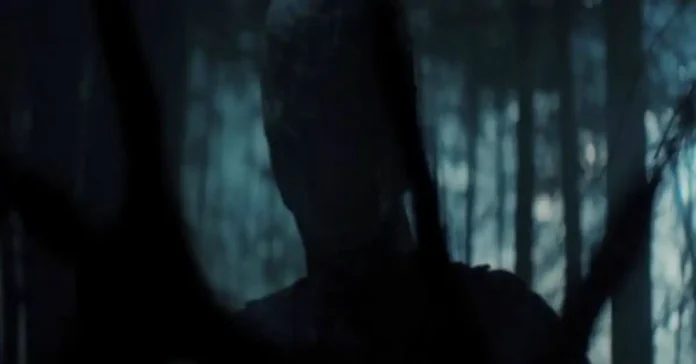
When director Sylvain White brought the internet’s most infamous creepypasta to theaters in 2018, fans expected a terrifying exploration of modern folklore. Instead, viewers walked away from Slender Man scratching their heads over a fractured plot and a protagonist who literally morphs into a tree. Making sense of that strange conclusion requires peeling back bizarre bio-horror mechanics, heavy studio censorship, and a tragic real-world controversy.
Bio video and the three bells
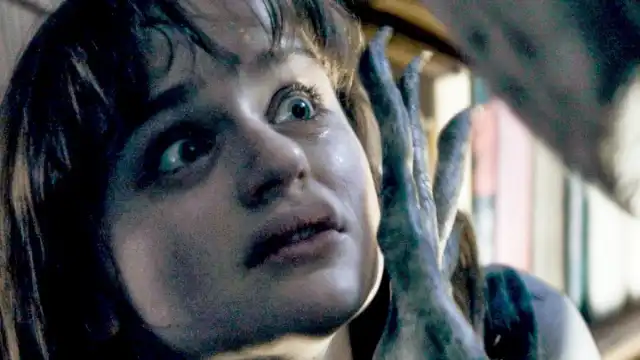
Long before Hallie ever steps foot in the dark woods, the film establishes a unique set of rules for its titular monster. Unlike classic slasher villains who stalk victims with physical weapons, this version of Slender Man acts like an airborne pathogen or a memetic virus.
Four high school friends — Hallie, Wren, Chloe, and Katie — gather for a mundane Friday night sleepover in small-town Massachusetts. Bored out of their minds, they decide to pull up an obscure internet video after hearing local boys brag about it.
The website lays out a strict occult ritual centered on sound and sight:
- You must stare into a flickering montage of grotesque, surreal imagery.
- Three distinct church bells chime sequentially throughout the clip.
- When the third bell rings, you must close your eyes immediately.
- Opening your eyes before the chime fades guarantees your mind becomes host to the entity.
Ever had a melody stuck in your head that you just could not shake? Slender Man operates on that exact cognitive vulnerability.
The video is not just a spooky movie clip; it functions as a digital bio-virus. The moment Katie and her friends watch the video, the monster plants a root inside their subconscious. Once the idea takes hold, you cannot un-think it. Obsession morphs into hallucinations, which quickly spirals into acute psychosis.
Wren (Joey King) discovers this terrible truth while scouring online forums: Slender Man feeds on terror, systematically wearing down a victim’s mental barriers until their sanity collapses completely.
What happened to hallie in slender man
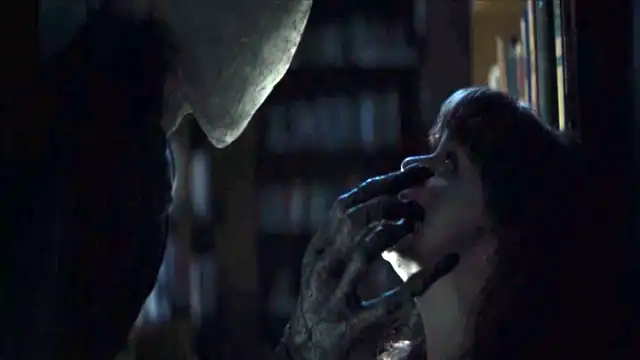
As the curse tightens its grip, the friend group disintegrates. Katie vanishes during a school field trip to an historic cemetery. Chloe suffers a violent panic attack and is dragged away into madness. Wren becomes a manic shell of herself, frantically pasting newspaper clippings and occult drawings across her bedroom walls.
The horror hits its absolute breaking point when Hallie’s younger sister, Lizzie, accidentally stumbles across Wren’s research.
Lizzie experiences a catastrophic mental breakdown and ends up comatose in a psychiatric ward. Desperate to save her sister, Hallie (Julia Goldani Telles) teams up with Wren to conduct an outdoor ritual to offer a trade. When Wren loses control, Hallie flees deeper into the Massachusetts woods.
That brings us to the moment everyone asks about: what happened to hallie in slender man?
Deep in the mist, towering among ancient pines, Slender Man corners Hallie. His limbs stretch unnaturally, bending toward the sky like gnarled branches. He does not tear her apart with claws or bite her flesh.
Instead, black, root-like tentacles sprout from his torso, winding tightly around Hallie’s arms, legs, and neck. As he lifts her off the dirt, the tendrils bore into her body. Her skin hardens, turning brittle and brown. Her limbs stiffen into wooden boughs, and her hair dissolves into tangled twigs.
Hallie does not just die. She surrenders her humanity to the entity to spare her little sister.
The movie cuts immediately to the hospital, where Lizzie suddenly awakens from her catatonic trance, completely healed. Hallie traded her physical existence so Lizzie could live.
Slender man tree ending meaning
Why did the filmmakers turn Hallie into an actual tree? That surreal visual choice baffled casual moviegoers, yet it ties directly into the thematic core of the folklore.
The slender man tree ending meaning operates on three distinct symbolic levels:
- The Mycelium Network: Throughout the story, characters compare Slender Man to a fungal root system spreading beneath the soil. In nature, mycelium runs invisible underground for miles, connecting trees and decomposing organic matter. Slender Man does the same thing to human minds. By turning Hallie into a tree, the film illustrates that she has become a permanent node in his parasitic underground network.
- The Faceless Nature of Folklore: Trees have no faces, no voices, and no individual identities. Hallie’s transformation strips away her selfhood, turning her into just another anonymous wooden pillar in an endless forest. The individual vanishes, leaving only the legend behind.
- Predatory Camouflage: From his very first creation on the Something Awful forums by Eric Knudsen in 2009, Slender Man was designed to blend into barren winter tree lines. By absorbing victims directly into the canopy, the entity replenishes the very woods he uses for cover. Every twisted branch in that forest might just be another lost child who looked too closely into the dark.
In the film’s final voiceover, Lizzie reflects on Hallie’s disappearance, comparing fear to a seed that grows until its branches choke out the sun. Hallie was not eaten; she was absorbed into the natural architecture of terror.
Studio reedits and the waukesha controversy
If you found the pacing choppy and certain plot threads jarringly unresolved, you are not imagining things. The slender man 2018 movie ending was heavily compromised long before it ever hit projection booths.
To understand why the theatrical cut feels so hollow, you have to look at the real-life tragedy that cast a dark shadow over production. In 2014, two twelve-year-old girls in Waukesha, Wisconsin lured their classmate Payton Leutner into a park and stabbed her nineteen times, claiming they had to appease Slender Man to protect their families.
When Sony Pictures and Screen Gems announced an official studio adaptation just a few years later, the public pushback was fierce. Bill Weier, the father of one of the attackers, publicly condemned the production, calling it an exploitative cash grab that capitalized on a horrific crime. Petitions demanding the film’s cancellation racked up thousands of signatures.
Spooked by the brewing backlash, Sony executives hit the panic button:
- Excising Graphic Self-Harm: The movie’s original promotional trailer featured scenes of raw, unsettling violence, including a sequence where a girl drives an X-Acto blade directly into her own eyeball during class. That entire sequence was wiped from the final cut.
- Trimming Body Horror: Shots of Wren screaming with blood gushing from her nose and eyes, a body plunging from a building, and graphic hallucination sequences were stripped out to ensure a PG-13 rating.
- Shredding Narrative Continuity: Entire secondary characters and emotional arcs vanished. Producers were reportedly so frustrated by Sony’s aggressive butchering that they attempted to shop the film to competing platforms like Netflix or Amazon, but nobody took the bait.
The studio ended up quietly dumping the neutered ninety-three-minute version into theaters during August 2018. The resulting film felt like an incomplete jigsaw puzzle, leaving audiences to piece together motivations that had been left behind on the cutting room floor.
Slender man ending explained
Internet horror is remarkably difficult to translate onto the big screen. Creepypastas thrive on ambiguity, amateur found-footage aesthetics, and crowd-sourced mystery. When a major Hollywood studio attempts to pin that amorphous dread down with conventional CGI tentacles and PG-13 jump scares, the magic evaporates.
Hallie’s fate remains the single most striking, audacious image in the entire film. Even within a heavily compromised narrative, her slow transformation into a dead tree captures the essence of what made the original legend so eerie.
Slender Man was never a monster you could shoot, outrun, or outsmart. He is an idea that wraps itself around your thoughts, takes root in your nightmares, and drags you quietly into the woods where nobody will ever hear you scream.
Missing trailer scenes
The original promotional campaign relied heavily on disturbing imagery of self-harm, gore, and surreal contagion. When Sony and Screen Gems mandated cuts to soften the tone, these showcase moments vanished entirely.
- The Eyeball Scalpel Scene: The most notorious cut in the entire marketing cycle. In the first teaser trailer, a schoolgirl sits at a classroom desk with deadened, glassy eyes. She takes an X-Acto scalpel and slowly drives the blade straight into her own pupil. The scene was completely removed to avoid depicting explicit adolescent self-harm.
- The Roof Fall / Window Plunge: A striking low-angle shot in the trailer showed a student’s body plummeting off the brick ledge of the school building, crashing toward the pavement below. The finished film cut out all secondary student casualties, making Katie’s disappearance feel like an isolated event rather than a town-wide epidemic.
- Wren Bleeding from Her Facial Orifices: In the marketing footage, Wren (Joey King) screams in raw agony while thick, dark blood violently gushes from her tear ducts, nose, and mouth. In the theatrical cut, Wren’s physical degradation is largely reduced to messy hair, frantic wall scribbles, and heavy breathing.
- The Maggot and Decomposition Hallucinations: Multiple brief trailer cuts showed decomposing corpses, swarms of insects, and maggots squirming across human faces. The original script framed Slender Man as a force of biological rot and blight; almost all of that visceral decay was excised.
- The Suburban Street Encounter: The teaser featured an unsettling visual of Slender Man’s elongated silhouette casually striding down a brightly lit suburban street between two manicured front lawns. In the final cut, his appearances are almost strictly quarantined to the deep woods or heavily shadowed interiors.
- Chloe’s Glass-Shattering Attack: A sequence featuring Chloe (Jaz Sinclair) frantically banging on a glass patio door as unseen forces violently smash the pane and drag her backward was trimmed and rearranged into a disjointed hallway jump scare.
Gutted subplots and erased storylines
The reedits went far beyond trimming bloody frames. Entire character arcs and narrative bridges were shredded on the cutting-room floor.
- Katie’s Father and the Town Paranoia: Early production reports and casting sheets established a much larger role for Katie’s father (Kevin Chapman). In the original cut, his descent into drunken grief and obsession led him to actively stalk and interrogate Hallie and Wren, creating a tangible human antagonist alongside the supernatural threat. His role in the finished film was reduced to a couple of brief, inconsequential cameos.
- The Full Context of the Internet Video: The bio-video the girls watch on the occult site was originally an extended sequence with significantly more surreal, disturbing vignettes — including dead birds, distorted ultrasound scans, and subliminal imagery designed to explain why the brain becomes neurologically compromised upon viewing. The theatrical release chops the clip down to a few generic seconds.
- Chloe’s Extended Disintegration: In the final film, Chloe has one panic attack in the library and essentially disappears from the plot until she is briefly seen catatonic. The original edit documented her gradual psychological breakdown over several days, detailing how her home life shattered as the entity invaded her sleep.
The unreleased R-Rated cut & studio feud
The reason the theatrical cut feels disjointed is not due to careless editing by director Sylvain White, but an intense corporate struggle behind the scenes.
- The Waukesha Controversy: When the trailer dropped in early 2018, Bill Weier — the father of one of the 12-year-old girls involved in the 2014 real-world Wisconsin stabbing — spoke out publicly against the film. He accused the studio of commercializing a near-fatal tragedy while the victims and perpetrators were still children. An online petition rapidly gathered thousands of signatures demanding the movie be shelved.
- The Producer vs. Studio Standoff: Spooked by the potential PR nightmare, Sony Pictures demanded an aggressive overhaul. They mandated an R-to-PG-13 recut, ordering the removal of any scene depicting teenagers engaged in self-mutilation, graphic suicide, or extreme psychological torture.
- The Attempted Studio Shop: The producers were so dissatisfied with Sony’s heavy-handed cuts that they exercised a contractual provision allowing them to shop the completed, original cut to outside distributors. They took the film to major streaming platforms, including Netflix and Amazon, hoping someone would purchase the distribution rights and release the unrated version.
- The Quiet Dump: When no streaming platform agreed to pay the high purchase price Sony wanted to recoup production costs, the producers were forced back to Screen Gems. Sony finalized their neutered, 93-minute cut and dumped it into theaters in August 2018 with almost zero press screenings or promotional push.
Neither Sylvain White’s original director’s cut nor the deleted scenes have ever seen an official home-video or digital release, leaving the original, far darker vision preserved only in promotional trailers and promotional stills.

