
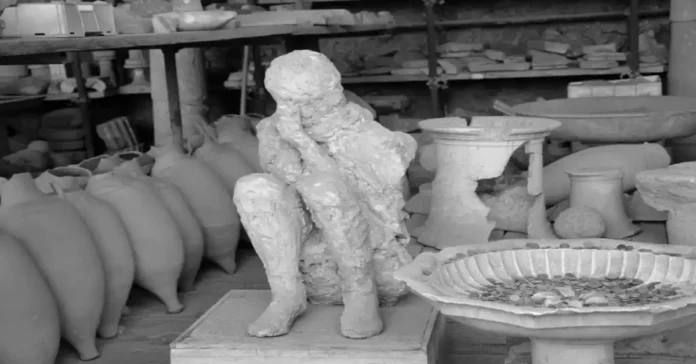
You know those time capsules people bury in their backyards, hoping someone finds them decades later? Mount Vesuvius created the ultimate version of that in AD 79, freezing an entire bustling city mid-breath. Archaeologists just cracked open a 2,000-year-old wooden cupboard in Pompeii, and what’s inside gives us a shockingly intimate look at a Roman family’s final morning.
The Pompeii Cupboard Discovery on Via dell’Abbondanza
The House of Cornelius Maximus sat directly on the Via dell’Abbondanza. Think of this street as the Times Square of ancient Pompeii. It was loud, chaotic, and packed tightly with people living out their daily routines. Behind a storefront facade initially excavated way back in 1912, researchers finally breached an inner room that had waited completely untouched for two millennia.
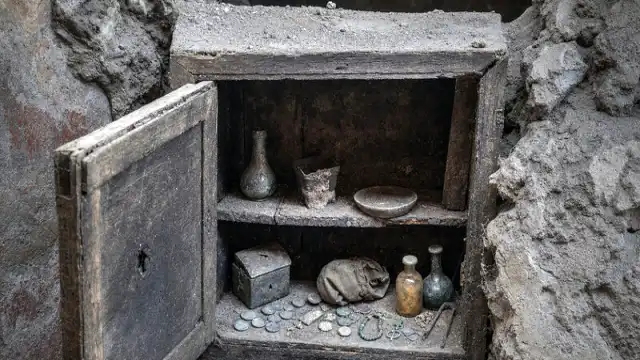
The volcanic ash had totally sealed the space off. Archaeologists identified this room as a triclinium, a traditional Roman dining space where families gathered. Right there in the corner sat a large piece of wooden furniture. We are talking about a standard domestic storage unit. This wasn’t some grand golden temple chest. It was a regular closet where everyday folks stashed their personal belongings.
Inside the Triclinium
Where was this wooden cabinet actually sitting? The excavation team found it wedged into the dining room. Romans didn’t just sit in chairs to eat; they reclined on lavish couches.
Having a storage unit crammed into a dining room reveals a lot about the harsh reality of ancient urban living. While the hyper-wealthy had massive countryside villas with dedicated storage cellars, middle-class merchants had to make the most of limited square footage. Placing a cupboard full of business weights and baby amulets next to the dinner table shows how tightly woven their private lives were with their economic hustles. It is the ancient equivalent of keeping your work laptop on the kitchen island.
Plaster Casting the Void: How to See the Invisible
How exactly do you study a wooden cabinet that rotted away centuries ago? You don’t study the wood itself. You study the exact ghost it left behind in the dirt.

When the superheated ash rained down on Pompeii, it packed violently around everything in its path. As the timber of the ancient armarium (cupboard) slowly decayed over hundreds of years, it left a perfectly hollow mold hidden deep in the hardened earth.
Here is how the brilliant recovery process works:
- Spotting the Cavity: Excavators carefully dig through the ash layer until they hit a hollow pocket.
- Pouring the Plaster: They gently pump liquid plaster directly into this underground void.
- The Reveal: Once that plaster cures and sets hard, workers chip away the surrounding volcanic rock.
The exact, three-dimensional shape of the ancient cabinet emerges from the dust. This plaster cast technique allows us to see the shelves, the doors, and the exact proportions of a piece of furniture that hasn’t actually existed since the first century. Every single item sitting inside was locked precisely in its original position.
24 Crepundia Amulets Pompeii
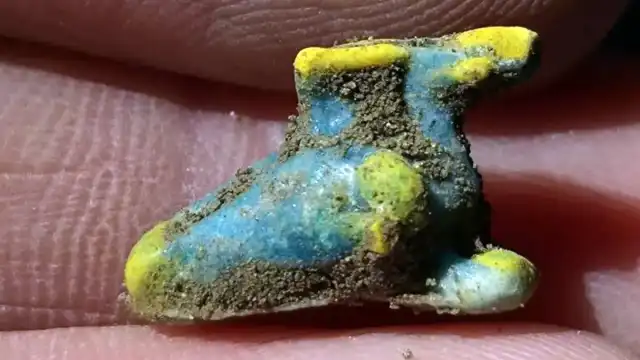
Tucked safely into a small cloth bag on one of the shelves was a collection of 24 tiny charms. Historians call these artifacts crepundia.
These were absolutely not just shiny trinkets or casual jewelry. Roman parents gave these protective amulets to their children specifically to ward off evil spirits and bad luck. Infant mortality in the ancient world was devastatingly high. A desperate mother would string these miniature objects into a necklace, hoping the chaotic magic of the gods would keep her child breathing.
The Pompeii wooden cupboard amulets included some wild items:

- Miniature human hands and feet
- Tiny bunches of grapes representing abundance
- Small figures of the deities Bes and Mercury
Finding these charms safely stored away hits hard emotionally. It strongly suggests the child either survived and simply outgrew the necklace, or the family kept the jewelry as a deeply sentimental reminder of a kid they lost prematurely. Keeping them secured inside a cloth bag means the owners cared enough to protect the memories.
38 Bronze Coins and the Hustle of Street Trade
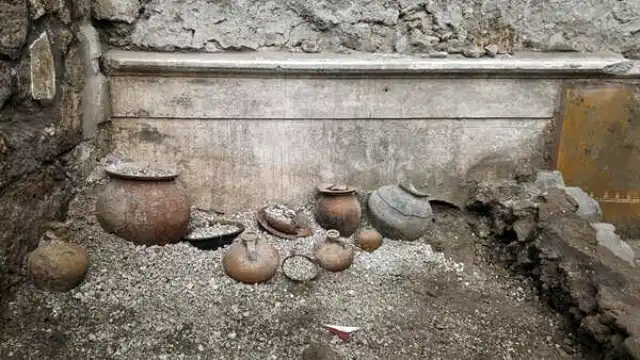
The shelves didn’t just hold magic and memories. They held cold, hard cash. Beside the charms sat a small woven basket packed tightly with 38 bronze coins. Right next to that stash rested a wooden box containing a set of lead trading weights.
This specific combination drops a massive socio-economic clue about who actually lived in this house. Bronze coins were the everyday pocket change of the Roman working class. You didn’t buy a luxury estate with bronze. You used it to buy a loaf of bread, a cheap tunic, or a quick cup of wine at the local thermopolium (street bar).
The lead weights scream commercial activity. Merchants used these on a statera (steelyard balance) to weigh out grain, spices, or produce. Someone in this family was constantly hustling. They likely ran a small shop right there on the Via dell’Abbondanza or worked as a street-level merchant. This wasn’t the sprawling estate of an ultra-rich politician. It was a bustling, middle-class home where domestic life and economic survival happened side by side.
Roman Household Artifacts AD 79
The rest of the items on the shelves read exactly like a modern bathroom cabinet. Archaeologists pulled out tweezers, a mortar for mixing makeup pigments, and a glass balsamarium — a fancy bottle that held expensive perfume or scented oils.
Picture that final morning routine. Someone woke up in AD 79 and plucked their eyebrows. Personal grooming was a massive priority back then. The famous Roman philosopher Seneca even complained about living near a bathhouse, writing about the annoying “skinny armpit hair-plucker, whose cries are shrill” making his clients shriek in pain.
After mixing a little makeup and dabbing on some perfume, that person might have lit the small incense burner to say a quick morning prayer. Ceramic cooking pots nearby show breakfast was probably on the menu too.

The Cost of Smelling Good
That small glass balsamarium holding perfume tells its own mini-story. Glass blowing was a rapidly evolving technology in the first century. Owning a delicate glass vessel filled with imported scented oils meant you had a bit of disposable income. Romans loved heavy, rich perfumes made from olive oil mixed with rose petals, saffron, or cinnamon. The owner of this cabinet wanted to project status and cleanliness on the crowded, sweaty streets of Pompeii.
The Fatal Optimism of Vesuvius
They eventually walked out the door, leaving their spare change and childhood keepsakes neatly organized on the shelf. The residents fully expected to come right back home.
The eruption of Mount Vesuvius didn’t announce itself as a civilization-ending apocalypse immediately. During the early hours, the falling pumice stones seemed survivable to a lot of locals. That fatal optimism kept thousands of people trapped in their houses. The closed cabinet door proves they thought the danger would pass. Vesuvius gave them zero time to realize their mistake. They never returned to collect their savings.
What We Learn From the Things Left Behind
We often get completely caught up in the dramatic plaster casts of the agonizing human victims. It becomes easy to forget the quiet tragedy of the ordinary things they left behind. The Pompeii cupboard discovery forces us to look closely at the people instead of just staring at the volcano.
This incredible find proves that the ancient Romans were aggressively normal. Families saved their pennies. Parents kept lucky charms just like modern people keep baby teeth. Everyone wanted to smell nice before heading to work.
The actual owners of this cupboard remain nameless ghosts lost to history. We currently have absolutely no idea if they escaped the suffocating ash or if they died screaming in the darkened streets. But for one brief second, standing in front of that newly opened cabinet, you can almost hear the clanking of the coins and smell the sharp perfume.

