

For decades, tales of vanishing ships, magnetic dead zones, and sea dragons have swirled around Japan’s infamous Devil’s Sea, also known as the Dragon’s Triangle. Sensational authors turned a stretch of the Pacific south of Tokyo into Asia’s terrifying counterpart to the Bermuda Triangle. The real story behind these mysterious sinkings is rooted in violent underwater volcanism, deep ocean trenches, and sudden Pacific weather shifts rather than supernatural forces.
What is the dragon’s triangle?
The region known as the Devil’s Sea (Ma-no Umi in Japanese) sits in the Pacific Ocean roughly 100 kilometers south of Tokyo. It spans a triangular zone connecting Japan’s mainland, the Izu Islands (including Miyake Island), and the Bonin Islands down toward the Philippine Sea.
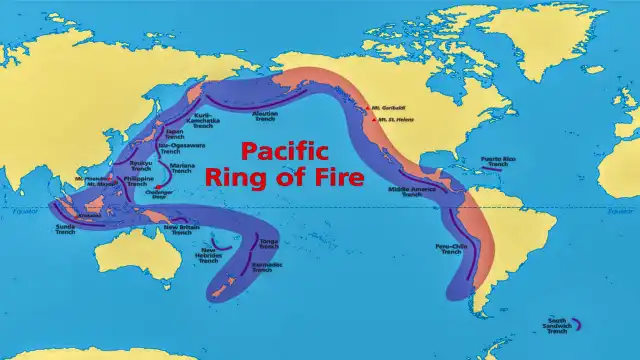
Ancient fishermen called this area the Devil’s Sea because water conditions changed instantly without warning. Legend claimed a massive dragon lived beneath the waves, pulling passing wooden ships into the abyss.
In 1989, pop-archaeology writer Charles Berlitz published a book titled The Dragon’s Triangle. Berlitz claimed the area was a paranormal vortex responsible for swallowing dozens of military vessels, fishing fleets, and planes between 1950 and 1954. He claimed the Japanese government officially declared the area an unsafe warzone.
Did a mysterious force swallow those ships? Not even close.
Debunking the myth
When historians and oceanographers cross-checked Berlitz’s wild claims against official Japanese maritime records, the sensational story fell apart.
Research showed that many of the “disappeared” vessels were small wooden fishing boats that lacked modern radio gear. They vanished during severe ocean storms and seasonal typhoons that regularly batter the Japanese archipelago. Some ships cited in paranormal books never existed at all, while others sank hundreds of miles outside the triangle’s boundaries.
| Step | Event |
|---|---|
| 1 | Pulp Fiction Myths (1980s) |
| 2 | Unchecked claims of “50 vanished warships” |
| 3 | Archival investigations & weather log audit |
| 4 | True culprits found: typhoons & shallow volcanoes |
The Japanese government never classified the entire Devil’s Sea as an eerie vortex. Instead, maritime authorities issued localized safety advisories around active underwater volcanic vents that periodically blast rock and steam into shipping lanes.

The disaster of the kaiyo maru no. 5
Every myth has a seed of truth. For the Dragon’s Triangle, that seed was a genuine naval tragedy that occurred on September 24, 1952.
The Japanese Hydrographic Department dispatched the oceanographic research vessel Kaiyo Maru No. 5 to investigate a newly active submarine volcano called Myojin-sho, located along the Bayonnaise Rocks ridge. The volcano had sprouted above the water days earlier, forming a temporary islet before sinking back beneath the surface.
Myojin-sho Rises
September 16, 1952
A submerged volcano along the Izu-Ogasawara Arc erupts violently, forcing lava and steam above sea level to form a transient island.
Kaiyo Maru No. 5 Deployed
September 23, 1952
The Japanese government sends the survey vessel Kaiyo Maru No. 5 with 31 crew members and scientists to map the seabed activity.

Catastrophic Submarine Eruption
September 24, 1952 (12:21 PM)
Myojin-sho explodes underwater directly beneath or beside the research ship. The explosive force triggers a localized tsunami, crushing the hull instantly.
Wreckage Recovered
September 27, 1952
Search teams locate lava-pitted pumice debris and wooden fragments floating nearby, confirming the vessel was destroyed by a volcanic eruption rather than a supernatural event.
Tragically, all 31 people on board — 22 crew members and 9 oceanographers — lost their lives. Wreckage retrieved days later contained embedded pieces of volcanic pumice. Scientists were not swallowed by a mythical monster; they were struck by an underwater volcanic explosion.
Volcanoes, Methane, and Seismic Forces
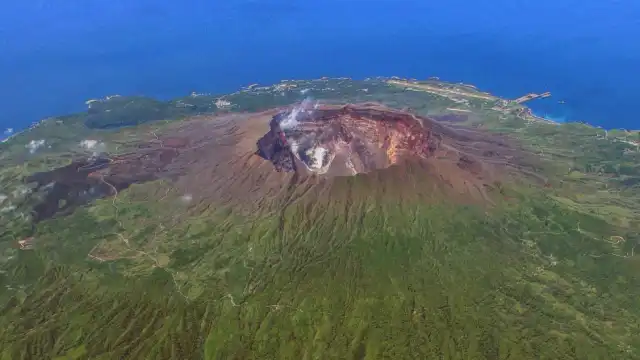
Why are the waters south of Tokyo genuinely treacherous for navigation? The answer lies in geology and oceanography rather than urban legends.

1. Active submarine volcanism
The Devil’s Sea lies directly along the Izu-Ogasawara Trench, where the massive Pacific Plate slides beneath the Philippine Sea Plate. This subduction zone creates an active chain of underwater volcanoes.
When a submarine volcano erupts, it releases thousands of tons of gas and hot rock into the water column. If a vessel passes directly over an erupting vent, two deadly things happen:
- Density Drop: Gas bubbles instantly reduce the water’s density. A ship loses buoyancy and drops straight down like a stone.
- Explosive Shockwaves: Shallow underwater explosions throw superheated water and heavy pumice hundreds of feet into the air.
2. Methane hydrate outgassing
Deep ocean trenches store vast reserves of methane hydrates — frozen pockets of methane gas trapped under immense water pressure.
Seismic shifts or underwater landslides fracture these gas pockets. When the pressure breaks, massive columns of methane gas shoot toward the surface. Ships hitting these gas-froth zones sink instantly because aerated water cannot support a steel hull.
3. The kuroshio current and rogue waves
The Kuroshio Current (Japan’s equivalent of the Gulf Stream) sweeps north through this region at high speeds. When fierce cold weather fronts from Siberia collide with warm water from the current, ocean swells instantly turn chaotic.
These conflicting forces generate sudden rogue waves – isolated walls of water over 80 feet high capable of snapping a fishing trawler in half within seconds.
Myth vs Science
| Feature / Legend Claim | Pseudoscience Myth | Geological & Historical Fact |
| Primary Cause | Extraterrestrial portals, sea dragons, magnetic vortices | Submarine volcanic eruptions, seismic subduction, typhoons |
| Loss of Kaiyo Maru No. 5 | Vanished without a trace in a sea anomaly | Destroyed by an explosive eruption of Myojin-sho volcano |
| Government Warnings | Entire sea declared a forbidden paranormal zone | Localized safety alerts issued near active volcanic vents |
| Ship Loss Rate | Statistically abnormal rate of missing vessels | Standard loss rate for a heavily traveled, storm-prone trade route |
| Geological Setting | Mysterious electromagnetic vortex | Tectonic junction on the Pacific Ring of Fire |
Quick Faq’s
Is the Devil’s Sea unsafe for modern ships today?
Modern commercial shipping passes safely through these waters every day. Advanced satellite navigation, real-time sonar, and volcanic monitoring by the Japan Meteorological Agency keep vessels far away from active underwater vents.
Where does the name “Dragon’s Triangle” come from?
The term was popularized in Western pop culture during the late 20th century, drawing inspiration from ancient Asian folklore about water dragons combined with the structural framing of the Bermuda Triangle.

