
Great Unconformity: Why 1.2 Billion Years Vanished from Earth’s Crust
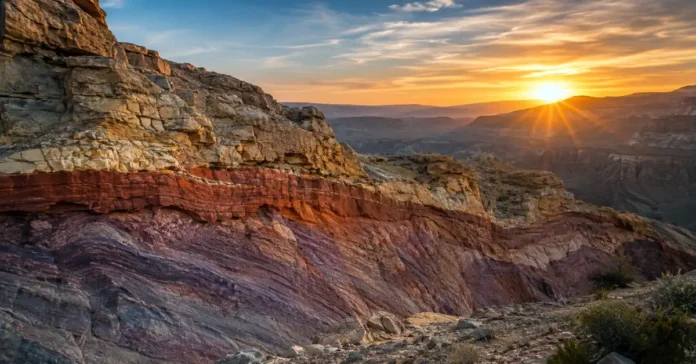
Imagine opening a massive history book, reading page 10, and realizing someone ripped out the next thousand pages before you hit page 11. That missing chunk of time is The Great Unconformity, a global geological puzzle where up to 1.2 billion years of rock simply vanished from Earth’s crust. You can actually walk right up to this missing timeline in the Grand Canyon and press your hand against a gap older than complex life itself.
What is the Great Unconformity?
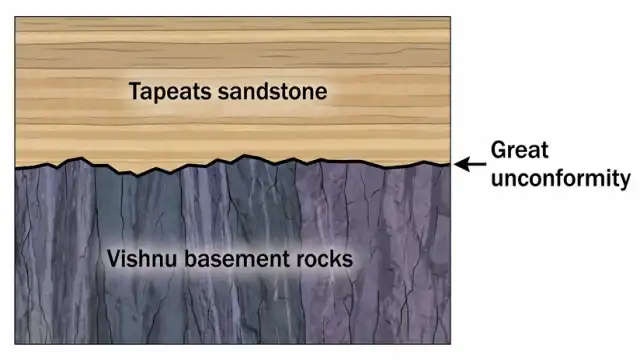
An unconformity is just a fancy geologist word for a gap in the rock record. Normally, mud, sand, and volcanic ash pile up layer by layer over millions of years, creating a neat stack of pages that scientists read from bottom to top. When wind, rain, or ice scrapes away older layers before new ones settle on top, you get a time jump.
The Great Unconformity is the undisputed heavyweight champion of these time jumps. First spotted by explorer John Wesley Powell during his famous 1869 boat trip down the Colorado River, this boundary shows up on almost every continent — from North America and China to Australia and Scandinavia.
Why does this matter to us? Because this giant missing gap sits right beneath the Precambrian-Cambrian boundary. Below the line, rocks hold almost nothing except traces of single-celled bacteria. Above the line, Earth suddenly bursts with complex animals — trilobites, shells, and early ancestors of modern creatures. That missing billion years hides the exact chapter where quiet, microbial Earth transformed into a planet teeming with animal life.
The Grand Canyon’s Starkest Boundary: Vishnu Schist vs Tapeats Sandstone
If you want to see this missing billion years of Earth history with your own eyes, hike down into the Inner Gorge of Arizona’s Grand Canyon. Along trails like the Bright Angel or South Kaibab, you can literally put one finger on rock from a dead, alien-looking world and another finger on rock from the dawn of animal life.

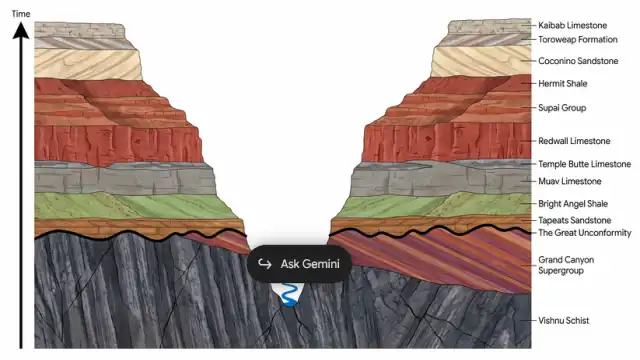
Look closely at the contact line where two totally different worlds collide:
- The Basement (Vishnu Schist): At the bottom sits pitch-black, twisted, crystalline rock laced with pink streaks of Zoroaster Granite. This rock formed roughly 1.75 billion years ago deep inside the fiery roots of an ancient mountain range. Heat and crushing pressure baked it like a brick ten miles underground.
- The Cap (Tapeats Sandstone): Resting directly on top of that jagged, vertical schist is a flat, tan, layered blanket of sandstone. Ocean waves washed this beach sand onto the coast around 508 to 525 million years ago during the Cambrian Period.
| Feature | Vishnu Basement Rocks | Tapeats Sandstone |
| Approximate Age | ~1.75 Billion Years (Paleoproterozoic) | ~508–525 Million Years (Cambrian) |
| Rock Type | Metamorphic schist & igneous granite | Sedimentary coastal sandstone |
| How It Formed | Crushed and baked miles underground | Deposited by shallow, advancing ocean waves |
| Visual Appearance | Dark, vertical, twisted stripes with pink veins | Flat, horizontal, tan-to-brown sandy beds |
Think about what had to happen between those two layers. An entire Himalayan-sized mountain range had to get pushed up, worn completely flat down to its roots, and then submerged under a rising ocean. 1.2 billion years of rock — roughly three to five vertical miles of solid crust — got ground into dust and washed away.
How scientists read erased time: Thermochronology explained
Wait a minute. If the rocks are completely gone, how on earth do geologists know when they vanished? You cannot date a rock you cannot hold, right?
Actually, scientists cracked this problem using a clever detective trick called thermochronology — literally “heat-time-telling”.
Deep inside Earth, rocks are hot. As erosion strips away surface layers, the rocks sitting underneath slowly rise toward the cool surface, like a submarine rising from the warm depths into chilly Arctic water. Tiny, microscopic crystals inside the remaining basement rock — like zircon and apatite — act like natural thermometers with built-in stopwatches.
Here is how those tiny crystal clocks work:
- Radioactive decay ticks steadily: Tiny amounts of uranium trapped inside zircon crystals decay into helium gas at a completely predictable rate.
- Heat lets the gas escape: When the rock sits deep underground at temperatures above 180°C (about 356°F), the crystal lattice stays loose, and helium leaks right out like air from a punctured tire.
- Cooling locks the clock: Once erosion removes enough overlying rock, the basement cools below that critical temperature threshold. The crystal tightens up, traps the helium, and starts the stopwatch.
By measuring how much helium sits trapped inside crystals just below the Great Unconformity, researchers can pinpoint the exact window when miles of overlying rock disappeared. According to research published in the Geological Society of America Bulletin (August 2026), combining multiple crystal clocks reveals that these basement rocks experienced repeated, kilometer-scale ups and downs across hundreds of millions of years.
Snowball Earth vs Supercontinent Tectonics
For years, geologists have argued fiercely over what scraped Earth’s crust so clean. Did giant ice sheets bulldoze the continents, or did colliding supercontinents shove the crust skyward into the path of wind and rain? In 2026, major breakthroughs in Nature and PNAS pushed this debate into overdrive.
1. The “Snowball Earth” Glacial Bulldozer Model
Around 717 to 635 million years ago, Earth froze over almost completely during two extreme ice ages known as Snowball Earth. Glaciers miles thick covered continents from the poles all the way to the equator.
Proponents of this theory argue that those massive ice sheets acted like planetary sandpaper. As glaciers crept across the land, they ground down miles of continental crust, dumping trillions of tons of pulverized rock sediment into the oceans. According to this view, all that freshly ground mineral dust flooded the seas with nutrients – like phosphorus and calcium — triggering the Cambrian Explosion of animal life right after the ice melted.
2. Supercontinent Tectonic Uplift & Deep Mantle Flow
Another camp of geologists says ice gets way too much credit. Instead, they point to plate tectonics — the slow-motion collision and breakup of massive supercontinents like Columbia (around 1.8 billion years ago) and Rodinia (around 1 billion years ago).
When continents smash together, they push crust upward into towering mountain belts. High mountains attract heavy rain and fierce rivers, which chew rock down to sea level over tens of millions of years.
Recent 2026 studies give huge weight to the tectonic side of the story:
- Ancient Supercontinent Erosion: A February 2026 study in PNAS examined basement rocks across the North China Craton and found that the heaviest erosion happened over 1.6 billion years ago during the assembly of the supercontinent Columbia — nearly a billion years before Snowball Earth even froze.
- Deep Mantle Upwelling: Even more recently, a November 2026 study in Nature by University of Wollongong geoscientists ran computer models of Earth’s churning interior. They discovered that rising plumes of hot mantle rock pushed entire continents upward over hundreds of millions of years, exposing their surfaces to relentless erosion long before shallow seas finally flooded back in.
Here is the kicker: A June 2026 follow-up analysis in PNAS warned that later burial and heating can actually “reset” some crystal clocks — meaning Snowball Earth glaciers still likely scraped off the final layer of rock on top of earlier tectonic damage.
Why the Great Unconformity matters
You might wonder why anyone outside a geology lab cares about missing rocks from half a billion years ago. Turns out, that erased chapter shaped the world you live in right now.
First, it likely built the chemistry for complex life. Whether glaciers or mountains did the heavy lifting, scraping miles of continental rock into the ocean dumped massive amounts of calcium, iron, and phosphate into seawater. Early marine organisms suddenly had the raw building blocks needed to grow hard shells, skeletons, and teeth for the very first time.
Second, it dictates where we find critical minerals and groundwater today. That flat boundary between hard, impermeable basement rock and porous sandstone acts like an underground plumbing floor. Water, oil, and mineral-rich fluids travel right along that ancient erosional surface, concentrating valuable resources in predictable zones across North America and beyond.
Next time you stand on the rim of the Grand Canyon — or look at any exposed cliff face — remember that the rocks aren’t just telling you what happened. Sometimes, the biggest story sits in the empty line between two stones, where a billion years quietly slipped away.

