
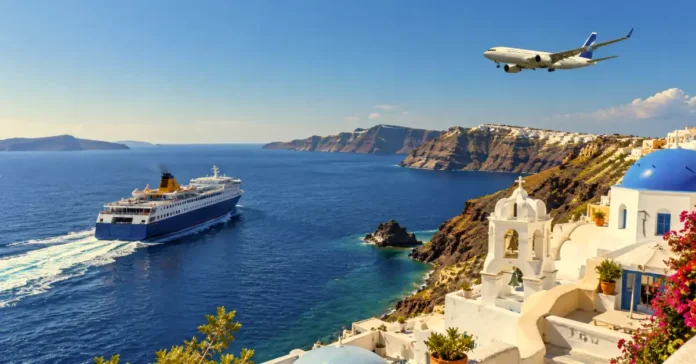
Staring at a map of the Aegean Sea usually triggers one big question: should you book a breezy boat ride or grab a quick plane ticket? Getting it wrong means losing entire vacation days to stuffy airport security lines or wrestling nausea on a choppy morning sea crossing. Here is the straight truth on choosing the fastest, cheapest, and most relaxing transit for your Greek island getaway.
Door to door time illusion
Flight times inside Greece look deceptive on paper. When an airline advertises a 45-minute flight from Athens to Mykonos, you naturally assume flying wins every single time.
Reality tells a very different story once you add up the hidden buffers.
Getting to Athens International Airport (ATH) from central districts like Monastiraki or Syntagma takes roughly 45 to 60 minutes on the Metro Blue Line (€9.00 ticket) or a €45-€60 taxi ride. Once at the airport, domestic security, bag drop queues, and boarding gate calls force you to arrive at least 90 minutes before your wheels leave the ground. After you land on an island runway, you wait another 25 minutes for baggage claim before hunting down an island taxi. That “45-minute flight” routinely burns three and a half to four hours of active transit.
Ferries run on a much simpler clock. Piraeus Port sits just 20 to 30 minutes from downtown Athens on Metro Line 1 (Green) or Line 3 (Blue) for a standard €1.20 city transit fare. You only need to show up 30 to 45 minutes prior to departure. You walk straight across the ramp, wheel your luggage onboard, drop into an outdoor cafe chair, and order an iced freddo espresso while the ferry glides out of the harbor.
When analyzing ferry vs flight greece, remember that sea travel counts as actual vacation time. You can walk outdoors on the deck, stretch your legs, feel the Mediterranean breeze, and watch dramatic white-washed cliffs drift past. On an airplane, you are strapped to a 17-inch seat counting down the minutes until landing.
Why ferries dominate the central cyclades
If your itinerary links neighboring islands like Mykonos, Paros, Naxos, Ios, Milos, and Santorini, skip the flight search engines altogether. Ferries are overwhelmingly the best way to travel greek islands in this cluster.
Why? Direct commercial flights between sister islands in the Cyclades practically do not exist. To fly from Naxos to Paros — two islands separated by barely four nautical miles of water — you would have to fly from Naxos all the way back to Athens, wait through a layover, and take a second flight down to Paros. You would waste six hours and several hundred euros on a trip that takes twenty minutes on a morning boat.

On central routes, the sea connections are swift, frequent, and breathtaking:
- Paros to Naxos: A gentle 30 to 45-minute ride on conventional boats or 20 minutes on catamarans. Fares start around €15 to €30.
- Mykonos to Paros: Just 40 to 50 minutes on high-speed vessels like SeaJets, or about an hour and a half on conventional ferries.
- Naxos to Santorini: Roughly 1.5 to 2 hours of scenic coastal cruising through the southern Cyclades.
- Milos to Sifnos: About 40 minutes on an express catamaran, letting you easily visit for a day trip.
For any journey under three hours of water travel, a boat beats a plane on price, convenience, and peace of mind every day of the week.
Athens to santorini ferry or flight?
The most hotly debated route across all travel forums is the athens to santorini ferry or flight matchup. Santorini sits on the far southern rim of the Cyclades, roughly 120 nautical miles from Athens. This is where your personal travel style determines the winner.
The case for flying to Santorini:
- Flight time in the air is 45 to 50 minutes.
- Total door-to-door transit runs roughly 3.5 hours.
- It works best if you land at Athens Airport on an international flight and can simply book a connecting domestic flight without ever entering the Athens city center.
The case for taking the ferry:
- High-speed catamarans (like SeaJets) take about 4.5 to 5 hours from Piraeus.
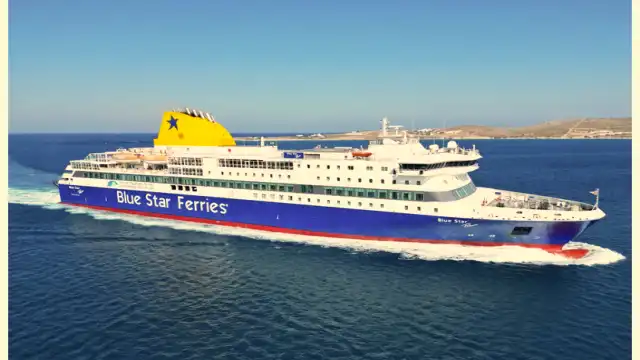
- Large conventional ferries (like Blue Star Ferries) take 7.5 to 8 hours.
- Arriving at Santorini by sea delivers one of the most stunning travel sights on earth: sailing straight into the submerged volcanic caldera while looking up at towns clinging to thousand-foot volcanic cliffs.
If you are staying in downtown Athens for a couple of nights first, taking a morning high-speed ferry gets you to Santorini in roughly the same door-to-door time as an airport run. If you have extra time and want to save money, booking an economy deck ticket on a Blue Star conventional ferry is a leisurely cruise where you can read, picnic, and unwind in the sun.
Where flights save your sanity
Are you planning to visit Crete, Rhodes, Kos, or the Ionian islands like Corfu from Athens? Book a domestic flight without hesitation.
Long-distance ferry routes eat massive chunks of daylight. Piraeus to Rhodes on a standard ship takes anywhere from 13 to 18 hours. Athens to Heraklion or Chania on Crete takes 8 to 10 hours. Unless you genuinely enjoy sleeping overnight in a private ferry cabin to save a night of hotel costs, you will surrender an entire day of your trip to open open sea.

A direct hop on carriers like Aegean Airlines or Sky Express from Athens to Heraklion takes just 50 minutes. You touch down in Crete before a morning ferry has even finished clearing the Athens coastline.
Choose flights when:
- Traveling between Athens and Crete (Heraklion, Chania, Sitia).
- Reaching the Dodecanese archipelago (Rhodes, Kos, Karpathos).
- Crossing from the mainland to the eastern Aegean (Samos, Lesvos, Chios).
- Heading to far-flung Ionian gems from the capital.
Hidden baggage fees
When comparing advertised ticket prices, beware of sneaky airline add-ons.
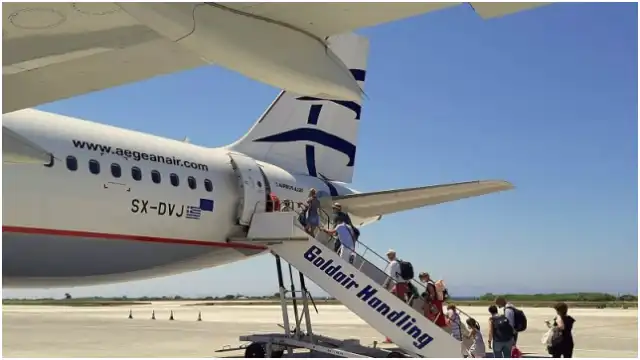
Budget domestic airfares in Greece often look like a steal at €40 to €60 one-way. Those introductory ticket tiers only include a tiny personal item or an 8-kilogram carry-on bag. Bring a standard 20-kilo rolling suitcase, and the airline will slap on checked-luggage surcharges ranging from €25 to €50 each way. If your family of three travels with checked bags, your cheap flight quickly triples in price.
Ferries handle luggage with zero drama. There are no scales, no tape measures, and no baggage fees.
Every passenger can bring up to 50 kilograms of personal gear without paying a single extra cent. When you board a Greek ferry, you walk into the garage bay, spot the luggage racks marked with your destination island’s name, stash your big bags, and carry only your daypack up to the seating decks. You skip baggage carousels completely when disembarking; just grab your bag on the way down the ramp and walk right out into the sunshine.
The summer meltemi factor
Weather plays a major role in Greek island hopping. Every summer, especially from late June through late August, strong northerly winds called the Meltemi sweep across the central Aegean Sea.
The sky stays cloudless and bright, but the winds can gust up to 35-45 knots (Beaufort scale 7 to 8). These winds create rough water that affects boats and planes in very different ways:

- High-Speed Catamarans (SeaJets, Hellenic Highspeed): These sleek vessels skim across the waves at high velocities. When the Meltemi kicks up, catamarans bounce aggressively. If you struggle with motion sickness, an agitated catamaran ride can be genuinely miserable. In severe weather (Beaufort 8 or 9), port authorities issue mandatory sailing bans, leaving fast craft stranded at the dock.
- Conventional Ships (Blue Star, ANEK, Minoan): These are massive steel vessels displacing thousands of tons. They feature heavy underwater stabilizer fins and plow through rough swells with smooth, easy rolls. Conventional boats rarely get canceled due to wind, making them the most dependable choice during peak summer storms.
- Domestic Island Flights: Planes are generally unaffected by sea swells, though high crosswinds on exposed island airstrips (like Mykonos or Milos) can occasionally trigger landing delays.
If you are traveling in July or August with an international flight home the next day, never book a high-speed catamaran for the final leg back to Athens. Choose a sturdy conventional ferry or take a flight 24 hours ahead of your departure home to ensure you make your flight.
Crunching the greek island ferry cost vs flights
How do the actual numbers stack up in your travel budget?
A typical one-way greek island ferry cost depends primarily on vessel speed and seating tier:
- Deck/Economy Ticket on Conventional Ferry: €20 to €45. Gives you free rein over outdoor benches, interior lounges, cafeterias, and deck chairs.
- Numbered Airline-Style Seat: €35 to €65. Guarantees a quiet, reserved reclining seat in an air-conditioned salon.
- High-Speed Ferry Ticket: €65 to €95. Gets you to your island in roughly half the time of standard ships.
- Private Overnight Sleeper Cabin: €80 to €150. Ideal for overnight voyages to Crete or Rhodes, doubling as a hotel room on the water.
Domestic flights range wildly based on how early you book. Snag a ticket four months in advance during promotional sales, and an Athens-to-Santorini seat might cost €45 before luggage fees. Wait until a week before departure in mid-July, and that same seat will soar past €180 to €240 one-way.
Essential Ferryhopper Greece Guide Tips
Navigating Greek maritime timetables used to require scouring broken carrier websites or negotiating paper tickets at dusty port kiosks. Today, digital booking tools make tracking sea routes straightforward.
Using a comprehensive search aggregator like Ferryhopper streamlines your island-hopping logistics:
- Verify E-Ticket Support: Most Greek ferry operators now offer digital boarding passes with QR codes sent straight to your phone. Always confirm your booking says “Web Check-in / E-ticket” so you do not have to wait in line at a port booth to print paper boarding cards.
- Watch Ferry Tracking Live: Ferries that hop across six islands often accumulate minor delays of 20 to 40 minutes as the day goes on. Use tools like MarineTraffic or the Ferryhopper live tracking feature on your travel day to see exactly where your ship is positioned before you head down to the dock.
- Know Your Departure Port: Athens has three distinct ferry ports. Piraeus connects directly to downtown Athens via the metro. Rafina sits much closer to Athens Airport and is often the faster launch point for Andros, Tinos, and Mykonos. Lavrio handles specialized routes to Kea and Kythnos. Always double-check which port your vessel sails from so you do not end up on the wrong side of Attica.
When you weigh all factors in the greek island hopping ferries vs flights debate, the winning strategy is almost always a combination of both.
Fly out to your farthest destination immediately upon arriving in Greece, island-hop between neighboring ports by ferry, and take a dependable conventional boat back toward Athens. You save cash, sidestep luggage headaches, keep your schedule safe from summer wind delays, and enjoy the sun-drenched Aegean Sea exactly as it was meant to be seen.

