

Grunch Road Monster: Inside the New Orleans Legend
Locals have whispered stories about this desolate stretch of woods for generations. They talk about glowing red eyes watching from the tree line. They warn against stopping on lonely stretches of asphalt after midnight. Most of all, they warn you about the Grunch Road Monster.
Is it a mutated swamp beast? A relic of old Voodoo curses? Or maybe just a dark tale invented to keep curious teenagers away from the marsh?
Key takeaways
- A Bayou Hybrid: Witnesses describe the Grunch as a terrifying cross between a leathery, spined Chupacabra and an upright, horned goat-man.
- Shifting Geography: While the original “Grunch Road” was isolated near Little Woods in New Orleans East, rural roads in Montz and Metairie also inherited the haunting legend.
- Dark Origins: Local lore ties the creature to everything from ostracized circus performers making pacts with the Devil to the legendary Voodoo Queen Marie Laveau.
- The High School Ritual: Generations of Louisiana teenagers tested their bravery by parking on remote railroad tracks, honking three times, and trying to outrun the beast.
- Post-Katrina Sightings: After Hurricane Katrina devastated the region in 2005, reports surged of displaced creatures roaming abandoned golf courses and Lakeview neighborhoods.
What Exactly Is the Grunch Road Monster?
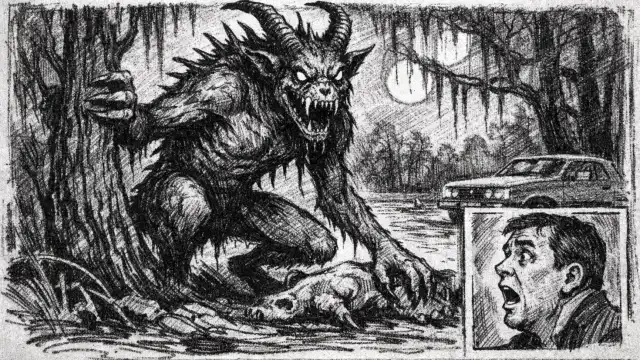
New Orleans has never lacked spooky stories. You have vampires in the French Quarter, ghosts haunting antebellum mansions, and the shapeshifting Rougarou stalking the Cajun prairies. But the Grunch feels different. It belongs to the urban fringes — those weird, neglected borderlands where city sprawl collides with wild swamp.
Cryptozoologists often struggle to categorize the Grunch. Some classify it as a local variation of the Chupacabra. Others see it as a classic American “goat-man.” If you gather up eyewitness reports dating back to the early 1800s, a truly nightmare-inducing anatomy emerges.
The Terrifying Physical Features
- Height and Stance: The creature stands anywhere from three to six feet tall. It walks on all fours when hunting, but rears up on double-jointed, goat-like legs when threatened.
- Reptilian Skin: Forget thick fur. Most witnesses report tough, leathery, blackish-grey skin that resembles an alligator’s underbelly.
- Razor-Sharp Spines: Severe, jagged quills or spines run down the back of its neck straight to the tip of a whip-like tail.
- Humanoid Hands: Unlike a regular wolf or coyote, the beast possesses long, muscular arms ending in four clawed fingers and an opposable thumb. It can turn doorknobs, unlatch gates, and manipulate tools.
- Hypnotic Eyes: Its eyes glow brightly in the dark, shifting between infernal orange-red and an eerie bioluminescent blue-green.
- The Stench: You usually smell the Grunch before you see it. A rotting, sulfurous odor fills the air whenever the monster draws near.
What makes this beast truly dangerous is its brain. It does not just blindly attack anything that moves. Witnesses claim the creature mimics human cries — especially the heartbreaking sound of a weeping child or a injured woman — to lure good Samaritans deep into the brush. Once the victim steps off the road, the ambush begins.
Where Is the Real Grunch Road?

Ask five different people in Southeast Louisiana where Grunch Road actually sits, and you will get five different directions. That geographic confusion is part of what makes the myth so resilient.
Historically, researchers trace the “true” Grunch Road to a forgotten, dead-end shell road in eastern New Orleans near the community of Little Woods. Decades ago, before Interstate 10 carved through the region, this area was a remote wilderness of tall water oaks, ferny undergrowth, and murky drainage canals running off Hayne Boulevard. It was the absolute edge of civilization. If your car broke down out there in 1950, you were entirely on your own.
As New Orleans expanded and suburban housing developments swallowed up the old dirt lanes, the legend packed its bags and moved.
By the 1970s, teenagers adopted isolated dirt tracks across surrounding parishes as their own local “Grunch Roads.” Evangeline Road out in Montz became a infamous hotspot. Other kids pointed toward dark stretches of Metairie, Chalmette, and even rural St. Charles Parish. Any road that felt narrow, unlit, and swallowed by swamp canopy qualified as hunting grounds.
Three Dark Origin Stories of the Grunch
How does a creature like this come into existence? Folklore thrives in the gaps of recorded history. Over the past two centuries, three distinct origin stories have emerged to explain why a horned, blood-drinking terror prowls the Louisiana wetlands.
1. The Outcasts and the Devil’s Pact
The most disturbing origin story dives deep into the cruelty of human society. Back in the nineteenth century, New Orleans was a harsh, stratified port city. According to local lore, a group of sideshow performers, albinos, and severe burn victims were driven out of the city limits by fearful, superstitious residents.
Forced into the harsh swamplands of eastern New Orleans, these outcasts built a secretive community on the fringes. People called them the “Grunch People.” They lived in extreme poverty, enduring endless harassment from cruel city dwellers who ventured into the woods just to throw rocks and torment them.
Desperate for protection, the elders of the outcast clan allegedly turned to dark magic. They forged a pact with the Devil. They traded their eternal souls for a guardian entity that would keep outsiders out of their woods forever. Hell answered by molding the surrounding swamp mire and animal bones into the terrifying Grunch. The guardian did its job too well. It slaughtered trespassers with extreme prejudice, eventually outliving the very people who summoned it.
2. Marie Laveau and the Curse of the Devil Baby
No New Orleans ghost story feels complete without mentioning the legendary Voodoo Queen, Marie Laveau. This version of the legend reads like gothic horror.
An old bayou tale claims that a desperate woman gave birth to a cursed, demonic infant known as the Devil Baby. Realizing the unimaginable evil entering the world, Laveau intervened. She castrated the demonic child at birth to stop it from ever breeding more of its wicked kind.
When the severed organs hit the floorboards, black magic reacted violently. The flesh morphed into two grotesque hybrids — a male and a female Grunch. The newborn demons immediately turned on Laveau. They mauled the powerful Voodoo Queen, biting and scratching until she fainted from blood loss. By the time she regained consciousness, the beasts had vanished into the cypress swamps. Many believers argue that every Grunch roaming the bayou today descends directly from that unholy pair.
3. The Corrupted Farm Animal
A more grounded, rustic theory suggests the creature started out as ordinary livestock. Early settlers along the Mississippi River raised goats, cattle, and pigs. Sometimes, deformed animals were born.
Instead of putting down a severely mutated goat, a superstitious farmer allegedly abandoned the creature deep in the marshes. Surviving on polluted swamp water, raw carrion, and isolation, the animal grew twisted and aggressive. It developed sharp fangs, learned to hunt on two legs, and developed an insatiable craving for warm blood.
Late-night high school ritual
Urban legends rarely survive on campfire talk alone. They need participation. Throughout the 1970s, 1980s, and 1990s, searching for the Grunch became a rite of passage for high school seniors across Southeast Louisiana.
On bored Friday nights, kids crammed into station wagons and muscle cars, holding cheap flashlights and six-packs of beer. They drove out to the darkest, most unpaved railroad crossing they could find along Evangeline Road or out near the old bayou levees.
To summon the beast, you had to follow a strict, terrifying ritual:
- Park on the Tracks: Pull your vehicle directly over the wooden railroad ties and kill the engine.
- Cut the Lights: Plunge the car into absolute, pitch-black darkness.
- Sound the Alarm: Honk the steering wheel horn exactly three times.
- The Bravery Test: The driver — or whoever lost a bet — had to step out of the car, leave the door open, and sprint around the vehicle three complete times without stopping.
According to the rules of the dare, executing this sequence drew the creature out of the brush. Most teenagers never made it past the second lap around the car. The suffocating silence of the swamp, interrupted only by the distant croak of bullfrogs and the snapping of pine twigs, usually triggered panic. Kids would scramble back across the vinyl seats, slam the locks, tear the ignition, and burn rubber all the way back to the illuminated safety of the main highway.
Hurricane Katrina and the Modern Resurgence
Did modern smartphones and GPS tracking finally kill the Grunch? Quite the opposite. The legend experienced a massive resurgence following the absolute devastation of Hurricane Katrina in August 2005.
When levees failed and floodwaters submerged 80 percent of New Orleans, entire ecosystems were flipped upside down. Alligators swam through residential living rooms. Water moccasins nested in flooded attics. The human population evacuated, leaving vast neighborhoods empty, dark, and silent for months.
During this eerie post-storm era, animal control workers and returning residents reported strange encounters. People cleaning out gutted homes in Lakeview and Gentilly claimed they spotted hunched, hairless, dog-like beasts darting through overgrown backyards.
Out on the abandoned, weed-choked golf courses of City Park, sanitation workers reported seeing aggressive creatures chasing stray cats and knocking over heavy municipal trash cans. Because these post-Katrina beasts appeared mangy, leathery, and desperate for food, locals immediately revived the old moniker. The Grunch was no longer confined to the remote woods of New Orleans East. The hurricane had flushed the monsters straight into the city suburbs.
Fact vs Fiction: What are people actually seeing?
Let’s step out of the fog for a second and look at the cold facts. Can a horned, blood-sucking reptile-goat actually exist in Louisiana? Science says no. But that does not mean eyewitnesses are outright lying. The Louisiana swamp is a master of visual deception.
Misidentified Bayou Wildlife
- Coyotes with Sarcoptic Mange: When a coyote contracts severe mange, its hair falls out completely. Its skin turns grey, thickened, and heavily wrinkled. It scratches constantly, creating open wounds. A hairless, starving coyote rearing up on its hind legs to grab food from a dumpster looks eerily like a demonic cryptid.
- Feral Hogs: Wild boars roam the Louisiana woods in massive numbers. They possess sharp tusks, bristly spines along their backs, and glowing eyes when caught in headlights. A massive boar crashing through brush sounds like a monster.
- Alligators in Transit: Alligators occasionally walk high on their legs across roadways between waterways. In poor lighting, the silhouette of a scaly, armored body moving swiftly across dirt tracks can easily confuse a startled driver.
Psychology of the Edge
Folklore expert and historians often point out that monsters like the Grunch serve a vital psychological function. Look at where sightings happen: geographic borders.
The creature thrives right where urban safety ends and untamed wilderness begins. These stories act as cultural boundary markers. Parents told their children about blood-drinking swamp demons for a very practical reason — to keep kids from wandering into deep, alligator-infested waters or falling into hidden drainage ditches after sundown. Fear is a fantastic babysitter.
Furthermore, the “Grunch People” origin story reflects historic anxieties about outsiders. Society has always projected its deepest fears onto marginalized communities living on the fringes. By turning outcasts into literal monsters, cities justified their own prejudices while creating a thrilling ghost tale in the process.
Why Louisiana Needs Its Monsters
If you walk into a French Quarter coffee shop today and mention the Grunch Road Monster, you might get a chuckle from the barista. But bring it up at a gas station out near the swamp at 2:00 AM, and the room goes completely quiet.
That dual reaction captures the magic of Louisiana storytelling. This state loves its dark corners. While modern cities bulldoze over their history and pave over their woods, New Orleans clings tightly to its shadows. Whether the Grunch is a misidentified mangy coyote, a lingering Voodoo spirit, or a shared hallucination born from swamp fog, it keeps the landscape feeling wild.
Next time you find yourself driving down a narrow, unpaved shell road on the outskirts of New Orleans, turn down your radio. Look out the passenger window toward the tree line. If you see two red eyes glowing back at you from the Spanish moss, don’t stop to honk your horn. Just step on the gas and keep driving.
Have you ever braved a dark Louisiana road at night? Do you think swamp cryptids are real biological anomalies, or just clever stories meant to scare us? Drop your thoughts, local legends, and terrifying road trip experiences in the comments below!

