

Stuck on a wooden ship in the middle of the Atlantic Ocean in 1875. Suddenly, the water erupts. A massive, snake-like beast wraps itself around a sperm whale, dragging the ocean titan into the crushing depths. Sounds like a pirate’s fever dream, right? But this exact scene sparked one of the biggest maritime controversies of the Victorian era. The mystery of the Barque Pauline sea serpent gripped the world when the crew swore under oath in 1877 that they had witnessed a real-life leviathan. Was it a surviving prehistoric monster? A giant squid? Or just floating trash playing tricks on tired minds?
At a glance
- The Sightings: In July 1875, the crew of the British ship Barque Pauline reported seeing a colossal sea serpent attacking a sperm whale off the coast of Brazil.
- The 1877 Frenzy: The story exploded in January 1877 when Captain George Drevar and his crew filed legal affidavits in a Liverpool court to prove they were not lying.
- The Tragic End: The obsession ruined Captain Drevar. He ended up on trial at the Old Bailey in 1881 for threatening a government official over the sea monster debate.
- Modern Explanations: Marine biologists today suspect the “serpent” was either the flailing tentacle of a giant squid or discarded fishing gear wrapped around a dying whale.
A Routine Voyage Turned Nightmare
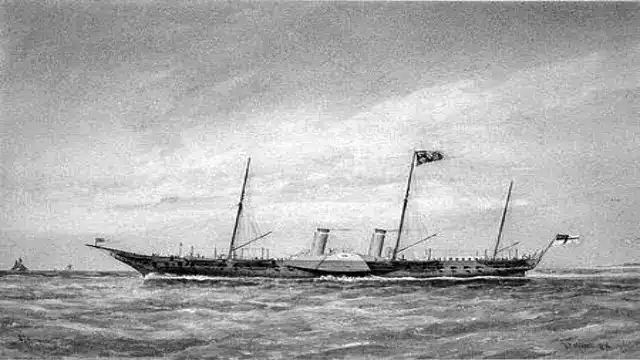
Before we dive into the courtroom drama of 1877, we need to talk about the event that started it all. The date was July 8, 1875. Captain George Drevar was navigating the British merchant ship Barque Pauline near the northeastern coast of Brazil. The weather was decent. The crew was going about their daily chores.
Then, the ocean surface shattered.
About twenty miles off the coast, the crew spotted three sperm whales. Sperm whales are absolute units. They can grow up to 60 feet long and weigh 45 tons. Taking one down requires serious firepower. Yet, one of these massive whales was in the fight of its life.
The Battle of the Titans
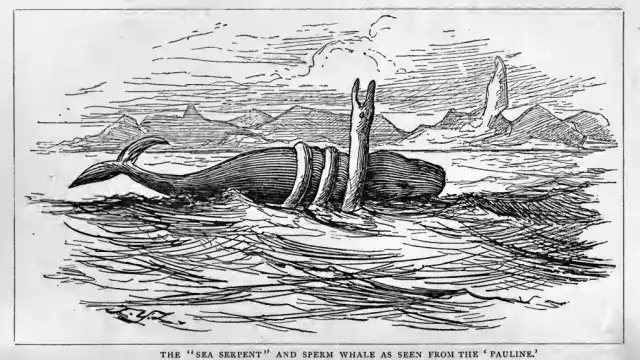
According to the ship’s log, a massive, snake-like creature had coiled itself tightly around the midsection of one whale. Captain Drevar watched in horror through his spyglass. He noted that the beast wrapped around the whale twice. The serpent’s head and tail stuck out a full 30 feet beyond the coils.
This was no quick ambush. The brutal wrestling match lasted for about 15 minutes.
The serpent squeezed. The whale thrashed. The combatants repeatedly sank beneath the waves and exploded back up to the surface, churning the ocean into a white foam. Finally, the serpent won. The monstrous snake dragged the whale down into the pitch-black depths.
Imagine standing on a creaky wooden deck watching a 45-ton whale get wrestled to death by a snake. You would probably question your own sanity. But the crew of the Pauline backed up their captain. They had all seen it.
60 Feet in the Air
If you thought the monster got its fill and took a nap, think again. Five days later, on July 13, the serpent came back.

Captain Drevar and an ordinary seaman spotted a similar snake-like creature about 200 yards from the ship. It was shooting along the surface of the water, its head and neck raised several feet in the air. A few moments later, the ship’s chief officer and several able seamen witnessed something even crazier. The serpent thrust itself completely upright, towering an estimated 60 feet perpendicularly out of the sea.
That is roughly the height of a six-story building. Just hovering above the water.
The 1877 Media Frenzy
Sailors seeing weird stuff is an old trope. Back then, if you claimed you saw a sea monster, people laughed at you. You were dismissed as drunk, sun-baked, or just spinning a good yarn. Captain Drevar hated being laughed at.
He wanted his story taken seriously. He wanted absolute proof.
So, on a chilly Wednesday in January 1877, Drevar marched his crew into the Liverpool Police Court. Standing before a magistrate named Mr. Raffles, the captain, his officers, and his crew swore legally binding affidavits confirming exactly what they saw. They placed their sea monster officially on the judicial record.
Why the Story Shook Victorian England
The 1877 affidavits changed the game. Suddenly, this was not just a pub story. It was a sworn legal document from seasoned British sailors.
Newspapers devoured the scoop. Publications like the Liverpool Journal and The Illustrated London News ran wild with the tale. On January 27, 1877, a popular magazine called The Graphic even published Drevar’s own terrifying sketches of the beast. The public went nuts. The Barque Pauline incident became the benchmark for sea serpent sightings.
Libel, Courtrooms, and Ruined Reputations
You would hope Drevar got a nice book deal and retired. He didn’t. The sea serpent sighting essentially cursed him.
Drevar became obsessed with proving his sanity. His fierce defense of the creature made him enemies in high places. Later in his career, he survived a completely unrelated shipwreck. During the official inquiry into that wreck, he clashed violently with Henry Cadogan Rothery, the Commissioner of Wreck. The dispute was partially fueled by the government’s mockery of his sea monster claims.
Things escalated. By 1881, Drevar found himself standing trial at London’s infamous Old Bailey criminal court. He was charged with libel and threatening to murder Rothery. The captain had sent unhinged letters demanding respect for his nautical record — and his serpent. He was convicted and sentenced to prison. The beast he saw in the Atlantic ultimately dragged his career into the depths, just like it did that whale.

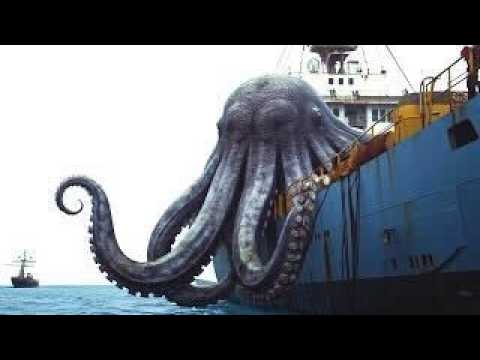
This video is highly relevant because it explores historical accounts of massive deep-sea creatures, including the 1875 St. George’s Bank Monster, which perfectly mirrors the giant squid theories surrounding the Barque Pauline incident.
Modern Science Weighs In
So, what did the crew of the Barque Pauline actually see? We know they saw something. You don’t drag your whole crew into a courtroom to commit perjury for a joke.
Let’s strip away the 19th-century superstition and look at the hard biology.
The Giant Squid Hypothesis
The ocean is terrifyingly deep and hides real monsters. One of the best explanations for the Pauline serpent is Architeuthis dux — the giant squid.
Giant squids can reach lengths of 40 to 50 feet. They have eight thick arms and two incredibly long feeding tentacles. These creatures naturally hunt in the deep ocean, but their biggest predator is the sperm whale. Sperm whales regularly dive thousands of feet to battle giant squids in the dark.
Usually, the whale wins. We know this because scientists frequently find giant squid beaks in whale stomachs, and massive sucker scars raked across whale skin.
But what if the Pauline crew witnessed a rare surface battle? If a giant squid threw its massive tentacles around a whale, those long, fleshy appendages would look exactly like a serpent. Furthermore, a squid tentacle has a wider “club” at the end. From 200 yards away, a flailing tentacle club easily looks like a snake’s head.
When the serpent “towered 60 feet in the air,” it could have been a desperate squid shooting its tentacles upward, or a whale throwing the dead squid around.
The Marine Debris Theory
There is another, slightly more depressing theory. Dr. Robert France, an ecologist at Dalhousie University, spent years digging through historical sea monster reports. He believes he solved the Barque Pauline mystery without using cryptids at all.

His theory? The crew watched a dying whale tangled in old fishing gear.
Dr. France points out that sailors often “fill in the blanks” when they see something weird at sea. Our brains are hardwired to recognize faces and animal shapes — a psychological trick called pareidolia. If a whale got heavily tangled in ropes, nets, and large floating buoys, it would panic. It would thrash wildly on the surface.
To a sailor watching from a distance, a long trail of rope dragging behind a whale looks like a tail. A string of bobbing buoys looks like a spiked spine. A floating barrel caught in the mess looks like a head. The 15-minute “battle” Drevar witnessed might have just been the tragic final moments of a whale drowning under the weight of heavy marine debris.
Sea Monster Myths
Whether it was a giant squid or a mess of fishing ropes, the Pauline monster proves one thing: we desperately want the ocean to be magic.
We have mapped the entire surface of Mars, yet we have explored barely 5% of our own ocean floor. The abyss is the last great frontier on Earth. When we hear stories about 60-foot serpents crushing whales, a part of us wants it to be true. It reminds us that nature is still untamed. It reminds us that out past the coastal drop-offs, the rules change.
The ocean does not care about our science or our shipping lanes. It keeps its secrets.
Barque Pauline Encounter
We will never know with 100% certainty what breached the surface off the coast of Brazil in July 1875. Captain Drevar took his truth to the grave, his reputation shattered by a society that refused to believe him.
Was he a madman? Probably not. He was just a guy trying to explain the unexplainable using the only vocabulary he had. He did not have submersibles or underwater cameras. He only had his spyglass, his crew, and his honor.
Today, the Barque Pauline remains a masterclass in nautical history. It sits perfectly at the crossroads of folklore, cryptozoology, and modern marine biology. It forces us to ask what else is swimming around down there in the dark.
What do you think Captain Drevar saw that day? A prehistoric survivor, a giant squid, or just a trick of the light? Drop your best theories in the comments below, and share this article with your favorite cryptid-loving friend!

