

Have you ever looked up at the night sky and wondered if it was just a giant, high definition screen? Maybe you experienced a bizarre coincidence and jokingly blamed it on a “glitch in the matrix.” Interestingly, that casual joke is rapidly evolving into a serious scientific debate among researchers. Are we actually living in a simulation? Could our entire reality just be a highly advanced video game played by some hyper intelligent being in another dimension?
Obviously, it sounds completely absurd at first glance. Yet, some of the brightest minds in physics are currently scratching their heads at how our universe behaves. Specifically, they keep bumping into fundamental physical laws that operate exactly like computer code. Therefore, this article breaks down five scientific “glitches” that make seasoned researchers wonder if we are simply lines of rendering data. And don’t worry I will keep the heavy, confusing jargon out of this. Think of this as a casual chat with a friend about the underlying fabric of our universe. Let’s dive right in.
1. The Double-Slit Experiment: Reality Only “Renders” When You Look
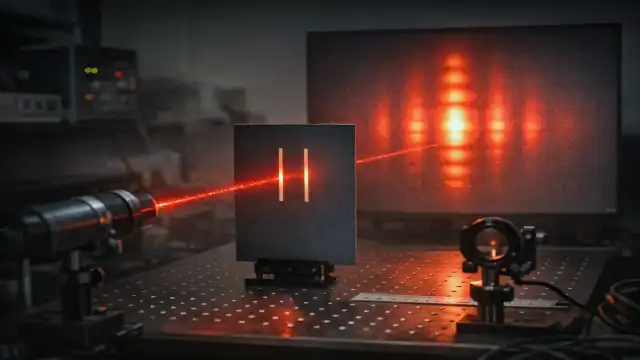
If you want to break a physicist’s brain, just bring up the double-slit experiment. Essentially, this famous quantum physics test reveals that the building blocks of our universe (like electrons and photons) change their behavior based on whether or not someone is watching them.
How the Experiment Works
Imagine you are shooting paintballs through a wall that has two vertical slits cut into it. Naturally, you would expect the paint to hit the canvas behind the wall in two distinct, vertical bands. For decades, scientists expected microscopic particles to do the exact same thing. However, when they fired single electrons through two microscopic slits, the particles did not form two bands. Instead, they created a complex “interference pattern,” which is the exact pattern a wave of water would make.
Consequently, scientists realized that a single physical particle was somehow moving like a wave, passing through both slits at the same time, and interfering with itself. Wild, right?
The Mind-Bending Result
To figure out what was happening, researchers placed a tiny detector next to the slits to observe which hole the electron actually went through. Suddenly, the universe changed the rules. The moment the detector was turned on, the electron stopped acting like a wave. It behaved exactly like a normal particle, creating two simple bands on the back wall. Ultimately, the mere act of observing the particle forced it to pick a solid state.
The Simulation Connection
So, how does this point to a simulated reality? Think about an open world video game like Minecraft or Grand Theft Auto. To save processing power, the game engine does not render the entire virtual world all at once. Furthermore, it only generates the specific trees, buildings, and textures that your character is actively looking at. Everything behind you is essentially stored as raw, un-rendered mathematical data.
Similarly, the double-slit experiment suggests that our universe might be conserving computing power. Unobserved particles exist in a fuzzy cloud of probabilities. Then, the moment a conscious observer (or a piece of measuring equipment) looks at them, the system quickly “renders” the particle into a fixed location. Is the universe just saving RAM?

2. The Speed of Light: The Cosmic Processing Limit

We all know that the speed of light is incredibly fast. Specifically, light travels at a staggering 186,282 miles per second (299,792 kilometers per second) in a vacuum. According to Albert Einstein’s theory of relativity, this speed represents the absolute maximum speed limit of the universe. Absolutely nothing can travel faster than light. But have you ever stopped to ask why?
A Universal Speed Limit
In a purely physical, infinite universe, you might assume that if you applied enough energy to an object, it could just keep accelerating forever. However, the laws of physics violently forbid this. As an object moves faster and approaches the speed of light, its mass increases, and the time around it literally slows down. Eventually, it requires an infinite amount of energy to push an object past that ultimate speed barrier.
The Simulation Connection
Why does reality have a hard-capped speed limit? Well, let’s look at how computers work. Every computer processor has a maximum clock speed. It can only transmit data and perform calculations so fast. If you try to force a computer to process information faster than its hardware allows, the system lags, glitches, or completely crashes.
From a simulation theory perspective, the speed of light is not just a random physical boundary. Rather, it is the maximum processing speed of the cosmic computer we live inside. Information in our universe cannot travel faster than (the speed of light) because the central processor of our reality simply cannot calculate data any faster than that. Therefore, time dilation where time slows down for objects moving at extreme speeds might just be the universe’s version of video game lag.
3. Computer Code Hidden in String Theory
This glitch is arguably the most literal piece of evidence for a simulated universe. Theoretical physics is constantly trying to find a “Theory of Everything” that perfectly explains all the forces in nature. String theory is one of the leading candidates, and a subset of it is known as supersymmetry.
Discovering the Code
While deeply studying the complex math behind supersymmetry, renowned theoretical physicist Dr. Sylvester James Gates Jr. stumbled upon something that absolutely defied logic. Hidden deep within the equations that describe the fundamental particles of our universe, he found actual, literal computer code.
What is an Error-Correcting Code?
Specifically, Dr. Gates discovered what computer scientists call “doubly-even self-dual linear binary error-correcting block codes”. That is a ridiculously long name, but the concept is easy to grasp. When your laptop sends a file over the internet, or when you load a web page on a browser, there is a risk that static or interference could scramble the digital data. To prevent your photos from looking corrupted, software engineers write error-correcting codes into the system. These codes act like digital proofreaders, instantly catching and fixing data errors so the system doesn’t crash.
The Simulation Connection
Dr. Gates found the exact same error-correcting codes embedded into the mathematical fabric of our physical reality. Why on earth would the natural universe need built-in autocorrect? If reality is just a random collection of rocks and gas, it shouldn’t require data protection algorithms. Conversely, if the universe is a digital simulation running on a highly advanced quantum network, it would absolutely need error-correcting codes to prevent the laws of physics from degrading over time. Nature, it seems, has its own IT department.

4. The Fine-Tuned Universe: Goldilocks’ Cosmic Settings
Imagine you are baking a cake. If you accidentally add an extra teaspoon of flour, the cake might be a little dry, but it is still fundamentally a cake. Now, imagine a cake recipe so insanely sensitive that if you add a single extra molecule of sugar, the entire kitchen explodes. That is exactly how our universe operates.
The Cosmological Constant
Physicists refer to this phenomenon as the “fine-tuned universe.” Our reality is governed by a set of fundamental physical constants such as the strength of gravity, the mass of electrons, and the strong nuclear force. Surprisingly, these numbers are not just a little bit lucky; they are balanced on a razor’s edge.
Take the cosmological constant, which dictates the rate at which the universe expands. According to theoretical physicist Paul Davies, if this constant were altered by even an unfathomably tiny fraction, the results would be catastrophic. If gravity were just slightly stronger, all the stars and galaxies would have violently collapsed back into a giant black hole moments after the Big Bang. On the other hand, if gravity were slightly weaker, matter would have flown apart so fast that stars and planets could never have formed. In both scenarios, life is completely impossible.
The Simulation Connection
The mathematical odds of all these physical constants randomly landing on the exact perfect numbers to allow for carbon based life are virtually zero. It is similar to winning the lottery every single day for a billion years. Consequently, many tech enthusiasts and philosophers point to simulation theory as the most logical explanation.
If you are a software developer building a virtual reality simulation, you actively tweak the environmental settings. You drag the “gravity” slider down a bit, and you adjust the “nuclear force” slider up a bit, until your simulation successfully boots up and creates a stable environment. The fine-tuning of the universe strongly mimics the deliberate parameter setting of a massive software program.
5. The Second Law of Infodynamics: Nature’s Data Compression
Let’s talk about something incredibly recent. In 2022, Dr. Melvin Vopson, a physicist at the University of Portsmouth, published a mind-blowing study that introduced a brand new law of physics. He called it the “Second Law of Information Dynamics” (or Infodynamics).
What is Infodynamics?
To understand why this is a massive deal, we first need to look at normal thermodynamics. The Second Law of Thermodynamics states that the entropy (which is a fancy word for chaos or disorder) in an isolated system will always increase over time. For example, a hot cup of coffee will eventually cool down, and an abandoned building will eventually crumble. Physical things naturally break down into chaos.
However, Dr. Vopson wanted to know how information behaved. He predicted that information would also become more chaotic over time. Astonishingly, his research proved the exact opposite. When looking at information systems like the genetic mutations of the COVID-19 virus or atomic structures the entropy of information actually decreased or remained constant.

The Simulation Connection
Why does information naturally organize itself and reduce its own complexity? Vopson realized that the universe is actively minimizing the amount of information it needs to store.
Think about your smartphone. When you are running out of storage space, you might use a program to compress your large files into a smaller ZIP folder, deleting duplicate data to save memory. According to Vopson’s findings, the universe is doing the exact same thing. It systematically erases unnecessary informational data to optimize itself.
Dr. Vopson himself stated that a highly complex universe like ours would absolutely require a built-in data optimization mechanism if it were a digital simulation. Otherwise, the simulation would eventually run out of computational storage. The discovery of the Second Law of Infodynamics acts as powerful, measurable evidence that the universe routinely compresses data just like a MacBook.
So, Are We Really Just Avatars?
Let’s take a deep breath. At this exact moment, scientists cannot definitively prove that we are living in a simulation. We can’t simply hack into a cosmic command prompt and type “Exit.”
Nevertheless, the clues left behind by the double-slit experiment, the speed of light limit, error-correcting string theory codes, a perfectly fine-tuned cosmos, and universal data compression are incredibly hard to ignore. Physics is increasingly starting to sound less like studying rocks and planets, and far more like reverse-engineering complex software.
Whether we are biological accidents wandering through a vast, physical cosmos, or advanced AI avatars rendering our way through a sprawling digital matrix, the reality we live in is undeniably magical. Perhaps the creator of the universe is a divine deity, or perhaps it is an alien software engineer sipping virtual coffee while watching us try to figure out their code.
What do you think? Are these scientific glitches pure coincidence, or is there a cosmic computer running our lives? Let us know your thoughts in the comments below, and don’t forget to share this article with that one friend who is always talking about the Matrix!
Sources help:
- https://users.cms.caltech.edu/~owhadi/index_htm_files/IJQF2017.pdf
- https://onbeing.org/programs/s-james-gates-uncovering-the-codes-for-reality/
- https://en.wikipedia.org/wiki/Fine-tuned_universe
- https://www.templeton.org/news/what-is-fine-tuning
- https://pubs.aip.org/aip/adv/article/13/10/105308/2915332/The-second-law-of-infodynamics-and-its

