

Inside the groundbreaking AWARE II research on near-death experiences and consciousness after cardiac arrest.
What exactly happens when we finally kick the bucket? Honestly, humans have obsessed over this profound question since the dawn of time. Religions offer beautiful promises of an afterlife. Philosophers continually debate the terrifying concept of nothingness. Meanwhile, modern society usually treats death as a taboo topic. Traditionally, we simply assumed passing away was just “lights out.” You take your last breath, your heart stops pumping, and the show instantly ends. But what if that assumption is completely wrong?
Recently, researchers decided to stop guessing and start measuring. Enter Dr. Sam Parnia and his groundbreaking scientific project. Specifically, we are talking about the famous AWARE studies. Basically, this medical research takes the mystical, often spooky concept of a near-death experience (NDE) and puts it directly under a microscope. Therefore, we finally have hard data to look at. And trust me, the results will absolutely blow your mind.
If you are a science enthusiast, a deeply curious thinker, or just an everyday person trying to wrap your head around mortality, you are in the exact right place. Today, we are breaking down the biggest findings from the AWARE and AWARE II studies. Let’s dive right in.
What Does It Actually Mean to Die?
To fully understand these discoveries, we first need to rethink how we view death itself. Growing up, most of us learned that dying is a single, unchangeable moment. For instance, a patient flatlines on a hospital monitor, a doctor calls the time, and it is over.
In reality, biology tells a much different story. Death is actually a gradual process. According to the World Health Organization (WHO), clinical death occurs when the heart and lungs cease functioning. Consequently, life giving oxygen stops flowing to the body. If doctors try to reverse this via CPR, the condition is called cardiac arrest. However, if those resuscitation attempts ultimately fail, we then declare the person legally dead.
For decades, physicians firmly believed the brain suffered irreversible damage within ten minutes of oxygen deprivation. Once blood flow stops, the brain supposedly shuts down entirely. As a result, any mystical memories or visions reported by survivors were quickly dismissed. Doctors usually chalked them up to hallucinations, drug side effects, or oxygen starved neurons firing wildly.
Yet, Dr. Sam Parnia, a critical care physician at NYU Langone Health, strongly suspected otherwise. Consequently, he set out to objectively explore human consciousness on the brink of eternity.
AWARE I: The First Scientific Glimpse Behind the Curtain
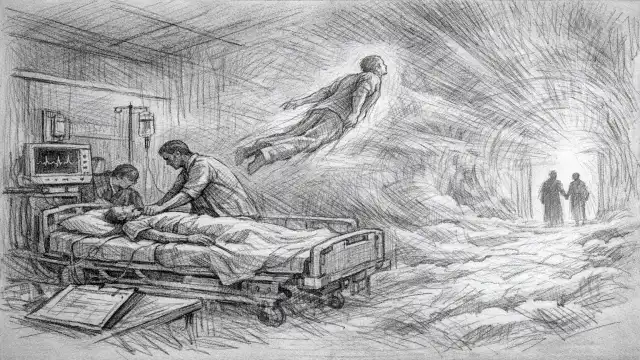
Back in 2008, Parnia launched the very first AWAreness during REsuscitation (AWARE) study. Eventually, the mind bending results were published in the medical journal Resuscitation in October 2014. This massive project tracked 2,060 cardiac arrest patients across 15 hospitals in the US, UK, and Austria.

Interestingly, the team discovered that a significant chunk of survivors experienced something profound. Out of the patients who survived and completed interviews, 39% reported a perception of awareness. Despite being clinically dead, their minds were still mysteriously active. Furthermore, they did not have any explicit, clear recall of specific events. This strongly suggests that trauma or sedative drugs may wipe the memory clean after recovery.
On the other hand, 46% of those who remembered their brush with death described experiences that completely broke the mold. They did not just see the cliché “light at the end of the tunnel.” Instead, their recollections were incredibly diverse.
- Fearful visions: Some patients felt intense panic or a terrifying sense of drowning.
- Familiar faces: Others vividly saw deceased family members.
- Peaceful sensations: Many reported an overwhelming feeling of calm and warmth.
- Out-of-Body Experiences (OBEs): A small fraction (roughly 2%) felt like they literally floated above their own bodies.
One specific case even validated an OBE. A 57 year old man accurately described the sounds of an automated external defibrillator (AED) and the exact actions of the nursing staff. Surprisingly, his conscious memory perfectly matched a three minute window when he objectively had no heartbeat. How is that even logically possible?
AWARE II: Hooking the Dying Brain to the Matrix
Naturally, science never stops asking questions. While AWARE I was groundbreaking, critics demanded more concrete evidence. As a result, Parnia and his global team leveled up their methodology. Thus, the AWARE II study was born.
Running from May 2017 to March 2020, this second phase closely monitored 567 cardiac arrest patients. This time around, the researchers were not just relying on interviews after the fact. Instead, they brought cutting edge technology directly into the emergency room chaos.
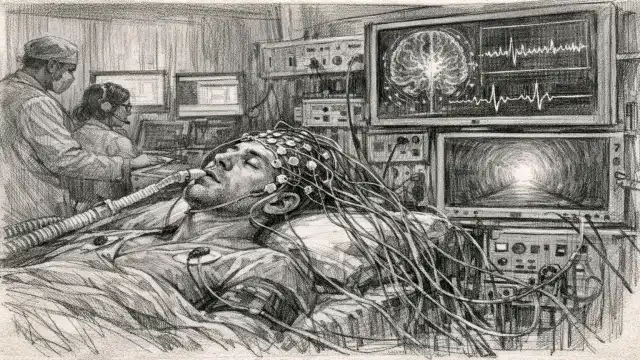
Whenever a “Code Blue” was called, researchers rushed in alongside the medical staff. Instantly, they attached electroencephalogram (EEG) sensors to the patient’s forehead. Simply put, an EEG is a device that tracks electrical signals in your brain. Additionally, they placed a cerebral oximeter on the patient to track brain oxygen levels.
Furthermore, they set up a clever test to check for out of body experiences. The team placed tablets displaying specific hidden images on high shelves, facing the ceiling. Simultaneously, they put headphones on the patients, playing audio clips of words like “apple, pear, banana.” The goal was incredibly clear. If a patient actually floated out of their body, could they see the hidden image or hear the secret words?
The Mind Blowing Discoveries of 2023
In September 2023, the much anticipated AWARE II findings finally dropped in the journal Resuscitation. Honestly, the data shook the medical community to its core. Even though fewer than 10% of the 567 patients survived to go home, the EEG readings from the 85 heavily monitored patients told a wild story.

1. Gamma Wave Fireworks in a Flatlined Brain
Unbelievably, nearly 40% of monitored patients showed brain activity returning to normal, or near normal, at various points during CPR. Specifically, the EEG machines picked up surges of Gamma, Delta, Theta, Alpha, and Beta waves.
In a healthy, awake person, Gamma waves are linked to high level thinking, memory retrieval, and conscious perception. They are the electrical signatures of a brain actively solving problems. Therefore, seeing these waves in a pulseless person is shocking. These high level brainwaves were firing up to an hour after the patients’ hearts stopped. Biologically, the brain is supposed to be fully offline and silent. Yet, the data showed a literal neurological fireworks display in the midst of death.
2. Awake While Unconscious
Moreover, the study revealed a fascinating paradox. Around 4 in 10 survivors recalled some degree of consciousness during CPR. Externally, they looked entirely comatose. They did not move, speak, or blink. Inwardly, however, their minds were intensely active. They were experiencing vivid, perfectly structured thoughts.
3. The Reality of the Tablet Test
Did anyone actually see the hidden images on the tablet? Ultimately, no. None of the survivors explicitly recalled seeing the specific pictures hidden near the ceiling. Likewise, they could not definitively repeat the audio words played through the headphones. Consequently, some argue this proves out of body experiences are just internal dreams. However, Parnia notes that the sheer chaos of a resuscitation room might prevent a dying brain from focusing on an iPad screen.
What Do the Critics Say?
Obviously, not everyone in the scientific community is buying the mystical angle. Skeptics frequently point to the “Texas Sharpshooter Fallacy.” Basically, this happens when someone fires a gun at a barn and then paints a target around the bullet hole. Critics argue that finding brainwaves after a heart stops doesn’t strictly prove conscious thought. Instead, it might just be the random, chaotic firing of dying neurons.
Furthermore, some scientists argue that these memories do not form during clinical death. Because we cannot perfectly timestamp a memory, a patient might experience these visions during the recovery period. Imagine waking up from deep anesthesia. Your brain tries to make sense of the missing time, so it creates a dream. Therefore, the vision happens after the heart is already restarted, not while it is completely stopped.
However, Parnia’s team aggressively counters this. The presence of highly organized Gamma waves suggests the brain is not just sputtering out. It is actively working. Clearly, the scientific debate is far from settled.
Is the Brain Just Playing Tricks, or Is It Real?
Without a doubt, these findings spark a massive debate. Are near-death experiences just a biological trick of an oxygen starved brain? Or are they a genuine glimpse into another dimension of existence?
Many neuroscientists push the “hallucination” theory. They argue that as the brain suffocates, it randomly fires off stored memories. As a result, you get a chaotic mashup of past experiences, flashing lights, and intense emotions.
Conversely, Dr. Sam Parnia strongly disagrees with the hallucination label. He points out that hallucinations are typically confusing, disorganized, and terrifying. By comparison, the experiences reported in the AWARE studies are highly structured, deeply meaningful, and incredibly lucid.

To explain this, Parnia introduced a fascinating theory based on “disinhibition.” When you are alive and well, your brain acts like a massive filter. It constantly blocks out unnecessary information so you can focus on daily survival. However, when you die, the brain’s braking system fails. Consequently, the literal filters shut down.
Because of this, the dying person suddenly gains access to the entire depths of their consciousness. They experience a profound, panoramic review of their entire life. Have you ever heard the phrase “my life flashed before my eyes”? Apparently, that is a very real medical phenomenon. People vividly re evaluate their actions, their relationships, and their moral choices. Parnia suggests this is not a random glitch. Rather, it is a uniquely human experience that uniquely emerges on the brink of death.
The 4 Stages of the Near-Death Journey
Based on years of interviews, researchers have categorized the dying experience into a few distinct themes. While everyone is different, a clear pattern definitely exists.
- The Sensation of Separation: Firstly, patients frequently feel detached from their physical bodies. They might hover near the ceiling, watching doctors desperately pump their chests.
- Evaluating the Past: Secondly, they undergo a deep moral review. This is not just passively watching a movie of their life. Instead, they literally feel the emotional pain or joy they caused others.
- Entering a Fulfilling Space: Thirdly, many travel toward a welcoming, warm light. They often describe meeting deceased loved ones who offer intense comfort.
- The Reluctant Return: Finally, the patient feels a sudden snap back into their physical body. Often, they describe the return as painful or disappointing, simply because the “other side” felt incredibly peaceful.
Why Does This Science Matter for You and Me?
Okay, so reading about brain waves and clinical death is fascinating. But how does this actually impact your daily life? Why should the average person care about the AWARE study?
- Better CPR and Medical Care: First and foremost, this research changes how hospitals operate. Since we now know the brain can recover long into CPR, doctors might push harder and longer to save lives. It fundamentally changes the timeline of resuscitation.
- Treating Patients with More Respect: Additionally, it forces medical professionals to watch what they say. If an unconscious patient can still hear and process information, doctors need to maintain a calm, respectful environment. Nobody wants their last earthly memory to be a surgeon complaining about the cafeteria food.
- Redefining Organ Donation: Furthermore, these discoveries raise complex ethical questions. If consciousness lingers for an hour after the heart stops, when is a person truly gone? Medical boards will likely need to urgently re evaluate the exact criteria for declaring brain death.
- Comfort for the Grieving: Ultimately, the most profound impact is emotional. Losing a loved one is undeniably gut wrenching. The AWARE study offers a tiny, scientifically backed sliver of hope. Death might not be a scary, painful drop into darkness. Instead, it seems to be a peaceful, lucid transition. For grieving families, knowing their loved one might have experienced a warm, meaningful journey is incredibly comforting.
Are We Any Closer to the Truth?
So, did Dr. Parnia and the AWARE II team definitively prove the existence of an afterlife? No. Science cannot map heaven or perfectly measure the human soul. However, they did prove something equally important. Consciousness does not just magically vanish the exact second your heart stops.
For decades, we arrogantly assumed we knew exactly what dying looked like. Now, thanks to rigorous medical studies, we realize we are barely scratching the surface. The human mind is vastly more resilient, complex, and mysterious than we ever gave it credit for.
As we continue to develop better medical tech, who knows what AWARE III might eventually uncover? We might finally bridge the gap between hard science and deep spirituality. Until then, we can rest a little easier knowing the final curtain call might actually be a beautiful encore.
What do you think about these mind blowing medical discoveries? Do you believe near death experiences are a genuine glimpse into the afterlife, or just a clever biological trick of the brain? Drop a comment below and share your personal thoughts let’s keep this fascinating conversation going!

