
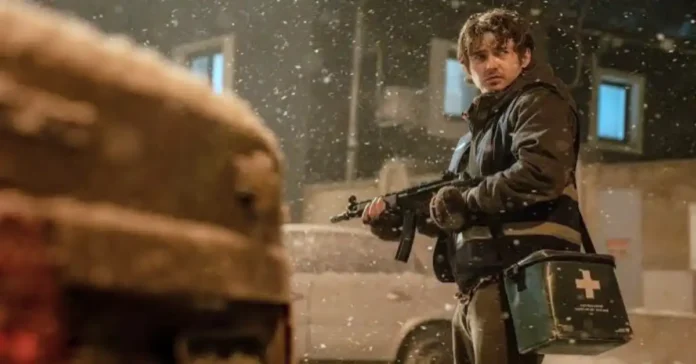
Raccoon City has claimed plenty of lives over the past thirty years, but none of those poor souls looked quite as frantic as Bryan. Director Zach Cregger took the wheel of the storied franchise and stripped away Hollywood gloss, delivering an intense ninety-minute sprint through survival horror purgatory. If you walked out of the theater clutching your armrest and wondering what was locked inside that metal container, you have reached the right safe room.
How bryan ended up in hell
Bryan never asked to be an action star. Austin Abrams plays him as an ordinary courier who considers himself little more than a glorified Postmates driver for hospitals. He spends his days ferrying blood bags, donor tissue, and prescription crates across icy Colorado highways.
Trouble begins before he even turns the ignition key.
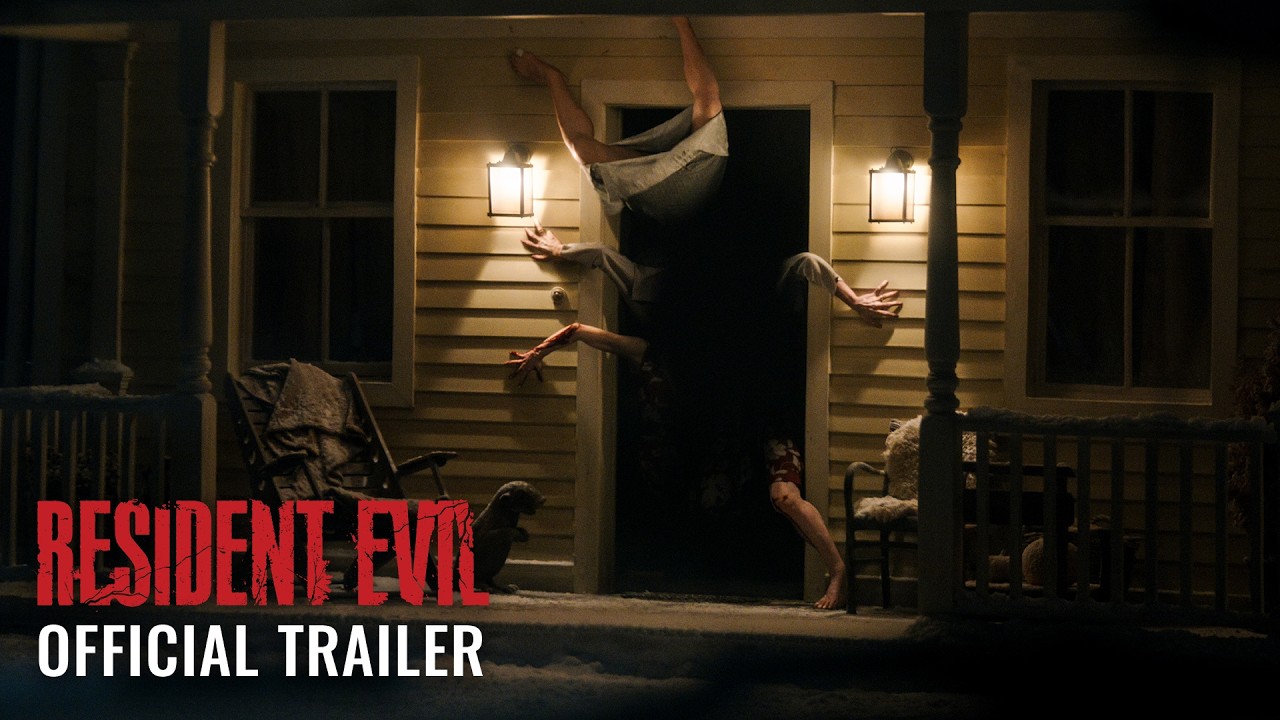
His girlfriend Michelle calls right as his evening shift ends to announce life-changing news: she is pregnant. Bryan reacts poorly, stumbling through an awkward conversation that quickly curdles into a bitter argument. Terrified of commitment and desperate for quick cash to prove he can provide, he accepts an urgent off-the-books courier run.
The dispatch clerk offers double his usual hourly wage. All Bryan has to do is drive through an approaching mountain blizzard and drop off an unmarked, temperature-regulated Pelican case at Raccoon City General Hospital.
His sedan lacks snow chains. The mountain roads are glazed in sheer black ice.
Distracted by incoming voicemail notifications, Bryan strikes a wandering pedestrian who stumbles onto the dark highway. Andrea Miltnerová portrays this dazed wanderer, whose mangled posture and snapping jaws instantly reveal that she is far from normal. Bryan tries to render aid, assuming he caused her horrific injuries, only to barely escape with his life when an infected guard dog ambushes him in a nearby snowbank.
From that instant, the film turns into an unforgiving live-action game of Resident Evil. Bryan scavenges weapons he barely knows how to hold, fumbles with gun safeties, searches desks for brass keys, and treats deep gashes with medicinal green herbs. The journey to the hospital ceases to be a delivery route.
It becomes an agonizing fight just to see sunrise.
Inside raccoon city general: a trap disguised as sanctuary
Bryan finally reaches Raccoon City General Hospital under the impression that he is entering a haven of doctors and emergency workers. What he encounters instead is a nightmare wrapped in institutional linoleum.
The hospital has completely collapsed into chaos.
Patients wander the halls with swollen veins and glazed eyes. Corridors are painted in arterial blood, and makeshift barricades of gurneys block entire wings. It does not take long for Bryan to discover that this medical center is not treating patients at all.
Raccoon City General is a clandestine research facility operated by the Umbrella Corporation.
Deep in the subterranean annex, Bryan runs into Umbrella security contractors Carl and Pauline, played by Paul Walter Hauser and Kali Reis. They are not there to evacuate the sick or organize triage. Their sole objective is sanitizing the building, retrieving sensitive corporate property, and eliminating witnesses.
Nearby laboratories reveal a team of scientists led by Dr. Dave, portrayed with twitchy desperation by Zach Cherry. The research staff is locked in an airtight control booth, watching containment failures play out across closed-circuit television monitors. They are waiting on one specific delivery to complete their emergency protocol.
That delivery is sitting right in Bryan’s backpack.
The big reveal: What was inside the courier’s package?
Throughout the first two acts, Bryan clings to the case because he believes an innocent person will die if he fails. He assumes the container holds a pediatric heart, a rare blood type, or vital transplant organs.
The reality is far more sinister.
When Bryan reaches the sub-level quarantine lab, the Pelican case is unlatched. Inside rest three pressurized vials filled with a dense, bioluminescent serum glowing with a sickly amber hue.
The case contains an experimental biological stabilizer, colloquially known as an anti-viral suppressor, developed under Umbrella’s secret bio-weapons umbrella.
The Cargo Breakdown:
- Designation: Experimental Antiviral Stabilizer / Viral Suppressor
- Manufacturer: Umbrella Pharmaceuticals (Special Projects Division)
- Primary Purpose: Suppress cellular degradation in T-virus test subjects
- Secondary Function: Serve as the missing catalyst for Phase-3 bio-weapon development
Dr. Dave’s team was never attempting to cure the townspeople. Raccoon City was already written off as an uncontrolled bio-hazard zone due to a leak from the nearby Arklay Mountains facility. The scientists needed this specific synthetic compound to halt rapid necrosis in their primary biological weapon specimen before total cellular death ruined their research data.
Bryan was never a trusted operative. Umbrella purposely used an independent, third-party courier service because standard corporate logistics would trace directly back to their headquarters.
Think about the sheer cruelty of that strategy.
If Bryan froze to death in the blizzard, Umbrella lost nothing but an expendable gig worker. If he somehow made it through the horde, they received their precious stabilizer without triggering federal transport alarms. Bryan risked his life across miles of infected terrain just to deliver the final component needed to keep a monster alive.
Cregger’s narrative shines because it grounds high-concept corporate malice within the everyday reality of a working-class kid who is completely out of his depth.
Climax: surviving the 2,000-pound nightmare
Once the stabilizer is delivered, things deteriorate instantly.
The research team attempts to inject the stabilizing compound into their containment subject, an enormous mutated organism housed in the sub-basement. The creature rejects the synthesis, triggering a catastrophic biological mutation.
Limbs tear through synthetic hide, multiple torso segments merge together, and massive practical tentacles whip through the observation glass. Special effects crews built a genuine two-thousand-pound practical puppet for this sequence, and the physical weight shows on screen. The monster crushes the containment crew in seconds, turning the clean laboratory into a slaughterhouse.
Simultaneously, the facility’s automated security protocols initiate an emergency demolition sequence.
Sirens wail across the complex. Digital countdown clocks flash crimson along the walls. Bryan finds himself caught between an advancing mountain of mutated flesh and automated bulkhead blast doors sealing shut one by one.
Bryan uses his environment like a seasoned gamer running out of inventory space:

- Baiting the Beast: Armed with an empty shotgun, Bryan lures the titan toward the industrial hydraulic maintenance shaft.
- The Heavy Door Trick: He slides beneath a descending blast door, triggering the emergency override to pin the monster’s main torso beneath tons of reinforced steel.
- The Final Escape: With seconds remaining before demolition charges ignite, Bryan races up a maintenance stairwell to an upper-floor recovery ward.
- The Window Leap: He shatters an exterior window with an oxygen tank and hurls himself into the frozen night just as internal concussions level Raccoon City General.
The shockwave tosses Bryan into a deep snowdrift outside the perimeter. Fireballs bloom into the winter sky, burning the facility and all of its corporate secrets to the ground.
Does Resident Evil (2026) have a Post-credits scene?
The credits roll over a haunting industrial score, leaving moviegoers glued to their seats waiting for the inevitable Marvel-style franchise teaser. Do you need to stay until the lights come up?
No. There is no mid-credits or post-credits scene in Resident Evil (2026).
Early test screenings sparked wild rumors that iconic characters like Albert Wesker, Jill Valentine, or Leon S. Kennedy would appear in a shadowy conference room during the credits. the theatrical cut contains zero bonus stingers once the primary title cards conclude.
Director Zach Cregger made a deliberate artistic choice to skip post-credits setups. Both of his previous horror features, Barbarian and Weapons, operated on absolute self-containment. Cregger prefers letting the emotional weight of the final scene linger rather than distracting viewers with corporate franchise promises.
For a deeper look into the theatergoer reaction to this decision, you can read Looper’s post-credits analysis, which confirms that the entire narrative concludes cleanly before the technical credits begin.
Where does the ending leave bryan?
While there is no stinger after the credits, the actual final scene of the film functions as a gut-wrenching narrative cliffhanger.
Bryan pulls himself out of the snowbank, bruised, bleeding, and trembling from hypothermia. Behind him, the hospital is an inferno.
He reaches into his jacket pocket and pulls out his cracked smartphone. Miraculously, the display flickers to life, revealing a faint bar of roaming cellular signal.
A voicemail notification pops up from Michelle.
Her voice plays through the speaker, crying softly, apologizing for how their conversation ended earlier that evening, and asking him to please come home safely so they can figure out parenthood together. Bryan sits in the snow, listening to her voice while clutching his bleeding forearm.
Did you catch the subtle camera cue on his arm?
Earlier in the hospital tunnels, Bryan was scraped across the forearm by an infected crawler. Blood trickles from the puncture wounds, but the veins surrounding the laceration are visibly darkening, pulsing with a faint, unnatural violet hue.
Bryan looks up toward the tree line. In the valley below, distant air raid sirens begin to wail across the heart of Raccoon City. Gunfire echoes in the freezing wind.
Bryan is alive, but he is stranded in the middle of a full-scale viral apocalypse with an active infection ticking inside his bloodstream. He survives the hospital, yet his personal survival horror has only just begun.
How Cregger connects to Capcom Canon
Hardcore franchise fans spent months debating how an original protagonist could fit into established Resident Evil history. By setting the movie entirely during the initial hours of the Raccoon City outbreak, Cregger crafted a story that runs parallel to legendary game events without contradicting them.

| Film Event | Corresponding Video Game Canon |
|---|---|
| Bryan’s Mountain Drive | The Arklay Forest / Arklay Mountains contagion spreading south into the city limits. |
| Hospital Cover-Up | Umbrella deploying clean-up squads to destroy incriminating viral research before military intervention. |
| The Monster in the Basement | Advanced Tyrant and G-virus mutation experiments conducted away from the main police precinct. |
| The Distant Sirens | The complete collapse of the R.P.D. seen during the opening hours of Resident Evil 2 and Resident Evil 3: Nemesis. |
Bryan never crosses paths with Leon Kennedy or Claire Redfield because they are fighting for their lives on the other side of town at the police department. Jill Valentine is navigating city streets dodging Nemesis, while Bryan is trapped on the rural hospital outskirts.
This creative decision keeps the universe authentic. We experience the disaster from the eyes of a regular civilian who has no clue what S.T.A.R.S. is, knows nothing about bio-terrorism, and only wants to get back to his family.
The thematic core: fatherhood and fear
Strip away the practical gore, the screeching mutants, and the shotgun blasts, and what is this movie really about?
It is a story about overcoming the instinct to run.
Bryan begins the night running away from responsibility. When Michelle tells him she is pregnant, his immediate reaction is flight. He takes a dangerous delivery job specifically to avoid sitting in a room and confronting his own fears of becoming a father.
Throughout his ordeal in Raccoon City, Bryan is forced to confront what happens when people surrender to self-preservation at all costs. Umbrella scientists sacrifice entire neighborhoods to save their stock prices. Security guards leave doctors to be eaten so they can reach an exit door first.
Bryan does the opposite.
Despite having countless opportunities to ditch the case and hide in a supply closet, he keeps pushing forward because he believes doing the job might save a stranger’s life. By the time he listens to Michelle’s voicemail in the final frame, Bryan is no longer running away from adulthood.
He fought through hell to earn the right to go home. The tragedy, of course, is that the infected veins on his arm might prevent him from ever holding his child.
What could happen in a potential sequel?
Will we see Bryan again?
Sony Pictures and Constantin Film financed the reboot with a relatively lean budget compared to massive comic-book tentpoles. With glowing critical praise highlighting its suspenseful pacing, a follow-up is well within reach.
Several story threads remain wide open for exploration:
- Bryan’s Search for a Vaccine: Since the hospital stabilizer was destroyed in the explosion, Bryan must locate an actual anti-viral cure inside Raccoon City before his infection turns him into a mindless ghoul.
- Entering the City Center: Escaping the hospital grounds forces Bryan downhill toward the city center, raising the possibility of running into iconic locations like the Raccoon City Police Department or Clock Tower.
- Umbrella’s Retaliation: High-level corporate executives will realize an outside courier made it out of the testing perimeter, making Bryan a primary target for assassination to prevent leaked testimonies.
Cregger has stated in interviews that he approached the film as a standalone survival ride. However, leaving Bryan infected on the outskirts of an exploding city is the ultimate sequel bait.
Final verdict on the ending
Zach Cregger pulled off what dozens of previous adaptations failed to achieve: making Resident Evil terrifying again.
He did not rely on flashy martial arts or endless CGI slow-motion shootouts. Instead, he returned the property to its roots — claustrophobia, limited resources, overwhelming monsters, and the frantic heartbeat of someone who is one bite away from oblivion.
Bryan’s package was never a beacon of hope; it was a symptom of corporate greed that chewed up an ordinary young man for profit. Whether Bryan finds a way to cure the darkness creeping up his veins remains to be seen. For now, his desperate scramble through Raccoon City stands as one of the rawest, meanest, and most satisfying entries the survival horror genre has delivered in years.

