
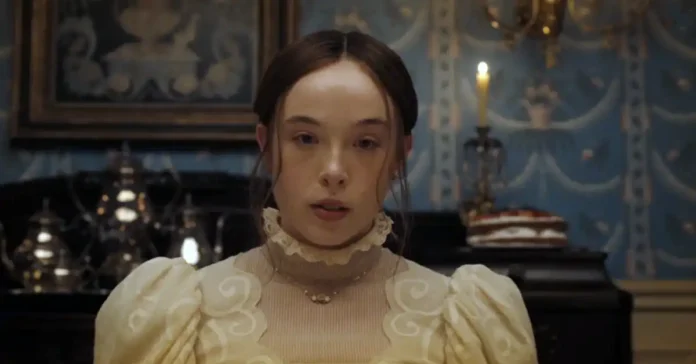
Netflix just dropped Monster: The Lizzie Borden Story, turning America’s most famous Victorian cold case into a bloody, darkly comedic fever dream. Ella Beatty swings the steel while Charlie Hunnam sports wild mutton chops, but how much of this chaotic spectacle actually happened? Grab a cold drink, because the real records behind Fall River’s 1892 double murder are stranger, colder, and far messier than Hollywood television.
The screen rant & production hook: punks, farce, and ryan murphy’s playbook
Whenever showrunner Ian Brennan and producer Ryan Murphy tackle true crime, viewers expect extreme style over quiet realism. Season 4 pushes that dial even further. In an interview with Screen Rant, episode director Max Winkler revealed that the creative team staged the Borden household like the classic stage farce Noises Off — characters constantly slam doors, toss metaphorical grenades, and lean hard into pitch-black humor. Charlie Hunnam, fresh off his chilling turn as Ed Gein in Monster Season 3, stepped into the boots of patriarch Andrew Borden, openly celebrating how the cast got license to play up the absurdities of the era.
Critics noticed the tonal shift right away, nearly every single historical fact has been remixed or thrown out the window. The real 1892 axe murders involved agonizing domestic dread and grueling courtroom battles. Netflix swaps that slow burn for campy thrills, modern pop-feminism, and sensational plotlines.
Are you wondering where television fiction ends and historical reality begins? Let’s stack the Netflix series directly against the 1892 Fall River trial transcripts and official coroner autopsies.
Netflix’s dramatization vs the 1892 historical record
The table below breaks down the key plotlines from Monster: The Lizzie Borden Story against primary records from the Fall River Police Department, Bristol County Superior Court transcripts, and Dr. William A. Dolan’s original autopsy reports.
| Story Element | Netflix’s Monster Season 4 (Ian Brennan) | Real Historical Record (1892-1893) | Forensic & Legal Reality Check |
| Lizzie Borden’s Age & Guilt | Depicted as an impressionable, rebellious 20-something who commits the murders. | Lizzie was a 32-year-old unmarried woman and church volunteer. | Legally innocent. An all-male jury acquitted her on June 20, 1893. The case remains officially unsolved. |
| Andrew Borden’s Persona | Charlie Hunnam plays a gothic coffin-maker who uses hatchets to trim corpses to casket size. | Andrew was a 70-year-old commercial landlord and bank president. | Pure Hollywood fiction. Andrew made his wealth in textiles, banking, and real estate, not hands-on embalming gore. |
| Abby Borden’s Role | Rebecca Hall plays a cartoonishly cruel, calculating stepmother. | Abby Durfee Gray was 64, quiet, stout, and lived in cool tension with her stepdaughters. | Exaggerated drama. Tension existed over property gifts, but Abby was hardly a fairy-tale monster. |
| Bridget “Maggie” Sullivan | Vicky Krieps portrays Bridget as Lizzie’s secret lover and murder conspirator. | Bridget was a 25-year-old Irish immigrant domestic servant. | Unsubstantiated myth. No historical evidence shows a romantic liaison or criminal conspiracy between them. |
| The Hatchet Blows (“40 Whacks”) | The show plays into the gory playground rhyme with stylized gore. | Abby took 18-19 blows to the head; Andrew took 10-11 blows to his face and scalp. | Forensic reality. The nursery rhyme nearly doubled the real blow count. The weapon was a hatchet, not an axe. |
| The Prussic Acid Incident | Portrayed as an explicit, failed murder attempt to poison family stew. | Pharmacist Eli Bence testified Lizzie tried to buy prussic acid to clean a sealskin cape. | Ruled inadmissible. The presiding trial judges barred this testimony as legally irrelevant and unproven. |
| The Burned Blue Dress | Dramatized as the frantic destruction of blood-soaked physical evidence. | Alice Russell testified Lizzie burned a cheap blue cotton dress stained with brown paint. | Major prosecution red flag. Burning clothing days after a double murder looked terrible, yet produced no blood trace. |
| Historical Cameos & Timelines | Sarah Paulson appears as Aileen Wuornos; Jessica Barden plays Nance O’Neil during the trial. | Aileen Wuornos lived a century later; Lizzie met stage actress Nance O’Neil in 1904. | Anachronistic framing. Ian Brennan stitched modern killers and future companions into an 1892 courtroom setting. |

Fact vs Fiction: Ella Beatty’s Lizzie vs The Devout Spinster
Did the real Lizzie Borden act like the punk-rock rebel we see on streaming screens? Not even close.
Ella Beatty gives a magnetic performance, but the script drops Lizzie’s age by nearly a decade. In August 1892, Lizzie Borden was 32 years old. She was not an angsty teenager locked in an attic. Fall River society viewed her as a devout, respected Victorian spinster. She taught Sunday school at Central Congregational Church, belonged to the Christian Endeavor Society, and served on the board of the Women’s Christian Temperance Union.
Why does that age gap matter so much? Because in Victorian New England, social optics decided courtroom fates.
Lizzie lived in a gilded cage. Her father, Andrew, was worth roughly $300,000 when he died — equivalent to over $10 million in today’s purchasing power. Despite that fortune, he refused to live in Fall River’s fashionable neighborhood, “The Hill.” He forced Lizzie, her older sister Emma, and his second wife Abby to dwell on Second Street, right next to noisy textile factories and commercial carriage traffic. The house lacked basic indoor plumbing. Occupants used chamber pots and hauled water from a pump.
This friction simmered for years. Andrew bought real estate for his wife’s family while skimping on his daughters’ allowances. Lizzie and Emma stopped eating meals with their parents. They addressed their stepmother stiffly as “Mrs. Borden”. Yet, throughout Fall River, Lizzie appeared every Sunday in high-collar lace, singing hymns and handing out flowers to hospital patients. That sterling reputation became her shield when the blood started flowing.
LIZZIE BORDEN: TWO PORTRAITS
| Netflix’s Revisionist Hero | Historical Reality (1892) |
|---|---|
| Early 20s, fiery & frantic | 32-year-old spinster |
| Openly rebellious daughter | Reserved church volunteer |
| Explicit queer co-killer | Strict Victorian socialite |
| Boldly confronts patriarch | Avoided family dinner table |
Charlie hunnam’s andrew borden: morbid undertaker or cheap landlord?
Charlie Hunnam plays Andrew Borden with chilling eccentricity. The show turns him into a backroom undertaker who uses axes to chop corpses down so they fit inside small wooden coffins. It makes for delicious horror television, but where did Ian Brennan find that detail?

Nowhere in history. He invented it.
Andrew Jackson Borden began his business life decades earlier manufacturing caskets and running a furniture shop. By 1892, he had moved on to high finance. He sat as the president of the Union Savings Bank and managed commercial developments. He spent his mornings walking downtown Fall River in a black frock coat, inspecting rent properties and checking on textile investments. He was an austere, humorless miser, not an eccentric serial slasher.
He did, however, possess a cruel streak that pushed Lizzie past her breaking point.
A few months before the murders, Lizzie built a roost for mourning doves in the barn behind the house. Andrew discovered the birds attracted neighborhood kids onto the property. His solution? He grabbed a small hatchet from the cellar, marched into the barn, and chopped the heads off every single one of Lizzie’s pet pigeons. That cold-blooded execution devastated Lizzie. Fall River neighbors remembered the incident clearly when police started searching the premises for a blade.
The bridget sullivan affair: sensational romance vs irish immigrant reality
Monster Season 4 leans heavily into a romantic affair between Lizzie Borden and the family maid, Bridget “Maggie” Sullivan, played by Vicky Krieps. The show depicts the two women bonding over shared oppression, sleeping together, and hatching a coordinated plan to slaughter the parents.
Did this lesbian murder pact actually happen? Zero historical evidence supports it.
Bridget Sullivan was a 25-year-old immigrant from County Cork, Ireland. She worked grueling fourteen-hour days inside the Borden home for less than three dollars a week. Her daily duties involved hauling coal, ironing linens in summer heat, and cooking heavy meals for a family that barely spoke to one another. The Borden sisters routinely called her “Maggie,” the generic, dismissive nickname wealthy families gave Irish domestic workers.
Consider Bridget’s movements on the scorching morning of Thursday, August 4, 1892:
- 6:15 AM: Bridget woke up with severe nausea, likely from spoiled mutton stew that had sickened the entire household the previous evening.
- 8:45 AM: Despite vomiting, she was ordered to wash all the ground-floor windows inside and out on a 90-degree summer morning.
- 10:30 AM: After Andrew returned home from his morning walk, Bridget retreated upstairs to her sweltering third-floor bedroom to rest.
- 11:10 AM: Lizzie shouted from downstairs: “Maggie, come down! Father’s dead! Someone came in and killed him!”
Bridget rushed down, saw Andrew’s ruined body on the sofa, and was sent across the street to summon Dr. Seabury Bowen. She gave detailed, consistent testimony before the grand jury and during the 1893 trial. Historians have found no diaries, love letters, or secret statements hinting at romance. When Lizzie walked free, Bridget packed her bags, moved to Montana, married a smelter worker, and stayed quiet until her death in 1948.
Autopsy files: deconstructing the “40 Whacks” nursery rhyme
Everyone knows the schoolyard rhyme: “Lizzie Borden took an axe, gave her mother forty whacks…”
It rolls off the tongue, but it gets the weapon, the victim, and the math wrong.
“Lizzie Borden took an axe,
And gave her mother forty whacks;
When she saw what she had done,
She gave her father forty-one.”

Official post-mortem reports written by Fall River Medical Examiner Dr. William A. Dolan reveal the true brutality:
Abby Borden’s Autopsy
- Time of Death: Between 9:00 AM and 9:30 AM (roughly an hour and a half before her husband).
- Location: Second-floor guest bedroom, crumpled between the bed and dressing bureau.
- Wounds: 18 to 19 distinct blows to the back of the head, skull base, and neck.
- Forensics: The killer stood astride her body while hacking downward. Undigested food in her stomach proved she died hours before Andrew.
Andrew Borden’s Autopsy
- Time of Death: Approximately 11:00 AM.
- Location: Ground-floor parlor, resting on the horsehair sofa with his feet on the carpet.
- Wounds: 10 to 11 strikes focused on the left side of his face and head.
- Forensics: His left eyeball was split in half, his nose severed, and his cheek crushed. The strikes caught him asleep; his face showed no defensive wounds.
The total blow count across both victims was 29 or 30 strikes — not 81. Forensic examiners also agreed the cuts were made by a light, sharp hatchet, not a two-handed woodsman’s axe.
Blow Count Comparison: Myth vs Autopsy
| Category | Count |
|---|---|
| Schoolyard Rhyme | 81 |
| Actual Forensic Autopsy | 29 |
| Abby | 18–19 |
| Andrew | 10–11 |
How did someone hack two skulls apart in broad daylight without covering the parlor walls in crimson? That mystery baffled police. When Officer George Allen entered the sitting room minutes after the alarm, Lizzie sat calmly in a clean dress, her hair pinned, without a visible drop of blood on her skin. Did she strip naked to commit the act, as television writers love to speculate? Or did the killer wear a raincoat and wash up before stepping outside? The records offer no answers.
The poison, the burned dress, and the missing blade
The prosecution’s case rested entirely on circumstantial evidence. Without fingerprints, DNA, or an eyewitness, District Attorney Hosea Knowlton chased three tantalizing clues.
1. The Prussic Acid at Smith’s Drug Store
On August 3, 1892 — the afternoon before the murders — local pharmacist Eli Bence claimed Lizzie walked into his store asking for ten cents’ worth of prussic acid (hydrocyanic acid). Bence refused the sale without a prescription. Lizzie claimed she needed the poison to clean a moth-eaten sealskin cloak. During the trial, defense attorney George Robinson fought hard to exclude this story. The judges agreed, ruling Bence’s testimony inadmissible because the state could not prove prussic acid had anything to do with blunt-force trauma.
2. The Burned Blue Dress
Three days after the killings, while Fall River police stood guard outside the house, family friend Alice Russell walked into the kitchen. She found Lizzie standing next to the cast-iron coal stove, feeding pieces of a blue corduroy dress into the flames.
“What are you doing with that dress, Lizzie?” Alice asked.
Lizzie answered casually: “I am going to burn this old thing up; it is all covered with paint.”
Alice warned her that destroying clothing during a murder investigation would look suspicious. Lizzie continued burning it anyway. That incident convinced a local judge to sign her arrest warrant.
3. The Headless Hatchet
Police searched the Borden cellar multiple times. On their second sweep, they found a small hatchet blade resting in a bucket of cold ash. Its wooden handle was freshly snapped off near the eye socket. Prosecutors argued Lizzie broke off the bloody handle and burned it in the stove to destroy evidence. However, Professor Edward Wood of Harvard Medical School tested the metal head with chemical reagents. His conclusion? No bloodstains of any kind were present. The true murder weapon was never identified.
The trial of the century and life at maplecroft
Lizzie Borden’s June 1893 trial in New Bedford, Massachusetts, captivated the country. Reporters flooded the courtroom. Feminists like Lucy Stone and Susan B. Anthony championed her cause, arguing that a woman was being railroaded by an all-male legal system.
The defense pulled off a masterclass in Victorian psychology. Former Massachusetts Governor George Robinson reminded the jury that Lizzie was a Sunday school teacher from good Puritan stock. Could a gentle, god-fearing maiden transform into a raging fiend, butcher her stepmother, wait calmly for ninety minutes, and butcher her father? The all-male, white, rural jury took just over an hour to deliberate. The verdict: Not guilty.

Key Milestones in the Borden Tragedy
August 4, 1892:
Andrew and Abby Borden are struck dead in their Fall River home.
August 11, 1892:
Lizzie is arrested following inconsistent inquest statements and dress burning.
June 5–20, 1893:
The Bristol County Superior Court trial ends in a full acquittal.
Fall 1893:
Lizzie purchases Maplecroft in the upscale “Hill” district.
June 1, 1927:
Lizzie Borden dies in Fall River at age 66.
Did Lizzie pack her bags and change her name? No. She and Emma inherited their father’s immense fortune, purchased a 14-room Queen Anne mansion on French Street in the elite “Hill” district, and named it Maplecroft.
Lizzie started going by “Lizbeth.” Fall River society snubbed her completely. Neighbors crossed the street when she walked by, and church members turned their heads. She found comfort in theatre, lavish spending, and animals, eventually willing most of her fortune to the Animal Rescue League.
What about that relationship with actress Nance O’Neil, played by Jessica Barden in Monster Season 4?Netflix weaves Nance into the 1893 trial period, but the two did not meet until 1904 — eleven years after the acquittal. Their intense companionship scandalized Fall River so severely that sister Emma packed her bags in 1905, moved out of Maplecroft, and never spoke to Lizzie again. Lizzie lived at Maplecroft until pneumonia took her life on June 1, 1927, at age 66.
Why true-crime fiction still won’t let lizzie go
Why does pop culture refuse to let Lizzie Borden rest?
Simple: an acquittal leaves a vacuum. When courts fail to name a killer, storytellers step in. Ryan Murphy and Ian Brennan turned Lizzie into an anti-hero because modern viewers love watching Victorian repression blow up into glorious, stylized vengeance. Monster: The Lizzie Borden Story works wonders as dark satire, but don’t mistake it for history.
The real mystery remains locked behind the doors of 92 Second Street. Whether Lizzie executed her parents in cold blood or an unknown intruder slipped through the cellar on that stifling August morning, the truth died with her in 1927.

