

London’s Female Body Snatcher: The True Story of Elizabeth Ross
London in 1831 was a city choking on its own fog, poverty, and paranoia. If you walked the cobbled streets of the East End after dark, you didn’t just fear being mugged. You feared being burked. This wasn’t a casual robbery. Burking meant someone was going to murder you, stuff you in a sack, and sell your fresh corpse to a medical school for dissection.
Sound like a nightmare? It was a terrifying reality. While history often remembers the infamous male “London Burkers” who terrorized the city, one ruthless woman managed to carve her own grim legacy into the history books. Her name was Elizabeth “Eliza” Ross.
In August 1831, Eliza Ross committed a crime so deeply cold-blooded that it still shocks true crime historians today. She targeted an elderly, hard-working grandmother, suffocated her in the dead of night, and sold her off for parts. But here is the wildest part of the story. The only reason Eliza was caught was because of her own 12-year-old son — and a fascinating, incredibly early use of forensic dentistry.
At a glance
- The Crime: 84-year-old street vendor Caroline Walsh was murdered in her sleep by her landlady, Elizabeth Ross.
- The Motive: To sell her body to medical surgeons, a gruesome practice known as “burking.”
- The Twist: The defense tried to prove Caroline was still alive by presenting a similar-looking woman from a poorhouse. The plot was foiled using early forensic dental evidence.
- The Downfall: Eliza’s own 12-year-old son testified against her at the Old Bailey, leading to her execution in 1832.
What on Earth Was “Burking”?
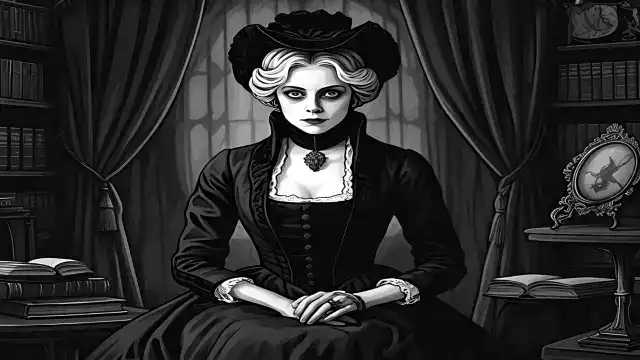
Before we get to Eliza, we need to understand the twisted economy of 19th-century London. Why would anyone want to buy a dead body?
In the 1820s and 1830s, medical science was booming. Anatomy schools desperately needed human corpses to teach aspiring surgeons how the human body worked. However, British law dictated that only the bodies of executed murderers could be legally dissected. That created a massive supply-and-demand problem. There simply weren’t enough murderers hanging from the gallows to keep the anatomy tables full.
Enter the “resurrection men.” These opportunistic criminals made a lucrative living sneaking into graveyards at midnight to dig up fresh corpses. But grave-robbing was messy, exhausting, and highly illegal.
In 1828, two men in Edinburgh, Scotland — William Burke and William Hare — figured out a horrifying shortcut. Why wait for people to die when you can just kill them yourself? They murdered 16 people, suffocating them to keep the bodies pristine for the doctors. This specific method of killing and selling a victim became known as burking.
By 1831, this terrifying trend had crept down into the slums of London. The public was terrified. The police were overwhelmed. And in a cramped, rat-infested garret in Whitechapel, Eliza Ross saw an opportunity to make a quick buck.
The Perfect Victim: Introducing Caroline Walsh
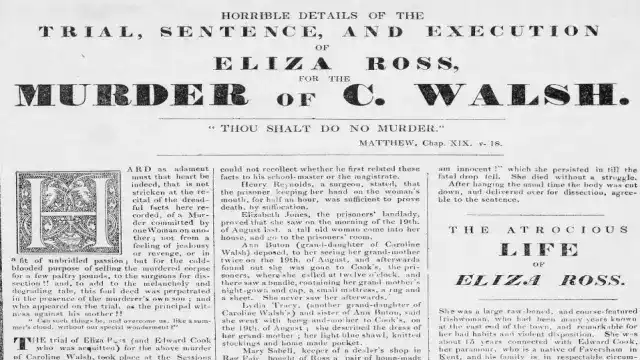
Caroline Walsh was 84 years old, but she was no fragile wallflower. Described by those who knew her as a “hearty” and tall Irishwoman, she made her living walking the harsh streets of London selling sewing threads, tapes, and laces. She wasn’t rich, but she carried a respectable little stock of goods and always had a few coins in her pocket.
Caroline was fiercely independent. Despite her age, she hustled every day to survive. Unfortunately, that independence made her vulnerable.
In August of 1831, Caroline made a fatal mistake. She needed a new place to stay and was persuaded to rent a corner in a squalid, single-room lodging in Goodman’s Yard, Whitechapel. The room belonged to 33-year-old Elizabeth “Eliza” Ross and her 50-year-old partner, Edward Cook. Also living in that single room was their 12-year-old son, Edward Cook Jr., affectionately known as Ned.

Caroline’s friends actually warned her against the move. Eliza Ross had a fierce reputation. Newspapers later described her as a “large, raw-boned, coarse-featured” woman who possessed masculine strength. She occasionally worked as a porter hauling heavy loads. She was not someone you wanted to cross.
Despite the warnings, Caroline moved in on the evening of August 19, 1831. She was never seen alive again.
The Night of the Murder: A Child’s Nightmare
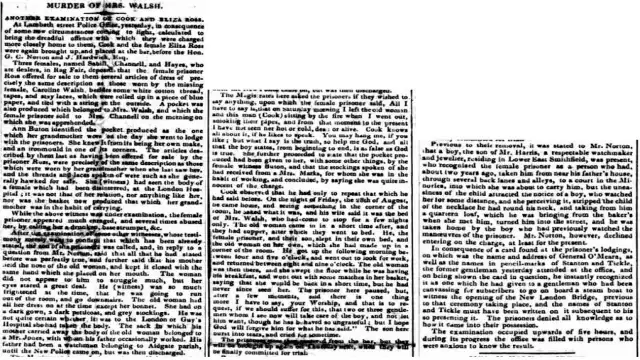
What actually happened inside that dark, cramped garret? We know the grisly details because 12-year-old Ned watched the entire nightmare unfold from his bed.
According to his later court testimony, the family and their new lodger went to sleep. Sometime in the dead of night, Eliza quietly slipped out of bed. She crept over to where the 84-year-old woman was sleeping.
Eliza didn’t use a knife or a club. Weapons leave blood, and doctors wouldn’t pay top dollar for a damaged corpse. Instead, she used the classic burking method. Eliza placed one heavy hand firmly over Caroline’s mouth and nose. She pressed her other hand down hard onto the old woman’s chest to stop her lungs from expanding.
Ned lay paralyzed in the dark, watching his mother commit murder. He later testified that the old woman didn’t struggle much. However, her eyes “stared and rolled very much” before her arm fell limp to her side. Eliza held her deadly grip for nearly half an hour, just to be absolutely sure.
Where was the boy’s father during this? Edward Sr. was allegedly staring out the window, completely ignoring the brutal murder happening a few feet behind him.
The next morning, Ned woke up to get ready for school. He went down into the dark, rat-infested cellar. There, he stumbled upon a heavy sack. Gray hair was poking out of the top. Later that Sunday, Eliza casually slung that heavy sack over her broad shoulders and carried it out the door. She told her son she was taking it to the London Hospital.
The Investigation: A Granddaughter’s Desperate Search
When an 84-year-old woman vanishes off the streets of London, the police rarely care. But Caroline Walsh had family who loved her.
Her determined granddaughter noticed her absence almost immediately. She scoured local workhouses, hospitals, and dark alleys. Nothing. Refusing to give up, she marched into the Lambeth-street Police-office and demanded help. An officer named Lea was assigned to the case.
Officer Lea started poking around Goodman’s Yard. He quickly uncovered a massive red flag. Within days of Caroline’s disappearance, Eliza Ross was spotted at the notorious Rag Fair in Houndsditch. What was she doing? She was casually selling off Caroline’s clothes and her entire stock of sewing laces.
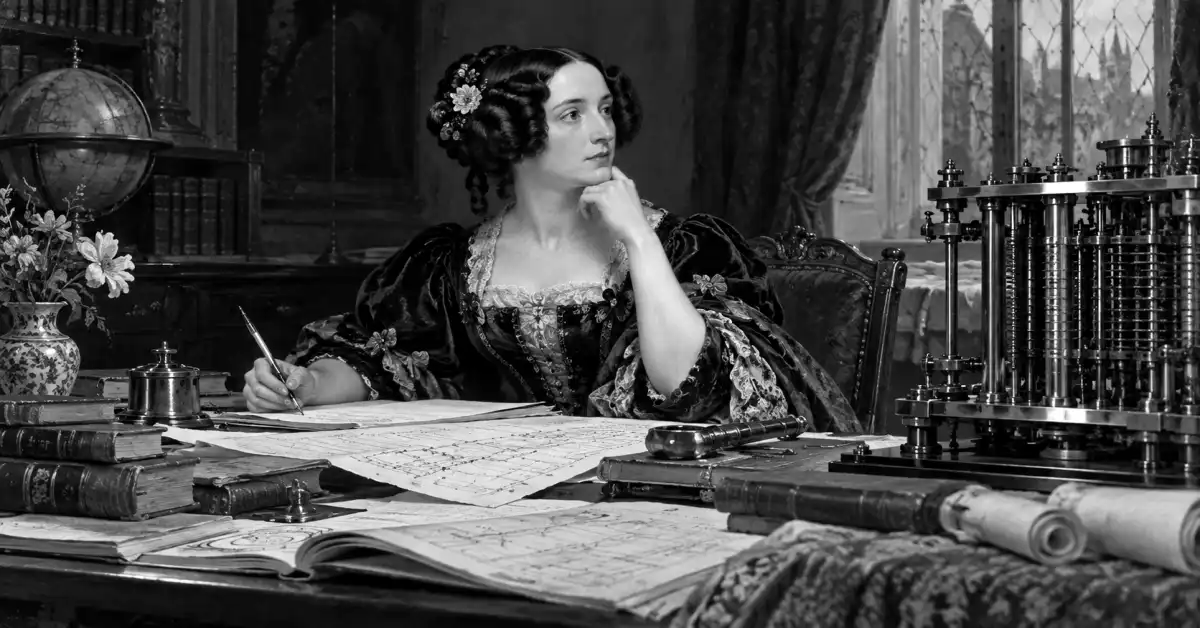
Lea didn’t waste any time. He arrested Eliza, Edward Sr., and young Ned. The adults vehemently denied knowing anything about the old woman’s whereabouts. But when authorities separated the 12-year-old boy and questioned him, the horrifying truth poured out.
A Bizarre Twist: Early Forensic Dentistry Saves the Case
Here is where the story shifts from a standard true-crime tale into a groundbreaking moment in legal history.
To convict someone of murder, the prosecution usually needs a body. But Caroline’s corpse had already been sold, dissected, and disposed of by medical students. There was zero physical evidence. The entire case rested on the shoulders of a 12-year-old boy.
Eliza’s defense lawyers realized this weakness and staged a brilliant, albeit devious, counterattack. They found an elderly Irish woman living in a local poorhouse whose name was eerily similar: Caroline Welsh. She roughly fit the victim’s description. The defense planned to bring her to court to prove no murder had ever happened.
Then, in a wild twist of fate, the poorhouse woman suddenly died before the trial.
The defense pivoted. They pointed to the fresh corpse in the poorhouse and claimed, “Look! Caroline Walsh just died of natural causes! Our client is innocent.”
It almost worked. But the prosecution pulled out an incredible trump card. They tracked down people who knew the real Caroline intimately. These witnesses confirmed a very specific physical trait. Despite being 84 years old, the murdered street vendor possessed a remarkably perfect set of upper front teeth (incisors).
Medical examiners quickly checked the mouth of the deceased woman from the poorhouse. She was missing all of her front teeth.
This is widely considered one of the earliest instances of forensic odontology (dental identification) being used to secure a murder conviction. The teeth didn’t match. The defense’s narrative completely collapsed.
The Old Bailey Trial: A Son Dooms His Mother
On January 5, 1832, Eliza Ross and Edward Cook Sr. stood trial at the legendary Old Bailey courthouse. The courtroom was packed to the rafters. The public was already in a state of absolute hysteria over “burkers,” as the notorious Bishop and Williams gang had just been executed a month prior for a similar crime.
The star witness was young Ned. Imagine the heavy silence in that courtroom as a 12-year-old boy stood before a judge and pointed the finger directly at his own mother.
Ned recounted the suffocation in chilling detail. He told the jury about the gray hair poking out of the sack. He swore his father had taken no physical part in the killing.

The jury didn’t deliberate for long. They found Eliza Ross guilty of willful murder and sentenced her to death. Because there was no hard evidence proving Edward Sr. actively participated in the suffocation, he was acquitted and walked free.
The Gallows and the Surgeon’s Slab
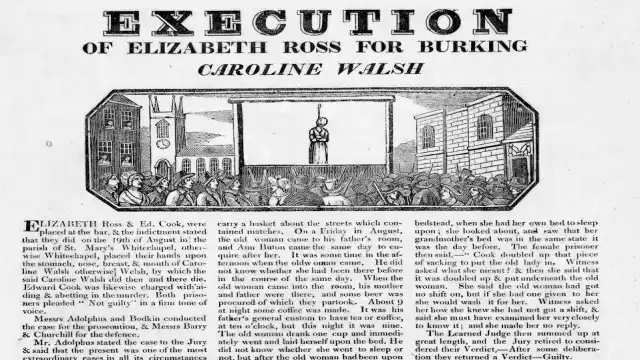
On the freezing morning of January 9, 1832, Elizabeth Ross was led out of Newgate Prison to face the hangman’s noose.
The crowd that gathered in the streets was massive and completely unforgiving. The people of London despised burkers. When Eliza mounted the wooden scaffold, the mob erupted into a “deafening yell and shout.” As the trapdoor swung open and she plummeted to her death, the crowd actually cheered. She was left to hang for the mandatory hour.
But the story holds one final, macabre piece of poetic justice.
During the 19th century, the standard legal punishment for murderers didn’t end at the gallows. To add a final layer of disgrace, the law required the murderer’s corpse to be dissected.
Eliza Ross had murdered an innocent woman to sell her flesh to surgeons. Now, her own lifeless body was cut down, loaded onto a cart, and delivered straight to the Royal College of Surgeons. She was laid out cold on the exact same anatomical slabs she had condemned Caroline Walsh to.
Before the surgeons took their scalpels to her, a medical conservator named William Clift stood over her body and sketched her face. That eerie drawing still sits in the archives of the Royal College of Surgeons today—a permanent, haunting reminder of London’s forgotten female burker.
The Aftermath of the Burking Era
Eliza’s execution occurred at the peak of Britain’s anatomical crisis. The public outrage over the murders of people like Caroline Walsh finally forced the government’s hand.
Later that same year, Parliament passed the Anatomy Act of 1832. This groundbreaking law finally gave medical schools legal access to unclaimed bodies from workhouses and hospitals. It instantly crushed the black market for human corpses. The era of the resurrection men and the terrifying burkers came to a sudden, permanent halt.
Caroline Walsh didn’t live to see the law change. She was a poor, elderly woman simply trying to survive a brutal city, only to be betrayed by the person she paid for shelter. Yet, her tragic death played a vital role in changing modern medicine forever.
What Do You Think?
The story of Eliza Ross feels like a script ripped straight out of a Victorian horror movie, doesn’t it? The use of early dental records to bust the defense’s fake-victim plot is absolutely mind-blowing for 1831. Which part of this case surprised you the most? Drop your thoughts in the comments below — let’s talk history!

