

You’ve probably seen the pictures. A writhing, pulsating knot of rats, their tails hopelessly entangled, fused together by filth, blood, and time into a single, grotesque organism. This is a Rat King.
The modern, scientific explanation is dismissively simple. It suggests a group of black rats (Rattus rattus), huddled together in a tight, filthy space, get their long, flexible tails knotted. As filth, food, hair, and feces build up, the knot tightens. Blood, scabs from frantic biting, and freezing temperatures can then fuse the tails together permanently. It’s presented as a freak, one-in-a-billion accident. A biological curiosity.
That’s the clean version. The one that lets us sleep at night.
The oral tradition from the heart of plague-era Germany tells a different story. A much, much darker story. To them, it wasn’t an accident. It was the birth of a monster. A composite being with many bodies and a single, malevolent will. The Rattenkönig (King of the Rats) was a living, breathing omen, and its appearance meant only two things were coming: plague and madness.
Let’s dive into the story that science tried to forget.
What is a Rat King? The Physical Horror
Before we get to the legend, let’s be clear about what we’re looking at. The few preserved specimens of Rat Kings are stomach-churning.
- Composition: They can consist of as few as three and as many as 32 rats.
- The Knot: The central point is a Gordian Knot of tails, often heavily calcified, indicating the rats lived like this for some time. The bones grew together.
- Survival: Evidence on the specimens, like bone calluses, shows that the rats continued to live and grow after being fused. This means the other rats in the colony must have brought food to the helpless, tangled entity. They were sustaining it.
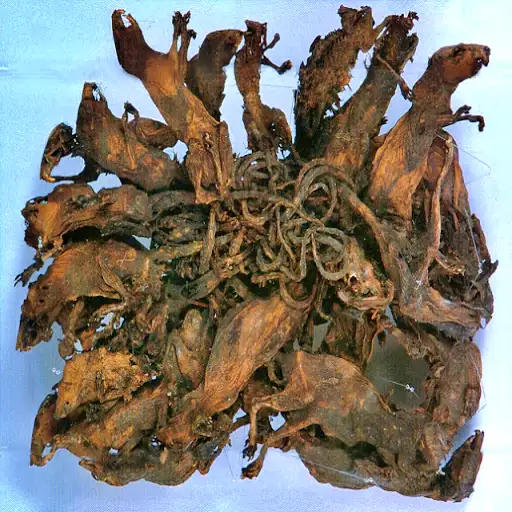
The most famous example is on display at the Mauritianum science museum in Altenburg, Germany. Discovered in a fireplace in 1828, it’s a mummified mass of 32 rats, the largest known specimen. To look at it is to understand that nature can produce things straight out of a nightmare.
But to the medieval mind, this wasn’t just a gross anomaly. It was a sign.
The Oral Tradition of the Rattenkönig
Forget the term “Rat King” in English. To understand the legend, you have to use its German name: Rattenkönig. This wasn’t just a descriptive title; it was a statement of hierarchy.
The legend didn’t see a group of unfortunate, tangled victims. It saw a sovereign entity. The belief was that an older, more powerful “king” rat would sometimes sit on the tangled tails of other rats, or that his tail would become entangled with those of his “subjects.” He was the brain; they were the body. The individual rats were no longer just rats. They were extensions of the king’s will, a living throne or a multi-limbed body for a single, horrifying consciousness.
This wasn’t a discovery for the person who found it in their cellar or chimney. It was an intrusion. Something that was not meant to be seen by human eyes had crawled out of the underworld and into our own.
A Hive-Mind of Sickness and Despair
This is the core of the folk-horror that science ignores. The Rat King was not seen as a tangle of panicked animals trying to get free. It was seen as a single organism moving with a unified, unnatural purpose. It was a hive-mind.
Think about it. Why would other rats bring it food? Sympathy? Or servitude?
The oral tradition leaned hard into the latter. The Rattenkönig exerted a psychic influence over its colony. It was their god and their general. When you saw the Rat King, you weren’t just seeing a dozen or so tangled rats. You were seeing the command-and-control center for the entire rat population of your town. And it was sending a message.
The Omen of Plague
This connection is both practical and deeply symbolic. We know now that the black rat’s fleas (Xenopsylla cheopis) were the primary vector for the bubonic plague. Rats were the harbingers of the Black Death.
Now, imagine you are a 16th-century German peasant. You already associate rats with sickness and death. Then, you find this abomination in your flour mill. A pulsating mass of dozens of rats, living and breathing as one.
It’s not a stretch to see it as the physical embodiment of the plague itself. It is the sickness, given monstrous form. It’s a walking, squirming concentration of the very pestilence you fear. The legend was clear: where the Rattenkönig appears, a great sickness will follow. It was the vanguard of the plague, sent to announce its arrival.

The Omen of Madness
This is the more subtle, and perhaps more terrifying, aspect of the legend. The Rat King didn’t just foretell physical sickness; it foretold a sickness of the mind.
Why madness?
Because the Rat King is a fundamental violation of the natural order. It’s a living paradox. Individual creatures, designed to run, forage, and breed, are fused into a helpless, yet powerful, collective. It’s a symbol of unity turned cancerous. The sight of it was said to be enough to unhinge a person’s mind.
But the “madness” it foretold was likely bigger than that. It was the collective madness of a society on the brink of collapse. The panic, the paranoia, the breakdown of laws and faith that occurred when the plague came to town. When neighbor turned on neighbor, when bodies piled up in the streets, when all hope was lost—that was the madness the Rattenkönig heralded. It was the living sigil of chaos.
Is the “Accident” Theory Just a Comfortable Lie?
From the our perspective, information is impartial. But one must question the narratives that provide the most comfort. The “accidental tangling” theory is comforting. It renders the Rat King a meaningless, random event.
But does it hold up?
The black rat’s tail is prehensile. They are expert climbers who use their tails for balance. The idea that dozens of these agile creatures could get their tails into a knot so complex it could never be undone seems… unlikely. Not impossible, but deeply improbable.
The legend offers a different, more chilling logic. It wasn’t an accident. It was design. A biological process that only activates under immense population pressure and stress—the very conditions that precede a plague. It suggests that when the rat population reaches a critical, disease-carrying mass, nature has a way of producing a king. A leader. An omen.
Which is more terrifying? A random accident, or a purposeful creation with a malevolent role to play in the ecosystem of disease?
More Than a Monster: A Cultural Echo
Today, the Rat King is a meme, a biological curiosity, a monster in a video game. But it was once a creature of profound cultural significance. It was a focal point for the deepest anxieties of medieval and early modern Europe: disease, social collapse, insanity, and the fear that nature itself could become twisted and hostile.
It embodies a time when the lines between the natural and the supernatural were blurred. When a knot of rats in a cellar could hold the weight of a divine warning. The real horror of the Rat King isn’t the tangled tails. It’s the thought that for a brief, terrible moment, they all started thinking the same thing.
The legend frames the Rat King as a conscious omen. Modern science frames it as a random accident. Which narrative do you find more compelling, and what modern “omens” do you think our society secretly believes in? Share your thoughts below.

