
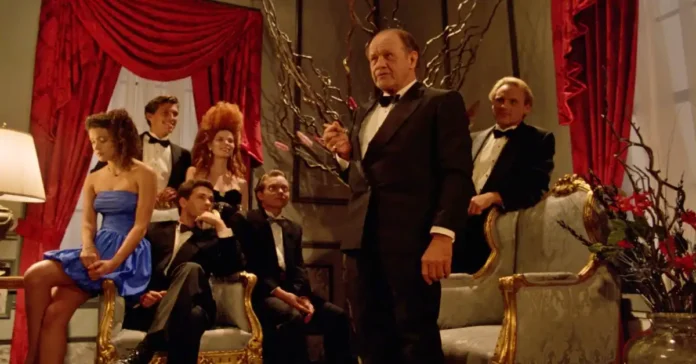
Before diving into the jaw-dropping madness of the finale, remember how quiet the movie feels at first. Director Brian Yuzna spent the first two acts building a classic paranoia thriller.
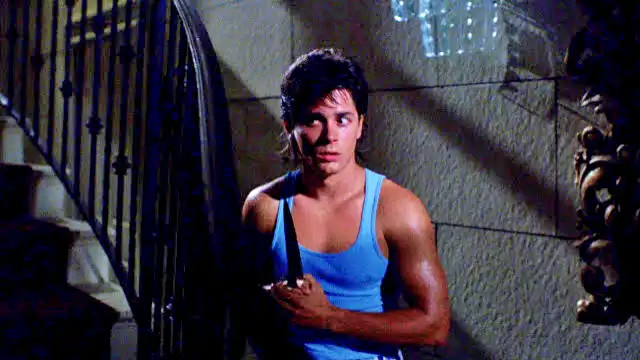
We follow Billy Warlock (Bill Whitney), an all-American high school jock living a life of utter luxury. He drives nice cars. He lives in a gorgeous mansion with manicured lawns. He runs for student body president.
Yet, deep down, Bill feels sick inside. He tells his therapist, Dr. Cleveland, that he simply does not fit in with his parents or his sister, Jenny. He senses something rotten hiding right beneath their polished smiles.
Things spin out of control when his sister’s ex-boyfriend, David Blanchard, slips Bill an unsettling cassette tape. The audio sounds like a horrifying, guttural orgy where Bill’s parents are making sickening, inhuman noises.
When Bill tries to play the tape for his therapist, the audio somehow changes into normal party chatter. Soon after, Blanchard supposedly dies in a violent car crash. Every time Bill catches a glimpse of something abnormal — like his sister’s skin bubbling in the shower — everyone around him claims he is losing his mind.
That psychological isolation hits home. Have you ever felt like everyone around you is in on a private joke at your expense? Bill is living that nightmare on an astronomical scale.
His girlfriend dismisses him. His doctor feeds him tranquilizers. The local police brush off his reports. The entire community forms an airtight wall of gaslighting designed to keep him off-balance and helpless.
The Big Twist: A Separate Human Species
When Bill finally races home after escaping a forced hospital stay, expecting to expose his family, he walks right into an elegant cocktail party. Crystal glasses clink. Wealthy guests wear tailored tuxedos and evening gowns.
Then comes the brutal confession from Dr. Cleveland and the Whitney family:
- They are not human: Bill assumes these monsters must be aliens from outer space. The elders chuckle at that childlike idea. They explain that they are an ancient, distinct biological species that has lived alongside standard humans for thousands of years.
- The class divide is genetic: Throughout history, this secret species has occupied the ruling seats of society. They claim historic conquerors and royalty belonged to their bloodline.
- Bill was bred as livestock: Bill discovers he is adopted. His family never loved him as a son. They brought him in from the common lower classes, raised him in pure comfort, and fattened him up like a holiday roast.
- The biological parasite rule: This predatory elite cannot survive without feeding on ordinary humans. They do not just take their money or labor; they physically suck down their vital life force and nutrients.
The movie stops being a teenage mystery and turns into an uncompromising body horror satire.
The Shunting Scene Explained
Once the truth drops, the party shifts into the legendary climax known as the Shunting scene.
The Beverly Hills social elite strip off their designer clothes, but they do not have a normal orgy. Instead, their anatomy loses all rigid structure. Their skin softens, liquefies, and begins to fuse together.
Limbs stretch like warm mozzarella cheese. Faces slide across shoulders. Bellies sprout mouths.
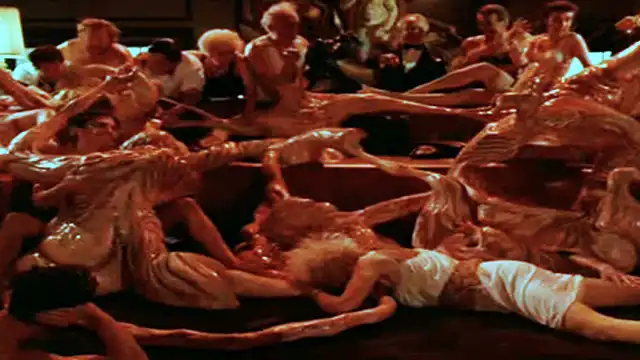
The guests form a writhing, pulsing mountain of melting flesh in the living room. To kick off the feast, they bring out David Blanchard, who never actually died in that car crash. The crowd surrounds the poor boy, pressing against him until their malleable skin penetrates his body.
They literally absorb his organic nutrients, draining him dry while squealing in ecstatic delight. By the time they finish feeding, Blanchard is reduced to an empty, disfigured husk.
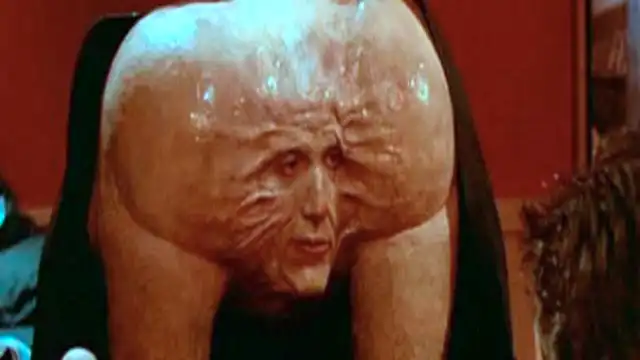
Bill runs upstairs to escape, only to walk in on his parents and sister engaged in their own private shunt. His father’s face has migrated to his rear end — giving literal, gross life to the playground insult “butthead”. His mother and sister have merged into an impossible, tangled loop of arms and torsos.
Trapped back downstairs, Bill gets tackled by his high school rival, Ferguson. Ferguson pins him to the ground and starts shunting with him, trying to digest Bill’s torso.
In a surge of pure survival instinct, Bill refuses to let his cells yield. He thrusts his arm straight through Ferguson’s squishy, destabilized torso, reaches all the way up through his throat, and pulls Ferguson inside-out like an old sock.
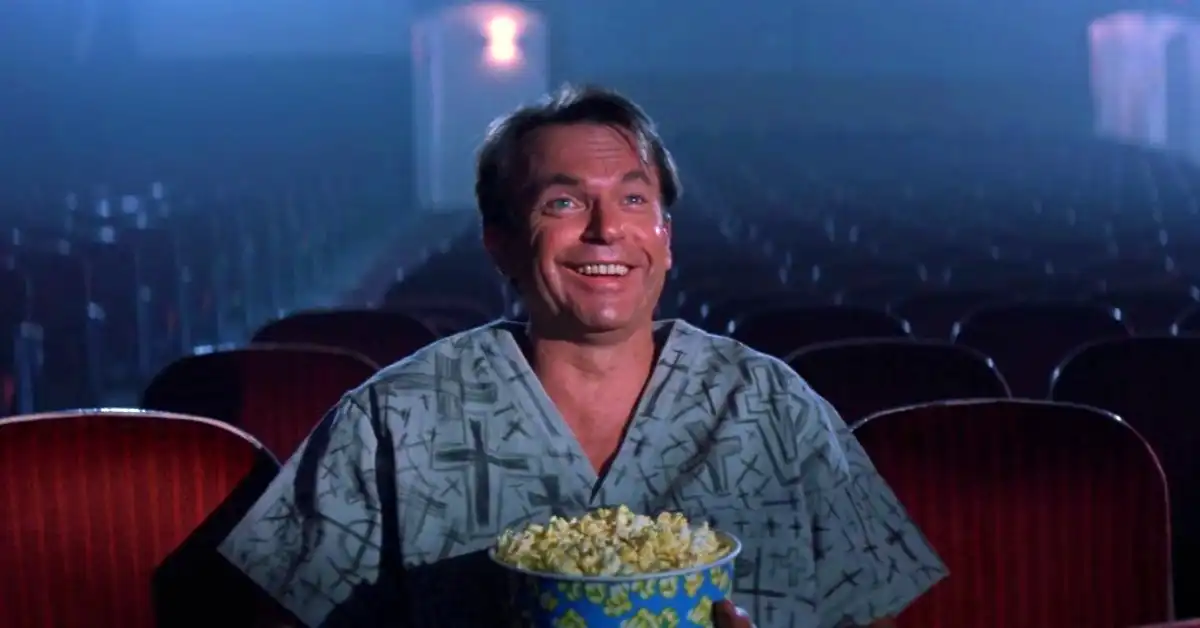
Using the ensuing panic, Bill breaks free and escapes into the night.
Screaming Mad George and the Art of Surreal Effects
Why does this ending stick in your memory long after the credits roll? The credit belongs entirely to special effects genius Screaming Mad George (Joji Tani).
Most 1980s horror movies leaned heavily into blood, flying limbs, and decaying zombie prosthetics. George took a radically different path. Influenced by surrealist painters like Salvador Dalí, he treated human flesh like wet clay.
Look at the mechanics behind how the production pulled off this gelatinous nightmare:
- Tons of slime and lubricant: The crew burned through hundreds of gallons of methylcellulose, KY Jelly, and warm industrial slime to give every surface a glistening, biological sheen.
- Foam latex suits and bladders: Actors wore multi-person suits joined together at the hips and shoulders. Hidden technicians pumped air into inflatable bladders beneath the latex to make the skin look like it was digesting someone alive.
- Under-floor puppeteering: The production built raised false floors throughout the mansion set. Puppeteers hid underneath the floorboards, manually shoving silicone faces, rubber arms, and mechanical tentacles up through slits in the carpet.
- Reverse footage tricks: To create Ferguson’s mind-bending inverted death, George built a hollow dummy with an internal cable rig. Pulling the skin inward while running the camera in reverse produced that impossible, sickening sight of a man turning inside-out.
Computers did not draw a single frame of this chaos. Every ripple of melting fat and every dripping pore existed physically on set. That tactile, rubbery reality is why the effects age so remarkably well. It looks strange because it was strange.
![Society (1989) Original Trailer [FHD]](https://www.gsnsp.com/wp-content/cache/flying-press/c708d4e74fb48b4aa04d8437f5e3b397.jpg)
Reaganomics as an Actual Monster
Brian Yuzna did not dream up the Shunting just to gross out teenage audiences at the drive-in. The film serves as a vicious takedown of wealth, class power, and unchecked privilege.
Released in 1989, Society arrived at the absolute peak of Wall Street greed, country club elitism, and supply-side economics. Popular culture spent the decade celebrating billionaires and luxury lifestyles. Yuzna flipped the script by asking a blunt question: What if the super-wealthy do not just exploit the working class financially, but biologically?
The metaphor operates on several distinct levels:
- Literal bloodsucking: Karl Marx once famously described capital as dead labor that, vampire-like, lives only by sucking living labor. Society takes that metaphor and makes it literal flesh. The upper class does not create anything. They feed off the vitality, youth, and bodies of ordinary working folks.
- Inbred exclusivity: The elite in Beverly Hills refuse to integrate with outsiders. They only merge with each other. Their grotesque physical fusion is the ultimate visual symbol of old money protecting its bloodline and keeping its assets strictly inside the family circle.
- The weapon of gaslighting: Notice how the villains maintain control. They do not rely on machine guns or prison bars. They control the therapists, the judges, the police, and the schools. When an ordinary person points out that the system is deeply rigged, the institutions simply label that person crazy or paranoid.
- Disposing of the used: Look at David Blanchard. He tried to blow the whistle, and the system chewed him up, squeezed out every ounce of value, and threw his shriveled shell away. That is modern corporatism distilled into pure body horror.
The Chilling Reality of the Escape
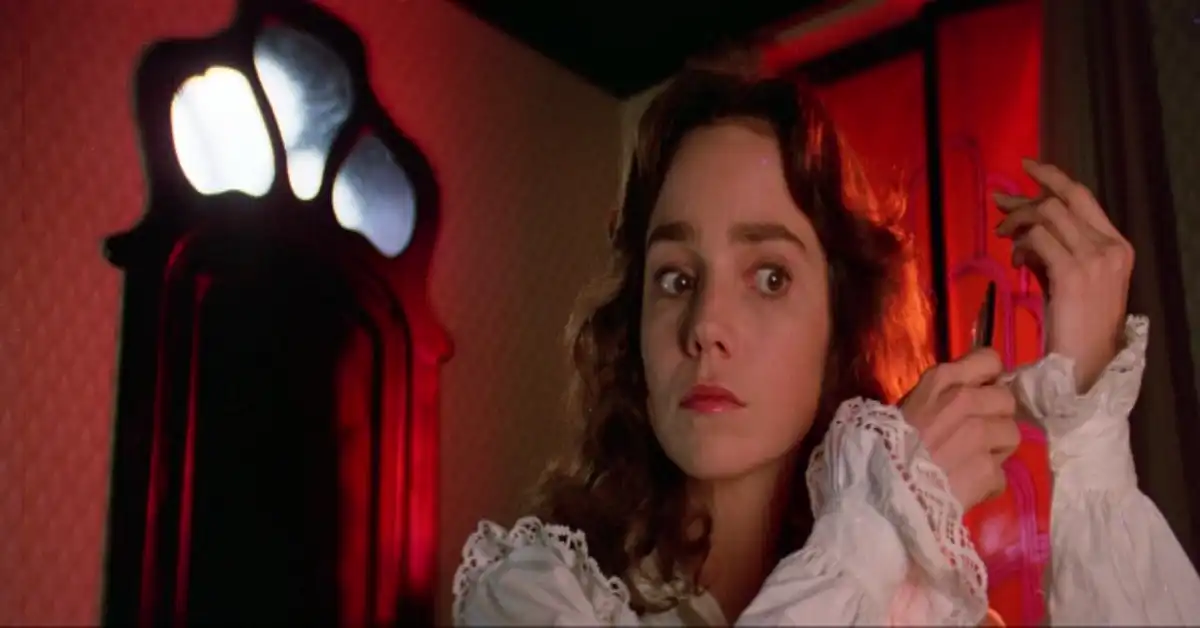
Bill manages to smash his way out of the mansion, climbing into a beat-up car with his working-class buddy Milo and his love interest Clarissa. They speed away into the night, leaving the burning chaos behind.
Is that a happy ending? Hardly.
Think about where Bill stands when the screen fades to black:
- Clarissa is still one of them: Clarissa helped Bill escape because she had feelings for him, but she remains a biological member of the parasitic species. Can Bill ever truly let his guard down around her, knowing what she is capable of turning into?
- The network is untouched: Bill killed one arrogant kid in Ferguson, but the rest of the coven is completely unharmed. They are billionaires, judges, and high-ranking officials. They still own the city, the banks, and the legal system.
- Nowhere to run: Dr. Cleveland smiles calmly as Bill runs out the door. The elite do not chase him with sirens blaring because they know something terrifying: where is an impoverished, runaway orphan going to hide? The Society is everywhere.
Milo sums up the entire ordeal with a darkly funny, bitter line as they drive away: “Anyway, how do you like your tea?”
It is a flippant joke to cut through the trauma, but the underlying truth is clear. Bill survived the dinner table, yet the predators still own the restaurant.
Why the Cult Following Continues to Grow
American movie studios did not know how to market Society in 1989. They sat on the film for nearly three years before giving it a quiet, limited release in 1992. Audiences expecting a standard slasher like Friday the 13th were totally baffled by its gooey, political surrealism.
Overseas, audiences instantly got the joke. In the United Kingdom, critics hailed Yuzna’s bold vision, and the movie became a massive midnight-movie phenomenon.
Decades later, the film feels sharper than ever. In a world dominated by expanding wealth gaps, private luxury compounds, and institutional distrust, Yuzna’s bonkers vision does not feel outdated at all. It feels prophetic.
Society proves that great horror does not just scare you with dark shadows or loud noises. Great horror takes a real, uncomfortable social truth, strips away polite manners, and shows you the monster hiding right behind the country club gates.

