

The Empty Theater and the Ultimate Punchline
Picture this scenario. You have somehow survived the literal apocalypse. Civilization has crumbled around you in a wave of cannibalistic riots, mutant rampages, and blood-soaked chaos. You walk through the shattered, deserted streets of a dead city, step inside a derelict movie theater, and slump down in an empty seat.
The film projector clicks on. Light hits the silver screen. You look up, and what do you see?
You see yourself.
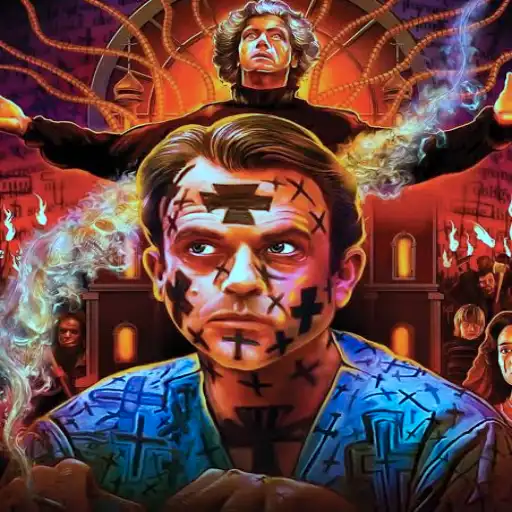
That is the nightmare John Trent faces in the final minutes of John Carpenter’s 1994 masterpiece. Played with razor-sharp cynicism by Sam Neill (John Trent), Trent discovers that his entire life — every cynical quip, every clever insurance investigation, every memory of his past — is nothing more than lines of text written by pulp novelist Jürgen Prochnow (Sutter Cane).
He isn’t a victim of circumstances. He isn’t a hero trying to avert disaster. He is merely a delivery boy fabricated out of thin air to carry a cursed manuscript straight into the printing presses.
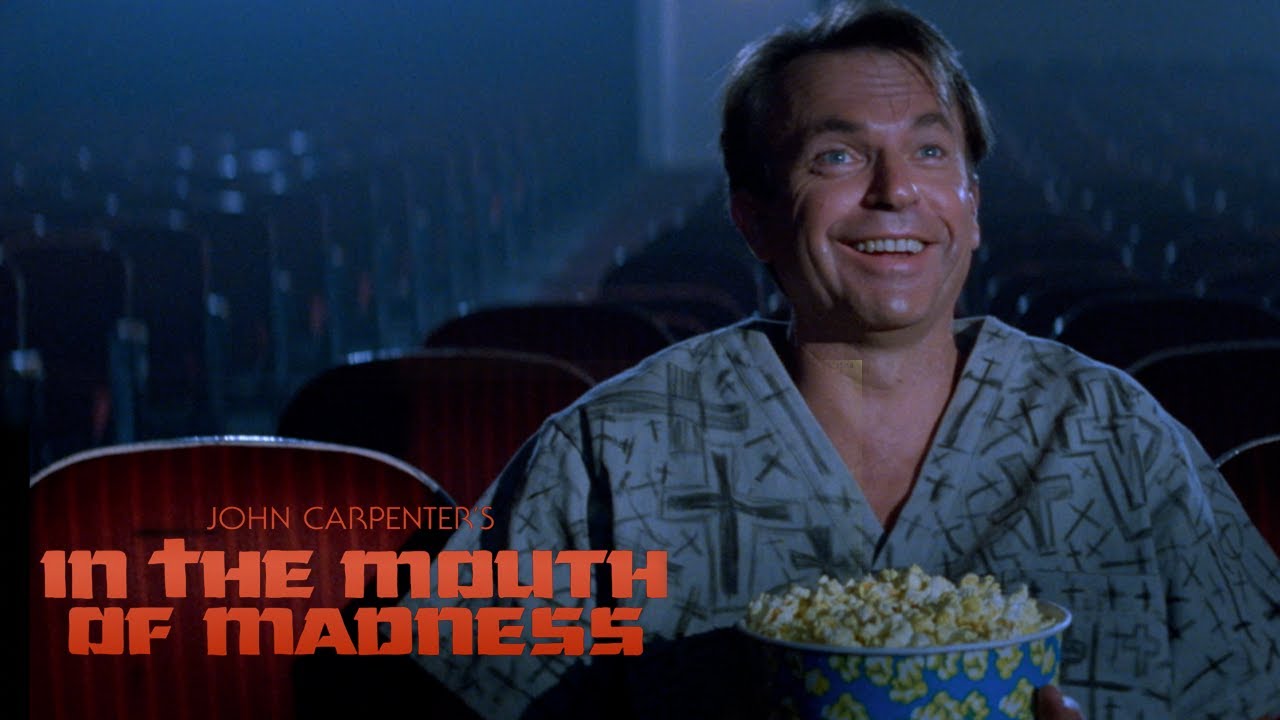
When the opening credits of the movie-within-the-movie roll, announcing In the Mouth of Madness starring John Trent, something snaps. Trent does not pick up a weapon. He does not pray. He grabs a cardboard bucket of buttered popcorn from the floor, shovels a handful into his mouth, and begins to howl with laughter.
The laughter starts as a stunned smirk. Within seconds, it morphs into a wet, wheezing, theatrical belly laugh. Right before the black screen cuts him off, that laugh cracks down the middle, teetering into a ragged sob. Why? Because Trent finally understands the cosmic joke. The joke is him.
The Capstone of Carpenter’s Apocalypse Trilogy
To understand why this finale hits like a freight train, you have to look at where it sits in cinema history. In the Mouth of Madness forms the final entry in what fans call the John Carpenter Apocalypse Trilogy. Carpenter did not design these movies as direct narrative sequels, but rather as spiritual siblings united by a shared dread: the extinction of humanity.
Each installment tackles human doom through a radically different lens:
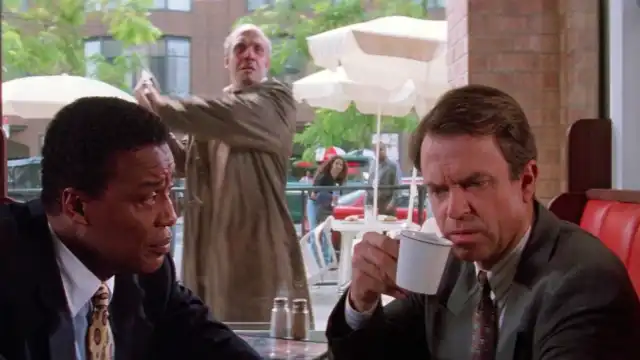
- The Biological Apocalypse: The Thing (1982) explored an alien organism capable of perfectly imitating human flesh. The terror was physical, parasitic, and grounded in claustrophobic paranoia. You could not trust your neighbor’s body.
- The Scientific and Theological Apocalypse: Prince of Darkness (1987) bridged quantum physics with ancient religious scripture. Evil was an antimatter liquid trapped in a forgotten church basement, threatening to overturn the laws of the physical universe. You could not trust science or faith.
- The Ontological Apocalypse: In the Mouth of Madness (1994) took the scariest turn of all. Written by Michael De Luca, the story attacks reality itself. You cannot trust your senses, your thoughts, or your own existence.
If The Thing showed us losing our bodies, and Prince of Darkness showed us losing our physical laws, In the Mouth of Madness showed us losing our minds. Carpenter stripped away the physical threat and turned the camera inward. How do you fight an enemy when you discover you are the weapon they used to erase the world?
Sutter Cane and the Terrifying Power of Consensus Reality
What actually gave Sutter Cane the power to tear down human society? He was not a sorcerer casting spells in a dungeon, nor was he an alien invader firing lasers from the sky. He was an author writing cheap paperback novels.
His publisher, Peter Heston (played with booming gravitas by Charlton Heston), brags early on that Cane outsells Stephen King. Cane’s lurid, blood-drenched books are translated into eighteen languages, read by millions of commuters on trains, housewives in kitchens, and teenagers in bedrooms across the globe.
The movie hinges on a brilliant philosophical concept: consensus reality.
Think about how our daily world operates. Why does a green traffic light mean “go” and a red light mean “stop”? Why does a piece of green cotton paper hold monetary value? They work because everybody agrees they work. Human reality is built on collective belief.
Midway through the movie, Linda Styles — the publisher’s editor who accompanies Trent on his search — explains this mechanism with chilling clarity:

“A reality is just what we tell each other it is. Sane and insane could easily switch places if the insane were to become the majority. You would have been locked up, and I would have been on the outside.”
That single line provides the skeleton key for the entire film.
Sutter Cane’s words do not just entertain people; they alter brain chemistry. They act like a psychological pathogen. As millions of readers finish his chapters, they begin to visualize the same monstrous entities, the same twisted landscapes, and the same grotesque mutations.
When enough minds accept that horror as real, the consensus shifts. The old world — the one governed by mundane physics, insurance claims, and logic — simply ceases to exist because the majority has voted it out of power. The nightmare becomes the new normal.
Hobb’s End and the Whispering Shadows of Cosmic Horror
Every horror fan recognizes the heavy shadow of H.P. Lovecraft cosmic horror throughout the story. The very title of the film pays direct homage to Lovecraft’s iconic 1936 novella, At the Mountains of Madness.
Lovecraft’s fiction always revolved around a specific brand of terror: humanity is not the center of the universe. We are tiny, arrogant microbes living on an insignificant speck of dust. Circling just outside our field of perception are the Old Ones — ancient, colossal, incomprehensible cosmic beings who ruled the universe eons ago and want to take it back.
In Carpenter’s film, Cane’s fictional setting is a foggy New England village named Hobb’s End.
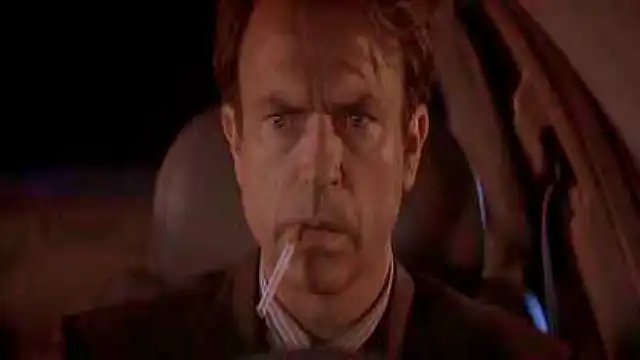
On real state maps, Hobb’s End does not exist. Trent and Styles only find it by cutting up Cane’s paperback covers, aligning the cover art, and discovering a hidden geographic roadmap. When they drive off the highway in pitch darkness, crossing a covered bridge into the fog, they cross the threshold between baseline reality and fiction.
Hobb’s End is a living graveyard of Lovecraftian tropes:
- Grotesque townspeople with shifting, asymmetrical facial features.
- An ancient, Byzantine black church standing menacingly at the center of town.
- Creepy children playing cruel games in cobblestone alleys.
- Monstrous beasts with slimy tentacles lurking beneath the cellar doors.
Sutter Cane is holed up inside that towering black church, clacking away on a manual typewriter. He is not the grand puppeteer pulling the strings. Cane is merely a vessel. The Old Ones are whispering the stories directly into his skull.
He writes because he has to. Every tap of his typewriter keys punches another hole through the barrier separating humanity from the cosmic void.
“I Think, Therefore You Are”: Ink on Paper
John Trent’s tragedy lies in his unwavering confidence.
When we meet Trent, he is an arrogant, sharp-dressed insurance investigator who sees through everyone’s bullshit. He can spot an arsonist by looking at receipts. He can tell if a man is faking an injury by the angle of his gait. Trent believes the world is cold, mechanical, and predictable. He laughs off the supernatural as cheap theatrics designed to sell books.
That supreme rationalism is precisely why Sutter Cane chose him.
When Trent confronts Cane inside the church, demanding to know the trick behind Hobb’s End, Cane looks at him with genuine pity and chilling amusement:
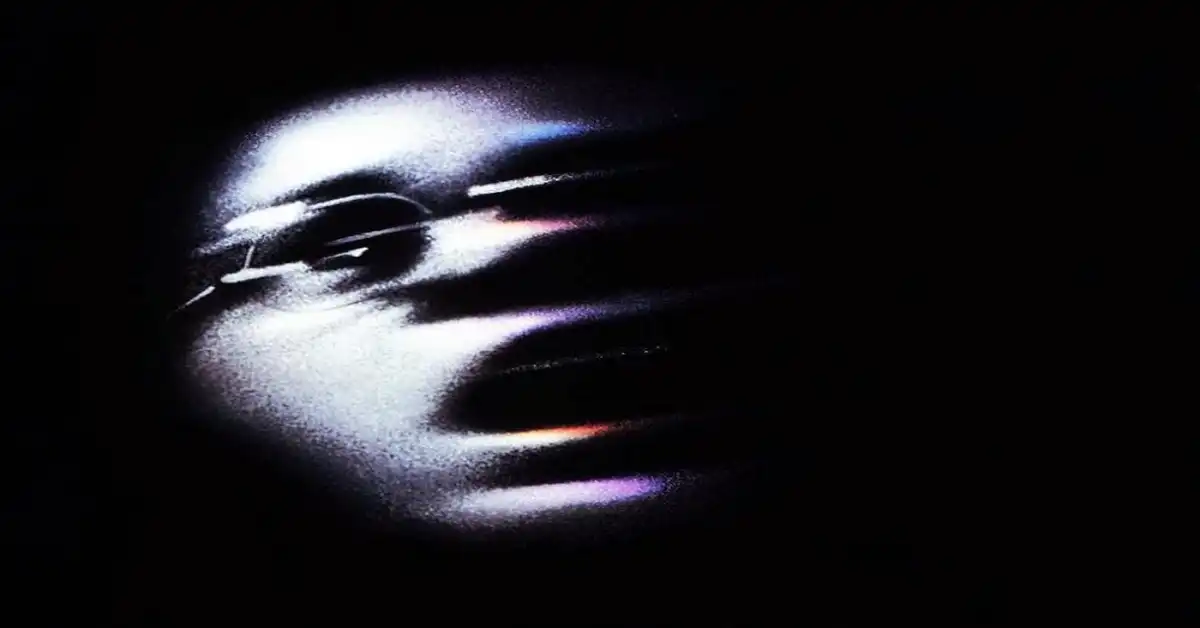
“Did you ever think you might just be a character in one of my books? … You can’t leave, John. I wrote you. I think, therefore you are.”
Consider how deeply horrifying that realization is.
Philosopher René Descartes famously proclaimed, “I think, therefore I am,” proving human existence through self-awareness. Cane takes that foundational principle of Western philosophy and butchers it: I think, therefore YOU are. Trent’s self-awareness is not proof of his humanity; it is just an attribute his author gave him to make the story compelling.
To prove his point, Cane tears his own face open down the center seam like a sheet of paper. Behind his skin is not muscle, blood, or bone — only a vortex of black cosmic ink and screaming voids.
Trent flees. He jumps in his car, stomps the gas pedal, and speeds down the highway. Every time he tries to leave town, the headlights sweep across the road, and he finds himself looping back to the exact same street corner in Hobb’s End. He cannot drive away from the setting because the author hasn’t written a scene outside the town yet.
Even when Trent finally makes it back to the real world, hands over the completed manuscript to the publisher, and tries to burn the pages, he fails. The publisher cheerfully informs him that Trent delivered the manuscript weeks ago. The book is already printed. The movie adaptation is already shot. The ink was dry before Trent even took his first breath.
The Asylum Crosses: The Futile Shield
The framing story of the film takes place inside a sterile mental institution. A visiting psychiatrist, Dr. Wrenn, enters Trent’s padded room to evaluate him.
The room is a visual shock.
Trent has used a single black crayon to cover every square inch of the white padded walls with hand-drawn asylum crosses. He has drawn them on the floor, on the ceiling, on the window frame, on his clothes, and even all over his face and arms.
Why did he cover himself in crosses?
On the surface, it looks like religious mania. Historically, the cross is humanity’s ultimate talisman against evil — a divine sign that promises salvation, protection, and holy intervention.
In a Lovecraftian cosmos, however, traditional religion is completely meaningless. The Old Ones do not fear crucifixes, holy water, or scripture. They existed before stars ignited, long before humanity invented languages or gods.
The crosses are Trent’s tragic, desperate attempt to create a line of demarcation. He is begging for order in a universe that has dissolved into formless chaos. He drew them because he knew the psychiatric staff would look through the door peephole, see a raving madman, and keep the heavy steel door locked tight.
Trent’s greatest desire was not freedom; it was containment. Being locked in an asylum padded room was the only way he could feel safe from the creeping madness consuming the globe. When the asylum doors finally swing open, abandoned by the slaughtered staff, Trent has nowhere left to hide.
The Fourth Wall Shatters: The Audience Is Infected
Screenwriter Michael De Luca crafted one of the boldest meta-twists in modern screenwriting.
Toward the end of the film, Trent is told that while the novel drove millions insane, an upcoming film adaptation would reach everyone else. People who do not read books still watch movies. The film adaptation would deliver the fatal psychological payload to the illiterate, the indifferent, and the holdouts.
When Trent enters the empty cinema at the end, what movie is playing on the projector?
It is John Carpenter’s In the Mouth of Madness.
On screen, Trent watches earlier scenes from the very movie we just spent ninety minutes watching. He watches himself talking to his boss. He watches himself arguing in the car with Styles. He watches his own panic.
Suddenly, the fourth wall does not just crack; it dissolves entirely.
Carpenter turns the camera around and points it squarely at us. If Sutter Cane’s fictional movie is the vector that infects anyone who watches it, what does that mean for the viewer sitting in the audience watching John Carpenter’s film?
It means we took the bait. We sat in the dark, consumed the exact same images, and allowed Cane’s story into our subconscious. The virus did not stop at the edge of the screen; it reached through the lens and pulled the real world into the fiction.
Why Trent Was Laughing: The Sound of Surrender
That brings us back to the central question: why was Trent laughing?
If you found out that your family, your memories, your choices, and your suffering were just lines written by a pulp author to sell cheap paperbacks, how would you react? Would crying change anything? Would screaming help?
Not a chance.
Trent’s laughter is not happiness, and it is not simple insanity. It is the ultimate expression of cosmic surrender.
Throughout the film, Trent fought like a cornered beast to prove his independence. He told Cane he was a fraud. He threw the manuscript away. He desperately tried to cling to rational laws. Every single action he took to prove his free will was merely following the script Cane had already typed out.
When Trent sits in that cinema, he is finally relieved of the burden of being John Trent. There is no point in grieving for a dead world when the world was never real to begin with. There is no reason to fight for a future that was never written.
He laughs because the absurdity is overwhelming. In a world gone totally mad, being insane is the only sane choice left. He eats his popcorn, stares up at his fictional self on screen, and enjoys the show.
For a deep dive into the psychological collapse of the final scene, watch this In the Mouth of Madness Ending Breakdown.
This video breaks down the psychological collapse of John Trent and explains every beat of John Carpenter’s reality-bending climax.

