

Early in Christopher Nolan’s Oppenheimer, a tortured young physicist injects potassium cyanide into an apple and leaves it on his tutor’s desk. The scene reaches a frantic peak when Robert knocks the fruit out of quantum pioneer Niels Bohr’s hand just before he takes a bite. It stands out as one of the movie’s most jarring sequences, but the true historical story behind that apple is far messier, darker, and stranger than Hollywood let on.
Fact vs Fiction at a glance
Did Robert Oppenheimer actually try to murder his Cambridge tutor with a poisoned piece of fruit?

The short answer: something very strange happened in the autumn of 1925, but the movie invented its biggest twists for dramatic flair.
| Christopher Nolan’s Film (2023) | Historical & Biographical Record |
|---|---|
| Uses lethal potassium cyanide | Chemical was never verified (likely lax) |
| Niels Bohr almost takes a bite | Pure fiction; Bohr was not present |
| Robert snatches the apple back | Never happened; no dramatic last-second |
| Tutor Patrick Blackett is humiliated | Blackett never knew until university met |
| Father pays off the administration | True; Julius Oppenheimer intervened |
| Required to see a psychoanalyst | True; placed on probation for therapy |
The 1925 cavendish breakdown: why robert spiraled
To make sense of the apple incident, you have to understand just how miserable twenty-one-year-old Robert Oppenheimer was in England.
After graduating summa cum laude from Harvard in just three years, Oppenheimer arrived at Cambridge University’s world-renowned Cavendish Laboratory in the fall of 1925. He expected to dive straight into theoretical physics. Instead, legendary laboratory director J.J. Thomson assigned him to experimental work under a brilliant, rising physicist named Patrick Blackett.
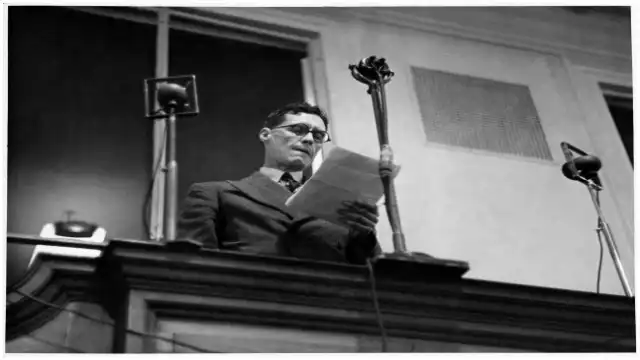
Blackett was everything Oppenheimer was not: a handsome, athletic former naval officer with incredible mechanical skill.
Blackett demanded that Oppenheimer spend long, tedious days in the lab:
- Coating delicate glass slides with thin films of beryllium.
- Soldering copper joints and troubleshooting temperamental vacuum pumps.
- Running hands-on laboratory apparatus that required physical precision.
Oppenheimer was clumsy with his hands. He constantly broke glassware, botched measurements, and felt completely out of his depth.
“I am having a pretty bad time,” Oppenheimer wrote to a friend in 1925. “The lab work is a terrible bore, and I am so bad at it that it is impossible to feel that I am learning anything.”
His clumsy benchwork quickly fueled a vicious psychological spiral. He stopped eating, smoked relentlessly, paced his room in bouts of severe depression, and grew to resent Blackett with burning intensity.
Apple incident: what do firsthand sources say?
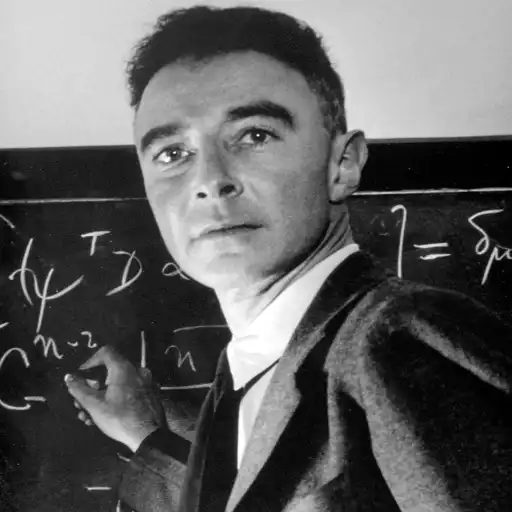
The primary source for the poisoned apple story comes from Kai Bird and Martin J. Sherwin’s Pulitzer Prize-winning biography, American Prometheus.
The authors drew heavily upon the recorded recollections of two of Oppenheimer’s closest Harvard friends: Francis Fergusson and Jeffries Wyman.
Francis fergusson’s account
Fergusson, who remained a lifelong confidant, recalled that Oppenheimer came to him in late 1925 and made a startling confession: he had laced an apple with toxic chemicals and placed it on Blackett’s desk.
According to Fergusson, Robert felt consumed by jealousy and resentment over Blackett’s relentless lab assignments. However, Fergusson noted that Oppenheimer claimed the chemicals were intended merely to make Blackett sick — functioning more like an emetic or a severe digestive irritant — rather than to kill him.
Jeffries Wyman’s recollection
Wyman, another close companion studying at Cambridge at the time, heard a similar version of the event. He remarked that whether the poison was lethal or just a stomach-churning concoction, the act itself signaled a young man standing on the edge of a complete mental breakdown.
Did Blackett ever eat the apple?
No. Blackett never took a bite, and there is zero evidence that he ever fell ill from anything on his desk.
Julius Oppenheimer to the rescue
If nobody ate the apple, how did university administrators find out?
Word of the incident reached the university leadership at Christ’s College, Cambridge. University officials viewed the act with extreme gravity. They alerted local authorities and initiated steps to expel Oppenheimer immediately, with the possibility of formal criminal charges.
Robert’s father, Julius Oppenheimer, caught the first available ocean liner across the Atlantic.

Julius was a wealthy New York textile importer with extensive social connections and deep pockets. He met with Cambridge administrators, pleading that his brilliant son was suffering from a temporary nervous breakdown rather than premeditated malice.
The Cambridge University Agreement
| Probationary Status | Mandatory Psychoanalysis |
|---|---|
| No criminal charges pressed; avoided permanent expulsion from Cambridge. | Required to attend regular therapy sessions with prominent Freudian analysts in London. |
The bargain worked. Cambridge agreed not to press charges on two strict conditions: Robert was placed on academic probation, and he had to undergo regular treatment with top psychiatric specialists on Harley Street in London.
Those psychiatric sessions yielded little progress. One London psychoanalyst diagnosed him with dementia praecox (an archaic label for schizophrenia) and declared him untreatable. Another analyst simply gave up after Robert refused to open up during appointments.
The Niels Bohr scene
Why did Christopher Nolan show Niels Bohr holding the apple?
In the movie, Danish physicist Niels Bohr (played by Kenneth Branagh) visits the Cambridge lab. He picks up the green apple from Blackett’s desk, chats about quantum mechanics, and lifts the fruit toward his mouth. A panicked Oppenheimer lunges forward, grabs the apple, tosses it into the trash, and tells Bohr it had gone bad.
This moment is 100% fictional.
Niels Bohr was nowhere near Cambridge when the apple incident occurred. Screenwriter and director Christopher Nolan added Bohr into the scene as visual shorthand.
In film, internal panic is hard to communicate. By putting the father of quantum theory within inches of fatal poisoning, Nolan instantly showed audiences the terrifying real-world stakes of Robert’s unstable mind.
It worked brilliantly on screen, but it never happened in history.
Did the poisoning even happen?
Following the release of Nolan’s film, Oppenheimer’s grandson, Charles Oppenheimer, publicly pushed back against the scene.
Charles pointed out a vital historical nuance: there are no surviving university records, police reports, or official disciplinary files that mention a poisoned apple by name.
The entire story survives solely through secondhand oral histories told by Francis Fergusson and Jeffries Wyman decades after the fact.
This raises a fascinating historical question: Did Robert actually poison an apple, or did he merely hallucinate the act during a manic, sleep-deprived episode?
Throughout the winter of 1925 – 1926, Oppenheimer exhibited extreme symptoms of psychosis:
- During a holiday trip to Paris, he suddenly jumped on Francis Fergusson and tried to strangle him with a luggage strap after Fergusson announced his engagement.
- He frequently fell into catatonic trances where he would sit on the floor and mutter incoherently for hours.
- He confessed bizarre, exaggerated fantasies to friends while sobbing uncontrollably.
Many modern biographers believe Robert may have had a severe manic episode where he thought about poisoning an apple, bragged about it, or left an apple with an ordinary chemical spill, which grew into a legendary tale among his peer group.
Finding salvation in göttingen
How did Oppenheimer escape the dark cloud of Cambridge?
His salvation arrived in the spring of 1926 when German physicist Max Born visited Cambridge. Born recognized that Oppenheimer was a dreadful laboratory experimenter but an absolute genius at mathematical physics.
Born invited him to the University of Göttingen in Germany — the world capital of quantum mechanics.
Once free from the test tubes, beryllium plates, and vacuum pumps of Blackett’s lab, Oppenheimer flourished. At Göttingen, he worked alongside Werner Heisenberg, Wolfgang Pauli, and Enrico Fermi, publishing seminal papers on quantum theory and earning his PhD at age twenty-three.
The poisoned apple remained a dark, shadowy footnote from his youth — a reminder of a brilliant mind pushed to the very brink before finding its true calling.

