

Uglies (2024) Movie Review & Ending Explained: Netflix’s Dystopian Adaptation Analyzed
Netflix’s sci-fi film Uglies brings Scott Westerfeld’s 2005 dystopian novel to the screen after nearly two decades stuck in development limbo. Directed by McG and starring Joey King, the story follows a futuristic city that enforces extreme cosmetic surgery on sixteen-year-olds under the guise of equality. While the feature delivers energetic hoverboard sequences and colorful cyberpunk visuals, it struggles to capture the psychological nuance that made the original book a classic.
How the world of Uglies works
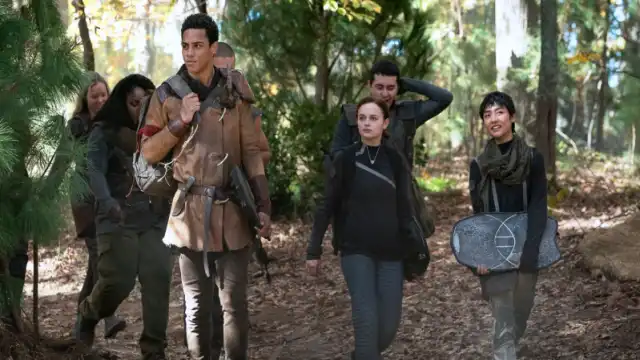
The story takes place three centuries after human civilization collapsed from fossil-fuel exhaustion and ecological warfare. To survive, scientists engineered a self-sustaining city powered by a genetically modified white orchid.
To eliminate human conflict, discrimination, and jealousy, society established an absolute cosmetic mandate:
- The “Uglies” (Ages 0 – 15): Children live in segregated dormitories and are conditioned to view their natural bodies as flawed, asymmetrical, and inadequate.
- The “Pretties” (Age 16+): On their sixteenth birthday, every teenager undergoes extensive surgical restructuring. Surgeons modify their bone structure, facial symmetry, skin texture, and eye color. Afterward, they move across the river into a glittering metropolis dedicated entirely to partying, pleasure, and zero responsibilities.
Tally Youngblood (Joey King) is counting down the days until her sixteenth birthday. Her best friend Peris (Chase Stokes) turns sixteen first, gets the operation, and crosses into the city. When Tally sneaks across the river to visit him, she discovers a hollow stranger who barely cares about their shared past.
Everything changes when Tally meets Shay (Brianne Tju), another teenage rebel. Shay refuses the surgery, introduces Tally to secret hoverboarding outside the city walls, and runs away to join “The Smoke” — an underground settlement of outcasts living off the grid.
Plot breakdown

When Tally arrives for her scheduled operation, the city’s ruthless head of Special Circumstances, Dr. Cable (Laverne Cox), presents an ultimatum. Tally must hunt down Shay and activate a tracking pendant to reveal the location of The Smoke. If she refuses, Dr. Cable will deny her the Pretty surgery forever, leaving her an outcast.
Tally travels across the dangerous wilderness following a cryptic riddle left by Shay. Upon arriving at The Smoke, she discovers an entirely different way of living:
- Natural Aging and Free Will: Smokies work physical jobs, wear simple clothes, build with timber, and age naturally without medical alteration.
- The Truth About the Orchids: Rebel leader David (Keith Powers) shows Tally that the city’s prized white orchids are an invasive monoculture that chokes out all native plant life and ruins the soil.
- The Brain Lesion Revelation: David’s parents, Az (Jay DeVon Johnson) and Maddy (Charmin Lee), were once city surgeons. They reveal that the Pretty surgery does far more than reshape skin and bones — it introduces microscopic brain lesions. These lesions blunt critical thinking, quell curiosity, and render the population docile and compliant. Only a select elite are spared to run the government and military.
Horrified by the truth, Tally renounces the city and throws her tracker pendant into a bonfire. The heat inadvertently triggers the transmitter, broadcasting the settlement’s coordinates straight to Dr. Cable.
Uglies ending explained
The climax begins when Dr. Cable’s enforcement squad raids The Smoke, capturing most of the rebels.Among the attackers is Peris, who has been upgraded into a ruthless, emotionless super-soldier called a “Special”.Peris kills David’s father Az during the attack, shattering any remaining connection between him and Tally.
The rescue mission and shay’s fate
Tally and David sneak back into the high-tech city to liberate the imprisoned Smokies. By the time they breach the operating theater, Dr. Cable has already forced Shay through the surgical procedure.
The transformed Shay is unrecognizable in spirit. Her fiery rebellion has evaporated into blissed-out, shallow contentment. When Maddy announces she has synthesized a cure for the brain lesions, Shay refuses to take it. Because the cure is unproven and Shay cannot give informed consent in her altered state, Maddy refuses to force it on an unwilling patient.
“Make Me Pretty”
To test the cure ethically, someone must consent before getting the brain lesions. Tally volunteers to surrender to Dr. Cable, undergo the operation, and serve as the cure’s human test subject.
David protests, knowing the surgery will wipe away the person he loves. Tally reassures him:
“I’m Tally Youngblood. Make me pretty.”
This iconic closing line from Westerfeld’s 2005 novel marks her surrender to the machine in order to destroy it from within.
The final shot: what does the scar mean?
The movie ends with Tally living in a high-rise Pretty apartment. Her face is polished, smooth, and symmetrical. Her hair is styled, and she wears the standard luxurious Pretty attire.
As she looks out over the skyline, she glances down at her right hand. The childhood scar she cut into her palm to match Peris is still there.
During standard surgery, all scars, birthmarks, and imperfections are scrubbed away. The fact that Tally kept her physical scar is her visual cue to David — and the audience — that her authentic memory and willpower survived the brain modification.Her mind is still her own, setting the stage for a potential counter-offensive.
Book vs Movie
Readers of the original book series will notice several major narrative divergences in McG’s film:
| Story Element | Scott Westerfeld’s Novel (2005) | Netflix Adaptation (2024) |
| Peris’ Role | A minor character who mostly fades into the background after turning Pretty. | Turned into an aggressive “Special” super-soldier who murders David’s father. |
| Dr. Cable’s Presence | A cold, shadowy bureaucrat operating from the background. | A hands-on, prominent antagonist present in nearly every major turning point. |
| The Orchid Conflict | Orchids are a weed spreading across the wild, threatening biodiversity. | Orchids serve double duty as the city’s primary bio-fuel power grid. |
| Pacing of the Rebellion | Slow, grounded exploration of wilderness survival and psychological body dysmorphia. | Fast-paced, action-heavy chase scenes filled with hoverboard stunts and explosions. |
| The Final Scene | Ends immediately on the line “Make me pretty.” | Shows Tally post-surgery in the city with her hand scar intact. |
Why the dystopian film misses the mark
The book Uglies arrived in 2005, well before The Hunger Games and Divergent triggered a Hollywood young-adult gold rush. By the time Netflix released this film in September 2024, the cultural landscape had shifted drastically. What was once a fresh critique of cosmetic consumerism now struggles with several creative hurdles.
1. The casting paradox
The fundamental flaw of the film lies in its visual medium. Joey King, Chase Stokes, and Brianne Tju are conventionally attractive Hollywood actors. Watching flawless twenty-somethings lament how “horrendous” and “repulsive” their natural faces look feels disconnected from reality.
Instead of showing genuine physical flaws, the production relied on digital smoothing filters and heavy makeup to indicate the “Pretty” transformation.The resulting look falls straight into the uncanny valley, making the Pretties look more like filtered social media avatars than aspirational human beings.
2. Style over subconscious dread
Westerfeld’s book excelled because it tackled the insidious nature of systemic peer pressure. The tragedy wasn’t that the government held people at gunpoint; it was that the kids wanted the surgery. They actively hated their own bodies because society taught them to.
The movie trades this psychological unease for generic action-movie beats. By turning Peris into a murderous Terminator-style brute and ramping up aerial CGI battles, the film loses the quiet, tragic heart of its source material.
3. Outdated YA tropes
The film leans on familiar narrative shortcuts:
- The instant, unearned love triangle between Tally, David, and Shay.
- Extended training montages on hoverboards that halt narrative momentum.
- Villain monologues that overexplain every philosophical motive.
Film overview & specifications
| Detail | Specification |
| Title | Uglies |
| Release Date | September 13, 2024 (Netflix) |
| Director | McG (Joseph McGinty Nichol) |
| Screenplay | Jacob Forman, Jon Krasner, Krista Vernoff |
| Based On | Uglies by Scott Westerfeld |
| Starring | Joey King, Keith Powers, Brianne Tju, Chase Stokes, Laverne Cox |
| Runtime | 100 Minutes |
| MPA Rating | PG-13 (Violence, Action, Thematic Elements) |
Will netflix make an Uglies 2 (Pretties)?
Director McG has stated publicly that the creative team designed Uglies as the opening chapter of a wider trilogy. The book franchise includes three direct sequels: Pretties, Specials, and Extras.
If Netflix greenlights a sequel, the second film will adapt Pretties, following Tally as she navigates high society with her new body while trying to trigger the hidden cure before the mental fog overtakes her permanently.

