
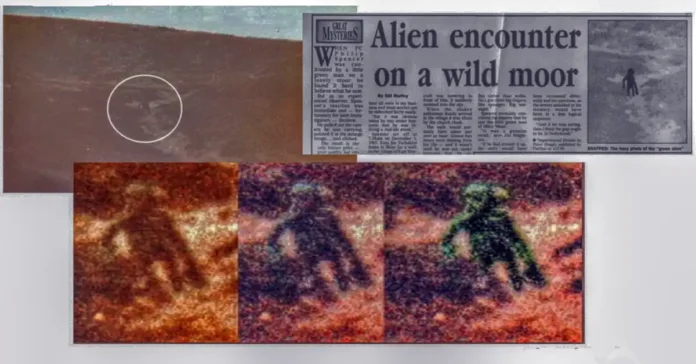
The Ilkley Moor UFO Incident: Britain’s Most Controversial Alien Photograph
On a foggy December morning in 1987, a retired police officer walked onto a bleak West Yorkshire moor and snapped a photo that still divides investigators today. He claimed the blurry figure in the frame was a four-foot green creature that vanished into a hovering saucer. Almost four decades later, nobody has definitively proved whether that snapshot captures an extraterrestrial visitor or a clever prank.
The witness account: Morning fog and missing time
To understand the Ilkley Moor UFO Incident, you first have to look at the guy holding the camera. The witness goes by the pseudonym Philip Spencer. He wasn’t a thrill-seeker looking for fame. Spencer had recently retired from the London Metropolitan Police and moved north to West Yorkshire with his wife and child to be closer to family.
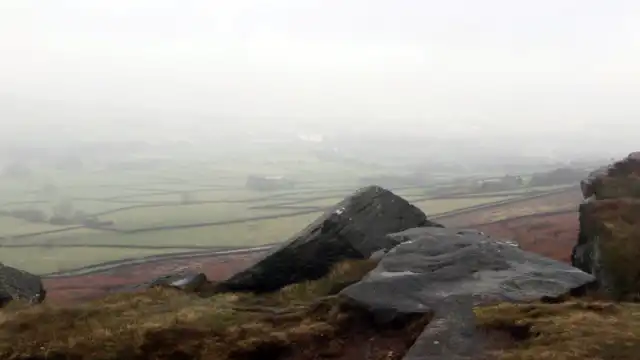
Around 7:00 AM on December 1, 1987, Spencer set out on foot across the rugged expanse between Ilkley and Keighley. His destination was his father-in-law’s house in the nearby village of East Morton. Because winter mist rolls over those hills fast, he packed two sensible tools: a standard compass to keep his bearings and a loaded camera to catch the early morning light.
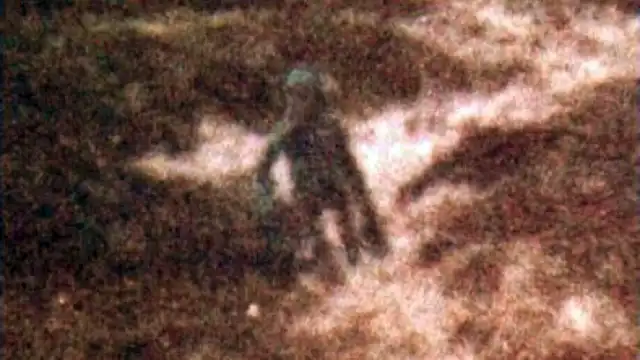
Things got weird as he climbed a small rise. Peering through the grey haze, Spencer spotted a small figure standing on the trail ahead. At first, he figured it was just another local walker. Then he got closer and stopped dead in his tracks.
Here is what Spencer described to investigators:

- Height and build: The creature stood roughly 1.2 metres (about four feet) tall with a thick torso, stubby legs, and unusually long, thin arms.
- Color and head: Its skin looked dark green, topped by a disproportionately large head.
- The gesture: When Spencer called out, the figure turned, raised one long arm, and waved a hand in a motion he read as a clear warning to back off.
Instinct kicked in. Spencer raised his camera and clicked the shutter. Immediately after the flash of the shutter mechanism, the creature bolted up the slope at an unnatural speed.
Spencer chased after it, losing sight of the figure in the thick fog. Moments later, a deep, throbbing hum vibrated through the air. Spencer watched a massive, whitish craft — shaped like two saucers clamped together rim-to-rim — lift off from the moorland and shoot upward into the clouds. Oddly enough, he never took a picture of the ship itself.
Shaken and disoriented, Spencer abandoned his route to East Morton and walked into a neighboring town instead. When he checked a public clock, his stomach dropped. A walk that should have taken thirty minutes had somehow eaten up nearly two hours. Even stranger, the needle on his trusty compass was pointing due south instead of north — its magnetic polarity completely reversed.
Inside the original photograph and lab tests
Days after the 1987 UFO sighting, Spencer reached out to veteran British UFO researchers Jenny Randles and Peter Hough. Hough admitted he was deeply skeptical at first. Plenty of people spin tall tales, right? Yet Spencer’s calm, matter-of-fact police demeanor — and his flat refusal to accept a single penny or reveal his real name — convinced Hough to take the film seriously. Spencer even signed over the copyright of the image to Hough so nobody could accuse him of chasing a payday.
When the film was developed, the alien photograph immediately sparked a firestorm. Looking closely at the frame, you can see a patch of light snow or frost on the dark peat ground. Right in the middle stands a blurry, greenish-grey silhouette with long arms hanging down toward its knees.

Hough didn’t just take Spencer’s word for it. He visited the exact spot on the moor to check angles and sent the negative out to several independent specialists:
- Kodak Laboratories (Hemel Hempstead): Technicians examined the physical negative for signs of double exposure, darkroom trickery, or pasting. Their verdict? No evidence of photographic tampering existed on the film.
- Wildlife Specialists: A professional wildlife photographer analyzed the shape and proportions to rule out a stray deer, hare, or game bird caught mid-motion. They confirmed the figure did not match any known British animal.
- Optical Analysis: U.S. Navy optical physicist and researcher Bruce Maccabee studied the print. His conclusion was blunt: while authentic as a raw exposure, the image was far too grainy and low-resolution for definitive computer enhancement.
Later, Spencer underwent hypnotic regression to probe his missing two hours. Under hypnosis, a much wilder story emerged — an alien abduction case involving paralysis, a medical exam aboard the saucer, and apocalyptic visions of Earth’s future. Interestingly, even staunch supporters of the photo tend to treat the hypnosis memories with caution, knowing how easily human imagination fills in blank spaces under suggestion.
Skeptical explanations: what else could it be?
Not everyone buys the extraterrestrial angle. In fact, if you ask a critical investigator about this West Yorkshire UFO encounter, they will point out several glaring holes in the story.
First, consider the geography. Ilkley Moor isn’t isolated wilderness; it sits right near major infrastructure. RAF Menwith Hill — a massive intelligence and communications base — is just a short drive away, and Leeds Bradford Airport operates nearby. Low-flying aircraft, military exercises, and atmospheric reflections over Rombald’s Moor explain dozens of routine sky-watching reports in the region.
Second, look at the photograph itself. Critics argue that the very thing supporters love — its graininess — is actually its biggest flaw. When an image lacks sharp detail, the human brain plays a trick called pareidolia, forcing recognizable faces or limbs onto random shapes. Skeptics have proposed far simpler, earthbound culprits for the mysterious silhouette:
- A distant hiker or child: Through dense morning mist, a person wearing a bulky winter parka or waterproof poncho can easily look distorted, short-legged, and weirdly proportioned.
- A staged prop: Some doubters suggest the figure could be a painted cardboard cutout or a small plastic figurine placed carefully in the foreground to trick the camera’s depth of field.
- The missing craft photo: This is the biggest sticking point for many investigators. Spencer had his camera ready, had just snapped a creature, and watched a huge glowing saucer hover in front of him — yet didn’t take a single frame of the ship. Why snap the blurry runner and miss the giant spaceship?
As for the reversed compass needle, skeptics note that a simple pocket magnet can flip a compass’s polarity in two seconds flat. Without independent witnesses on the trail that morning, the physical evidence rests entirely on one man’s honesty and one fuzzy picture.

Modern analysis vs 1987 forensics
How does the case hold up under today’s investigative lens? Looking at the Ilkley Moor mystery side-by-side shows why modern digital tools still struggle with analog ghosts.
| Investigative Angle | 1987 Assessment | Modern Digital Perspective |
| Film Integrity | Kodak found zero darkroom manipulation on the negative. | Confirms the photo wasn’t faked in post-production, though an in-camera prop remains possible. |
| Image Resolution | Bruce Maccabee noted extreme grain prevented deep analysis. | Modern AI upscaling actually hurts here — it invents pixels that aren’t there, creating false details. |
| Witness Credibility | Viewed as highly reliable due to police background and anonymity. | Modern investigators still value his lack of financial motive, though hypnosis testimony is widely discounted. |
| Environmental Context | Focused heavily on nearby stone circles and local folklore. | Emphasis shifts to optical distortion in heavy moorland fog and military radar corridors. |
Modern image analysts emphasize an important rule: you cannot extract detail from a photograph that the lens never captured. When internet hobbyists run Spencer’s 1987 print through modern sharpening filters, the software guesses at edges, accidentally turning blurry pixels into “alien ears” or “metallic suits”. Stripped of digital guesswork, the original print remains just as ambiguous today as it was in 1987.
Why the case remains unsolved
So, why hasn’t the Ilkley Moor UFO Incident faded into forgotten trivia like thousands of other eighties sightings?
It comes down to a stalemate of motives and evidence. Usually, hoaxes unravel because someone slips up, brags to a friend, or tries to cash a check. Philip Spencer never cashed in. He never wrote a bestseller, never went on a paid speaking tour, and quietly faded back into private life. Adding fuel to the fire, UFO historian Nick Redfern later reported that British Ministry of Defence personnel visited Spencer’s home shortly after the sighting — a detail that keeps conspiracy theorists wide awake.
At the same time, science demands more than an honest witness and a grainy smudge. Without a clear photograph of the saucer, radar logs, or a second hiker backing up the story, the picture sits permanently in limbo. You can stare at that figure on the frosty trail and see a visitor from another star system — or just a trick of Yorkshire fog and imagination. And honestly, that razor-thin line between proof and illusion is exactly why people are still arguing about it.

