

The JonBenét Ramsey Ransom Note Explained: What the Evidence Shows
You waking up the morning after Christmas, walking down your own staircase, and finding a three-page letter demanding money for your child’s life. That is exactly the nightmare Patsy Ramsey described to Boulder police on December 26, 1996.
The brutal murder of six-year-old JonBenét Ramsey remains one of the most polarizing unsolved mysteries in American history. While modern detectives furiously chase microscopic DNA samples using advanced genetic genealogy, seasoned investigators keep circling back to one stubborn piece of physical evidence.
The ransom note.
True crime buffs know that real kidnappers do not sit inside a dark house writing 300-word essays. The letter found on the Ramsey family’s staircase defies every single rule of criminal behavior. Did an international terrorist faction really break into a Colorado mansion, or was the letter an elaborate cover-up staged by someone already inside?
Breaking down the forensic handwriting analysis reveals a chilling narrative that DNA alone cannot explain.
Need to know
- The Unprecedented Length: Spanning two and a half pages, this document is the longest ransom letter in FBI history.
- The Tools Used: The killer didn’t bring the letter. They drafted it using a legal pad and a Sharpie pen pulled directly from the Ramsey kitchen counter.
- The Exact Dollar Amount: The $118,000 demand perfectly matched John Ramsey’s annual corporate bonus down to the exact dollar.
- The Handwriting Stalemate: Forensic experts officially cleared John Ramsey as the author, but they could never definitively clear or indict Patsy Ramsey.
Why the Letter Defies Logic
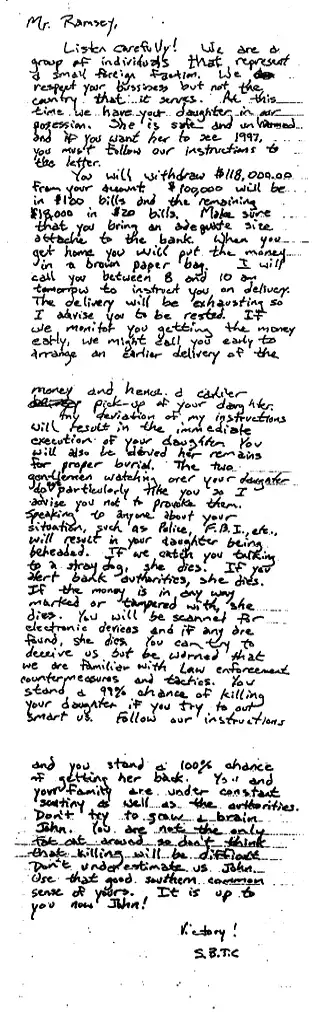
If you want to understand why this case has paralyzed law enforcement for thirty years, you have to read the actual text. The letter claims to be from a “small foreign faction” that respects John Ramsey’s business but hates the United States. It threatens to behead JonBenét if the parents contact the police.
Read it closely, and the cracks immediately start to show.
First, consider the sheer length of the document. Criminals want to get in and get out. The longer you stay at a crime scene, the higher your chances of getting caught. Yet, this intruder allegedly spent over twenty minutes sitting in a dimly lit house drafting a 370-word manifesto.
Even more baffling? The killer arrived completely empty-handed. They grabbed a notepad belonging to Patsy Ramsey and used a black Sharpie pen that was sitting by the family telephone. Police actually found practice drafts inside the nearby trash can. The writer started a version, messed up, tore it off, and started over.
Does that sound like a tactical foreign terrorist cell executing a flawless kidnapping operation?
Then there is the bizarre financial demand. Why ask a multi-millionaire CEO for exactly $118,000? Most kidnappers demand clean, round numbers like a million dollars. Investigators quickly realized that $118,000 was the exact amount of the corporate bonus John Ramsey received earlier that year. The killer either had intimate knowledge of John’s private finances, or someone inside the house picked a number that was already stuck in their head.
The Handwriting Experts Weigh In

When the Colorado Bureau of Investigation (CBI) got their hands on the letter, they immediately demanded writing samples from both parents.
John Ramsey passed his test quickly. His penmanship looked absolutely nothing like the cramped, frantic script on the legal pad. He was officially ruled out as the author.
Patsy Ramsey was a completely different story.
Investigators collected dozens of historical writing samples from Patsy. They pulled old grocery lists, Christmas cards, and personal letters written long before the murder occurred. When forensic document examiner Chet Ubowski compared her letters to the ransom note, the results were deeply unsettling.
Ubowski concluded that the handwriting showed significant “indications” that Patsy Ramsey was the author. He pointed out striking similarities in how certain letters were formed, specifically the lowercase “a” and the unique way the writer crossed their “t”s.
Despite these massive red flags, the results were ultimately classified as inconclusive. Why? Handwriting analysis is notoriously subjective. It is not an exact science like fingerprinting or blood typing. A sharp defense attorney can easily argue that the killer deliberately disguised their writing, or that Patsy’s handwriting simply shared common traits with millions of other people. Because the state could not guarantee a 100% mathematical match, the evidence never translated into a criminal indictment.
Some detectives also noted a strange phenomenon following the murder. They claimed Patsy’s handwriting drastically changed in the years after 1996, suggesting a subconscious attempt to alter her natural style. Whether this was intentional deception or just the psychological trauma of losing a child remains fiercely debated among armchair detectives today.

The Hidden Voice Inside the Text
If the ink couldn’t secure a conviction, what about the words themselves?
Forensic linguistics — the study of language patterns to profile a suspect — ripped the ransom note to shreds. The vocabulary used in the letter does not match the profile of a hardened foreign killer. It reads exactly like a suburban American trying to sound like a movie villain.
In fact, the letter literally quotes Hollywood blockbusters. Phrases like “Don’t try to grow a brain” and “Listen carefully!” are lifted almost word-for-word from 1990s action movies like Speed, Ransom, and Dirty Harry. A highly organized terrorist group does not borrow dialogue from a Keanu Reeves flick.
Furthermore, FBI profilers noticed distinct maternal and feminine language patterns buried in the text. The writer warns John to use his “good southern common sense.” They advise him to be “rested” for the delivery. Real kidnappers do not care if you get a good night’s sleep before handing over the cash. These linguistic quirks heavily suggest the author was an educated American woman projecting a tough, masculine voice.
Even the mysterious sign-off — “S.B.T.C” — remains a massive point of contention. Some analysts believe it stands for “Saved By The Cross,” pointing out that the Ramseys were deeply religious. Others argue it is just a random string of letters designed to look like a terrorist signature.
Physical Impossibilities: Timing and Lighting
To fully grasp the absurdity of the note, you have to put yourself inside the house at 2:00 a.m.
The Ramsey home was massive, spanning several floors with a maze-like layout. The killer supposedly sat at the hallway counter, found the pad, and began writing. To draft nearly 400 words of coherent text requires decent lighting and immense concentration.
Doing this while the parents of the victim are sleeping just one floor above you takes a level of psychological nerve that criminal profilers find impossible to swallow. A barking dog, a creaking floorboard, or someone waking up for a glass of water would have completely derailed the entire operation.
How Does the Note Fit the DNA?
If you fast forward to today, the landscape of the investigation looks radically different. The Boulder Police Department and the FBI are no longer focusing heavily on the handwriting. Instead, they are pouring their resources into Investigative Genetic Genealogy (IGG).

Authorities possess a tiny, mixed DNA profile found on JonBenét’s underwear and long johns. It belongs to an unidentified male. For decades, the Ramsey family’s defense team has pointed to this microscopic genetic material as the ultimate proof of an outside intruder. If a random man’s biological material is on the victim, the parents must be innocent, right?
But this creates a massive, glaring paradox.
If a sadistic intruder broke into the house solely to assault and murder a little girl, why write the ransom note at all? Why stage a fake kidnapping? A random predator does not care about John Ramsey’s corporate bonus. A transient killer does not neatly place a three-page essay on the stairs, carefully put the Sharpie back in the pen holder, and then leave the body hidden in the basement wine cellar.
The existence of the note demands a motive that goes far beyond a random act of violence. It points directly toward a frantic, panicked cover-up. Someone needed the police to believe a kidnapping occurred to deflect attention away from the real crime scene downstairs.
Ultimate Dead End?
Thirty years later, the ink on that yellow legal pad is completely dry, but the debate still rages on.
The grand jury that heard the case back in 1999 actually voted to indict both parents for child abuse resulting in death. They made that heavy decision largely because the physical evidence inside the house pointed inward. However, the District Attorney famously refused to sign the indictment, citing a lack of concrete proof beyond a reasonable doubt.
The ransom note is the elephant in the room that refuses to leave. It sits at the very center of the case, perfectly capturing the bizarre, contradictory nature of the tragedy. It is too messy to be the work of a professional, yet too ambiguous to send anyone to prison.
What Do You Think?
Do you believe a terrified intruder sat down and wrote that sprawling manifesto, or does your gut tell you it was a desperate cover-up drafted by someone who lived in that house? How do you reconcile the unknown male DNA with the deeply personal language of the letter?
Drop your theories in the comments below. Let’s keep the discussion respectful as we analyze one of the most heartbreaking cold cases in American history. If you want more deep dives into forensic evidence and true crime case updates, make sure to bookmark our page and subscribe to the newsletter!

