

The Axeman of New Orleans: The Unsolved 1919 Serial Murders Explained
You wake up in the dead of night to the sound of splinters cracking against your bedroom floorboards. You reach for the oil lamp, but a massive silhouette is already looming over your bed, raising a heavy iron blade. Worst of all? The weapon belongs to you.
Between May 1918 and October 1919, this exact nightmare plagued the residents of Crescent City. A elusive predator known simply as the Axeman stalked the streets of Louisiana, breaking into private homes and hacking sleeping families to pieces. He left behind blood-soaked mattresses, broken doors, and an absolute trail of urban panic.
How did an unidentified killer manage to turn the birth of jazz into a desperate tool for human survival? the true story of the Axeman of New Orleans, exposing deep historical prejudices, and examining one of the greatest cold cases in American history.
At a glance
- The Reign of Terror: The Axeman officially targeted the New Orleans metropolitan area for an intense 18-month period, leaving behind at least six dead and nearly a dozen severely injured.
- The Unique Visual Pattern: The killer rarely brought his own weapons. He systematically chiseled wood panels out of back doors and hunted for axes or straight razors already kept inside his victims’ homes.
- The Jazz Ultimatum: On March 14, 1919, The Times-Picayune published an eerie letter supposedly penned by the killer, promising to spare any home blasting hot jazz music on a specific night.
- Ethnic Targeting: The vast majority of the victims were Italian immigrants or Italian-American grocers, highlighting a dark era of systemic cultural tension and local xenophobia (fear of foreigners).
- An Unsolved Void: Despite multiple high-profile arrests and wild theories involving the early American Mafia, the Axeman vanished into thin air and was never caught.
Blood-Stained Timeline: The Axeman’s Calling Card
The terror did not begin with a theatrical warning. It started with the quiet, brutal slaughter of an ordinary working-class couple.
In the early morning hours of May 23, 1918, an Italian immigrant named Joseph Maggio and his wife, Catherine, were sleeping soundly in their apartment above their corner grocery store. An intruder slipped through the back door, fractured their skulls with an axe, and slit their throats with a straight razor.
When Joseph’s brothers discovered the gruesome scene, the couple was barely clinging to life. They tragically passed away within minutes.
Investigators surveying the property noticed a series of highly unusual clues that would quickly become the killer’s signature calling card:
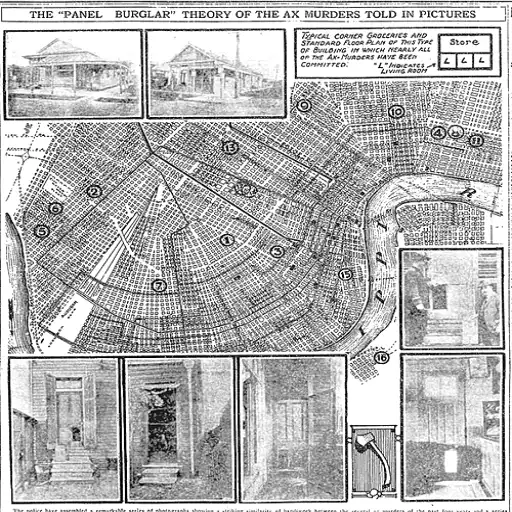
- The Chiseled Panel: A lower wooden panel on the rear door had been systematically gouged out with a chisel to allow the intruder to reach inside and unlock the door.
- The Local Weapon: The bloody axe and razor used in the assault belonged directly to the Maggios. The killer had simply found them on the property.
- The untouched Cash: Despite drawers being rifled through, stacks of money and valuable jewelry were left completely out in the open. Robbery was clearly not the motive.
- The Chalk Message: Just a block away, police found a chilling message scrawled on a sidewalk: “Mrs. Maggio is going to sit up tonight just like Mrs. Toney.”
Much like the Axeman, the mystery surrounding the Beaumont Children’s disappearance remains an enduring cold case that still puzzles investigators today.
The Body Count Rises
Was this just an isolated neighborhood vendetta? New Orleans residents desperately hoped so, but the unfolding months shattered that illusion.
On June 27, 1918, a grocer named Louis Besumer and his companion, Harriet Lowe, were found hacked in their quarters behind their business. While both survived the initial assault, Lowe eventually succumbed to her severe injuries months later after pointing fingers at various false suspects.
By August, the panic reached a fever pitch. On August 5, a young pregnant woman named Anna Schneider awoke to a dark figure standing over her bed. The intruder struck her repeatedly in the face, fracturing her scalp. Miraculously, she survived the bludgeoning and gave birth to a healthy baby girl just two days later.

Five days after that, the Axeman struck again, fatally wounding Joseph Romano in his home. His nieces caught a fleeting glimpse of the attacker as he fled into the dark yard, describing him as a heavy-set, dark man wearing a dark suit and a slouched hat. The city was officially trapped in the jaws of mass hysteria.
The Victims & Survivors of The Axeman of New Orleans
| Victims | Survivors |
|---|---|
| Mary Cortimiglia | Harriet Lowe |
| Rose Cortimiglia | Louis Besumer |
| Anna Schneider | |
| Louis Besumer | |
| Joseph Maggio | |
| Catherine Maggio | |
| Harriet Lowe | |
| Charles Cortimiglia | |
| Sarah Laumann | |
| Mike Pepitone | |
| Joseph Romano |
The chilling anonymity of the Axeman is echoed in the truly horrific and still unsolved Hinterkaifeck murders, another historical crime where the perpetrator vanished.
Letter from Hell: The Night the music saved the city
By early 1919, the public frenzy had cooled slightly. The neighborhoods were finally beginning to breathe a sigh of relief when the killer pulled his most theatrical stunt yet.
On March 14, 1919, The Times-Picayune newspaper published a letter that sent shockwaves through the entire state of Louisiana. The author claimed to be a supernatural entity straight from the underworld.
“They have never caught me and they never will,” the letter boasted in chilling prose. “They have never seen me, for I am invisible, even as the ether that surrounds your earth. I am not a human being, but a spirit and a demon from the hottest hell.”
The writer then issued an extraordinary ultimatum. He announced that at exactly 12:15 p.m. on the night of Tuesday, March 19, he would roam the city looking for victims. However, he offered one bizarre loophole for the terrified populace.
“I am very fond of jazz music, and I swear by all the devils in the nether regions that every person shall be spared in whose home a jazz band is in full swing… One thing is certain and that is that some of your people who do not jazz it on Tuesday night (if there be any) will get the axe.”
   The Axeman's Jazz Night Paradox (March 19, 1919)
   =================================================
   [The Threat]  --> Unfiltered slaughter for quiet homes
   [The Command] --> Play live or recorded jazz music
   [The Result]  --> City-wide parties; zero murders reported
The Ultimate jazz party
How would you react if a serial killer threatened your neighborhood? In 1919 New Orleans, the answer was to throw the loudest party the American South had ever seen.
On the night of March 19, the city transformed into a massive, booming musical festival. Professional jazz ensembles packed into local dance halls like the local infamy spots. Families huddled around their mechanical phonographs, blasting the latest jazz records into the humid night air.
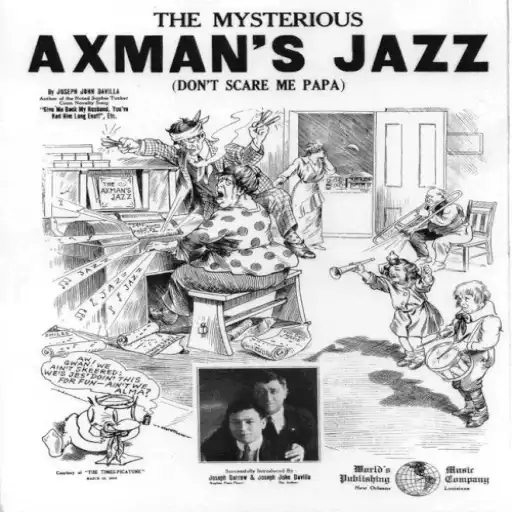
Amateur musicians played trumpets and trombones on front porches. Local composer Joseph John Davilla even rushed out a brand-new sheet music track titled “The Axeman’s Jazz (Don’t Scare Me Papa)” to cash in on the madness.
Did the trick actually work? Unbelievably, yes. The clock struck midnight, the music played on, and dawn arrived without a single drop of blood being spilled. The Axeman kept his word.
Xenophobia and the Italian Grocery Targets
While the legendary jazz letter provides a colorful, almost cinematic backdrop to the mystery, the actual history of the crimes reveals a far darker social undercurrent. If you examine the victim list closely, a stark pattern emerges.
Joseph Maggio, Louis Besumer, Joseph Romano, and Charles Cortimiglia were all independent merchants. More specifically, they were almost all Italian immigrants or Sicilian-Americans running independent corner grocery stores.
Why did the killer target this specific demographic?
To understand the tragedy, you have to look at the socio-economic landscape of early 20th-century Louisiana. According to extensive historical analyses by Smithsonian Magazine, thousands of Sicilian immigrants arrived in New Orleans during this era. Many worked grueling hours on sugarcane plantations before saving enough capital to open independent fruit stands and neighborhood grocery markets.
These corner stores were wildly successful, often springing up at intersections across the city. This rapid economic rise triggered a massive wave of xenophobia among native New Orleanians. The immigrant community was frequently stereotyped as violent, untrustworthy, and inherently tied to organized crime networks.
       Immigrant Success                 Local Xenophobia
  (Profitable Corner Groceries)  ──►  (Prejudice & Mob Stereotypes)
               │                                  │
               ▼                                  ▼
       [Systemic Distrust] ──► Police blind spots / Quick scapegoats
The Tragedy of the Jordanos
This public prejudice severely crippled the official police investigations. Local authorities were so desperate to blame the violence on internal Italian blood feuds or secret societies that they routinely ignored actual physical evidence.
The most heartbreaking example occurred following the March 10, 1919, attack on the Cortimiglia family in nearby Gretna. The assault left Charles and his wife, Rosie, severely injured and resulted in the tragic death of their two-year-old daughter, Mary.
Local police chief Peter Leson immediately bypassed standard investigative procedures. He put extreme pressure on a traumatized, hospitalized Rosie Cortimiglia until she falsely accused her next-door neighbors — an elderly Italian man named Iorlando Jordano and his teenage son, Frank.
Despite an absolute lack of physical evidence or motive, a panicked jury quickly convicted both men. Frank was sentenced to hang, while his elderly father received life in prison.
Justice was only served months later when a guilt-ridden Rosie walked into the offices of The Times-Picayune to fully retract her coerced testimony. She admitted she had lied out of sheer police manipulation and spite, allowing the innocent Jordanos to walk out of prison as free men in December 1920. Meanwhile, the real killer was still out there roaming the streets.
The Axeman’s calculated brutality bears comparison to other notorious serial killers, whose heinous acts leave an indelible mark on history.
Suspects: Who Was the Real Axeman?
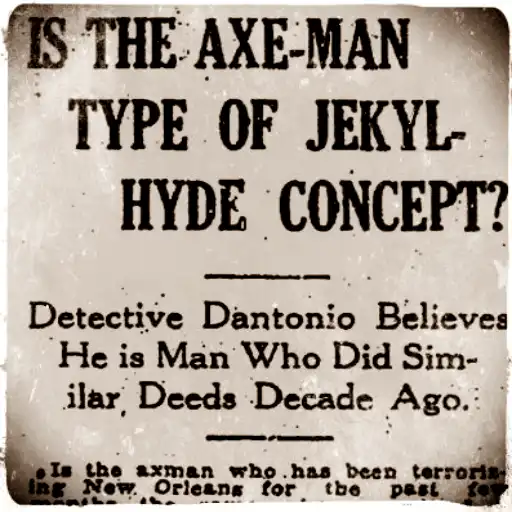
More than a century later, the case remains an absolute mystery. In an era long before DNA profiling, digital surveillance, or automated fingerprint databases, linking a transient killer to multiple private crime scenes was practically impossible. Still, modern criminologists and historical researchers have floated several compelling theories.
1. The Mafia Enforcer Theory
Because the victims were heavily concentrated within the Italian commercial sector, many contemporary detectives believed the crimes were the work of a Black Hand extortionist. The Black Hand was an early form of the Italian-American Mafia that specialized in shaking down small business owners for protection money.

However, major crime historians have largely dismissed this angle. A mafia hitman operates with cold, calculating efficiency; they do not typically crawl through chiseled doors to bludgeon women and children with random household tools while leaving stacks of cash completely untouched on the kitchen counter.
2. The Sexual Sadist
Alternative modern profiles suggest the Axeman was an early American serial killer driven by psychological deviations rather than financial gain. Crime analysts Colin and Damon Wilson argued that the killer may have been a sexual sadist who specifically targeted women, pointing out that male victims were typically only attacked when they directly obstructed the killer’s path to the women in the house.
3. The Strange Case of Frank Mumphrey
The closest the case ever came to a neat, narrative conclusion involves a mysterious man named Frank Mumphrey, who also went by the alias Mike Pepitone.
In October 1919, a grocer named Mike Pepitone was brutally axed to death in his bedroom. His wife ran into the hallway just in time to see a large, dark figure fleeing into the night. This would mark the final official attack attributed to the Axeman.
Fast forward to December 1920 in Los Angeles, California. A man named Frank Mumphrey was shot and killed by a woman named Esther Albano — who happened to be the widow of Mike Pepitone. Albano claimed she shot Mumphrey because she recognized him as the shadowy figure who had murdered her husband back in New Orleans.
While true-crime writers have frequently seized on this story as the definitive end of the Axeman, official police records offer zero concrete proof linking Mumphrey to the broader New Orleans crime scenes. He remains a fascinating footnote in a completely cold case.
Unending Echoes of the Axe
The Axeman of New Orleans did not go out with a dramatic courtroom confession or a sensational shootout. He simply vanished from the pages of history as mysteriously as he had arrived. No further chiseled doors were discovered; no more demonic letters arrived at the local printing presses.
He left behind a city that was permanently altered. The terrifying saga exposed the deep, fragile racial and economic fault lines of a rapidly growing southern metropolis.
Yet, it also cemented a fascinating cultural truth about New Orleans. When faced with absolute horror, the city chose to fight back with the one thing the monster claimed to love: the infectious, community-driven power of jazz music. They took a nightmare and turned it into a brass band parade, ensuring that the story of the Axeman would live on forever in American folklore.
Join the Discussion
What is your personal theory on the Axeman? Do you believe the infamous jazz letter was a genuine message from a deranged killer, or was it a clever hoax whipped up by a local journalist to sell newspapers? Why do you think the murders stopped so abruptly after the Pepitone hit?
The long-standing mystery of the Axeman brings to mind other cases of elusive predators, like the Grim Sleeper’s unidentified victims, where justice was slow to arrive.
Tell us your thoughts in the comments section below! If you are fascinated by early 20th-century history, true-crime cold cases, and deep historical analyses, don’t forget to bookmark our site and subscribe to our weekly newsletter for more deep dives into the past.

