

“La journée sera rude” (The day will be hard.)
—Robert-François Damiens, on the morning of his execution, March 28, 1757
He was right. His day would not just be hard; it would be a meticulously staged nightmare of human suffering. It would be the last time in France’s history that a man was publicly ripped apart by horses, a final, horrifying spectacle of medieval justice colliding with the dawn of the Enlightenment.
This is the story of Robert-François Damiens. A domestic servant, a religious fanatic, a possible madman, and the man who committed the ultimate crime in 18th-century France: regicide. He didn’t just try to kill a man; he tried to kill the King.
And the punishment for striking the “Anointed of God” was something out of a dark, twisted fairy tale.
Who Was This Man Who Dared to Strike a King?

Before he was a monster in the eyes of France, Robert-François Damiens was just… a guy. And not a very successful one.
Born in a small village near Arras, France, on January 9, 1715, his life was unremarkable. He came from a family with a history of debt and minor crime. After a brief stint in the army, Damiens did what many men of his class did: he became a domestic servant.
This is where his problems really started.
He was, by all accounts, a terrible employee. He was surly, unstable, and had a fiery temper. He bounced from job to job, dismissed by a long line of Parisian aristocrats for “misconduct.” His behavior earned him the nickname Robert le Diable (Robert the Devil).
But he wasn’t just angry; he was agitated. Damiens lived in a France that was in the grip of a bitter religious and political war. It wasn’t a war of armies, but of ideas, fought between:
- The Jesuits (and the King): The established, powerful Catholic authority.
- The Jansenists: A Catholic reform movement that was seen as heretical by the establishment.
The conflict had real-world consequences. Priests were refusing to give the holy sacraments (like last rites) to suspected Jansenists, essentially damning them in the eyes of the public. The parlements (the high courts, not to be confused with a modern parliament) were pushing back against the King, and the King was pushing back against them.
It was a chaotic, toxic mess. And Robert-François Damiens, a deeply religious and mentally unstable man, got caught in the middle. He served in households of parlement members and listened to their furious denunciations of the King and the Church. He became obsessed.
In his fractured mind, all this turmail, all this sin, was the fault of one man: King Louis XV.
Damiens believed he had to send a message. Not to kill the King—he would later insist on this—but to warn him. To give him a “jolt” that would make him see the error of his ways and save France.
He was going to touch the King.
The Assassination Attempt: A Stab in the Winter Gloom
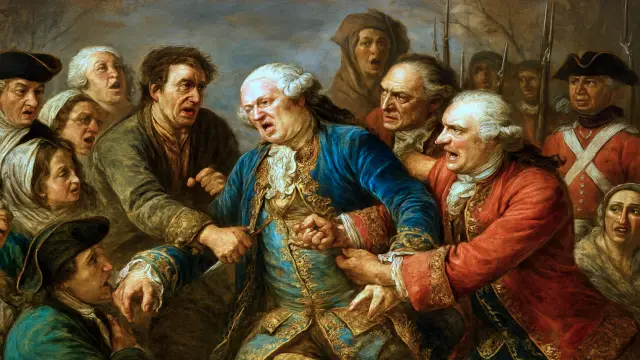
January 5, 1757. The Palace of Versailles.
It was freezing. A bitter cold had settled over Paris, and the King, Louis XV—known as le Bien-Aimé (the “Well-Beloved”)—was visiting his daughter. Around 6:00 PM, he walkad down the Marble Courtyard toward his carriage, surrounded by guards.
The courtyard was dark, lit only by the flickering torches of the attendants. Damiens, who had been loitering at Versailles for days, saw his chance.
He pushed through the guards.
He shoved past the King’s attendants.
And he lunged at the King.
It happened in an instant. Damiens struck the King in the side with a small knife, then… just stood there. He didn’t try to run. He didn’t try to fight. He just stood, hat in hand, as the guards grabbed him.
The King, at first, didn’t even realize what happened. He thought Damiens had just punched him. He clutched his side and felt the warm, wet stain of blood. “That man has given me a terrible blow!” he cried out. “He must be arrested!”
One of the guards, already holding Damiens, said, “He is, Sire.”
The King was carried to his chambers. Panic swept through Versailles. The King is dead! The King is dying! He wasn’t. The blade, a small, two-bladed penknife Damiens had bought at a corner shop, had barely hurt him. Why?
He was saved by his clothes. It was so cold that Louis XV was wearing multiple thick layers of velvet and fur. The knife, after penetrating the “winter-fortress” of his royal outfit, made only a slight wound.
When Damiens was searched, they found the knife, a few coins, and a book of prayers. The greatest act of treason in a generation had been carried out with a simple penknife and had failed spectacularly.
For Damiens, the real horror was just beginning.
The Trial and Torture: Breaking the Man
Damiens was now the most hated man in France. The authorities weren’t interested in why he did it; they were interested in who helped him. They were convinced this was a grand conspiracy. A lowly servant couldn’t have acted alone.
They were determined to get names. And they would use any means necessary.
For two and a half months, Damiens was subjected to a series of “interrogations” that were nothing more than brutal, systematic torture.
- The Boots (Brodequins): His legs were placed between wooden planks. Iron wedges were then hammered in, systematically crushing his bones and joints. Damiens screamed, but he gave no names.
- Red-Hot Pincers: While he was chained to his bed, torturers would come in and tear pieces of flesh from his arms, legs, and chest with glowing-hot pincers. He gave no names.
- Sleep Deprivation & Chaining: He was chained to his bed in a tiny, dark cell, often bound in a harness that forced him to stand. He was never left alone, watched day and night by guards ordered to stop him from committing suicide.
Through all this, his story never wavered: He acted alone. He was trying to warn the King, not kill him. He was a good Catholic who wanted the King to restore peace to France.

His torturers were furious. The court was furious. If he wouldn’t give them a conspiracy, they would give the people a spectacle.
On March 26, 1757, he was convicted of parricide and regicide. In France, this was the ultimate crime. It was not just an attack on a man, but on the nation, and on God’s chosen representative on Earth. The punishment was ancient, specific, and designed to erase the criminal from existence in the most painful way imaginable.
He was sentenced to be drawn and quartered.
The Execution: A Spectacle of Horror
March 28, 1757. The Place de Grève, Paris.
This wasn’t a hidden execution. This was a show. Tens of thousands of people crowded the square and rented windows in the surrounding buildings. The philosopher Giacomo Casanova was in the crowd, having rented a window with his friends, and he documented the horrific, carnival-like atmosphere.
Damiens, wearing only a plain linen shirt, was brought to the square in a cart. The “hard day” he had predicted had begun.
For over two hours, Damiens was systematically and publicly destroyed. The official sentence was read, and the chief executioner, Charles-Henri Sanson, and his team got to work.
Step 1: The Hand
The hand that had held the knife was bound and held over a brazier. It was burned away with burning sulfur. Damiens, according to witnesses, let out a “horrible cry” but did not curse.
Step 2: The Pincers
The executioners took the red-hot pincers and tore flesh from his chest, arms, thighs, and calves.
Step 3: The Wounds
Into these large, open, sizzling wounds, the executioners poured a bubbling, scalding-hot concoction of molten lead, boiling oil, burning resin, and melted wax. The crowd watched as his body smoked and burned. He was still alive. He was still conscious.
Step 4: The Horses
This was the main event. Four large, powerful draft horses were harnessed by ropes to his arms and legs. The executioners gave the signal. The horses pulled.
And… nothing.

Damiens was a strong man. His body would not tear. The horses pulled again, rearing and straining. The crowd grew restless. This was taking too long. Damiens, in unimaginable agony, was still breathing.
The executioners, sweating and panicked, had to change the plan. They authorized the executioners to use their knives. They ran forward and, while the horses pulled, they hacked at his joints and sinews, severing the limbs from his torso.
One leg was torn off. Then the other. Then his arms.
Through it all, he remained conscious. Witnesses reported he was still breathing, his head turning to look at his own dismembered body, until his last arm was finally ripped from its socket.
Step 5: The Fire
His still-living torso, and the severed limbs, were thrown onto a prepared bonfire. His body was burned to cinders, and his ashes were gathered and scattered to the wind.
The entire event was designed to be a total annihilation. Damiens was to be erased from the world.
The Legacy: The End of an Era
The execution of Robert-François Damiens was a seismic shock. It was supposed to reinforce the absolute power of the King.
It did the exact opposite.
Even in the hardened, brutal world of 18th-century Paris, the crowd was sickened. They had come for a spectacle but had witnessed a butchery. It was too much.
The leading minds of the Enlightenment, like Voltaire, were appalled. They pointed to the execution as the perfect example of a barbaric, superstitious, and tyrannical Ancien Régime (Old Regime) that was out of touch with reason and humanity.
The event became a rallying cry against the absolute monarchy. It wasn’t a show of power; it was a show of weakness and desperate, savage cruelty.
It’s no coincidence that just 32 years later, the French Revolution would erupt. And the first head to fall to the new, “humane” killing machine—the guillotine—would be that of a king.
The execution of Damiens is famously the opening scene of philosopher Michel Foucault’s masterpiece, Discipline and Punish. Foucault uses the graphic, personal, and spectacular torture of Damiens as the ultimate example of the “old” way of punishment—an attack on the body. He contrasts it with the “modern” way—a new system of prisons, rules, and surveillance that seeks to control the soul.
Robert-François Damiens failed to kill his king. But in his death, he exposed the rot at the heart of the monarchy and, in a strange, horrifying way, helped fuel the revolution that would bring it all crashing down. He wanted to give the King a “jolt,” and in the end, his gruesome death gave one to the entire nation.
What do you think? Was Damiens a madman, a religious terrorist, or a misguided political actor? Let me know your thoughts on this brutal piece of history in the comments below.

