

Can Dogs See Ghosts? What Science Says About Their Spooky Behavior
Your house is quiet. You’re settled on the couch, scrolling through your phone, and everything is calm. Suddenly, your dog, who was sound asleep seconds ago, bolts upright. His head is cocked, ears perked. He lets out a low growl, his eyes fixed on a completely empty corner of the room. He barks. Not at a sound you can hear, but at nothing.
The hair on your arms stands up. Your heart does a little pitter-patter. And you can’t help but ask the question every dog owner has whispered into the darkness: What does he see that I don’t?
Is it a mouse in the wall? A car door down the street? Or is it something else? Something… supernatural?
The idea that our canine companions are tuned into the spirit world is as old as ghost stories themselves. They are our loyal guardians, our real-life protectors. So, doesn’t it make sense they could protect us from the unseen, too?
Let’s cut through the folklore and dig into the real science and the compelling stories. Can dogs actually see ghosts? The answer is a lot weirder, cooler, and more fascinating than a simple yes or no.

Why We Think Our Dogs See Ghosts: The Telltale Signs
Before we dive into the science, let’s admit it: dogs do some seriously spooky stuff. Their behavior is often the “proof” we point to when we think our house might be haunted. It usually falls into a few categories:

- The Blank Stare: Your dog freezes and stares intently at an empty space, a blank wall, or a vacant chair as if someone is sitting there.
- Barking at Nothing: Random, aggressive, or fearful barking directed at a seemingly empty area, which they refuse to back down from.
- Sudden Fear: Cowering, whining, or tucking their tail and refusing to enter a specific room or part of the house they were previously fine with.
- Invisible Tracking: Following something with their eyes and head as it moves across the room, even though you see absolutely nothing.
- Comforting the Air: Nuzzling, whining, or trying to comfort a space where a recently deceased family member used to sit.
If you’ve seen your dog do any of these, you know how unsettling it can be. It’s hard not to let your imagination run wild. But is it a ghost, or is it just good old-fashioned dog biology?
The Science Behind the Spooks: What’s Really Happening?

The truth is, dogs are equipped with a set of biological superpowers that make our human senses look like a joke. Their world is infinitely more detailed than ours. What we interpret as paranormal is often just them experiencing normal—for a dog.
Super Senses, Not Supernatural Senses
The number one reason for your dog’s “ghostly” encounters is their incredible senses of hearing and smell. They aren’t seeing ghosts; they’re experiencing a reality that’s completely undetectable to us.
- Hearing Like a Superhero: A dog’s hearing is up to four times more sensitive than ours. They can also hear at much higher frequencies. According to research from Louisiana State University, humans can hear frequencies up to about 20,000 Hertz (Hz), while dogs can hear up to 45,000-65,000 Hz. What this means: That “empty” corner your dog is barking at? He might be hearing the high-frequency hum of electronic devices in the wall, the ultrasonic squeak of a mouse hiding under the floorboards, or even termites chewing on wood. That distant sound you can’t place? He could be hearing a dog barking several blocks away or the faint jingle of a collar from down the street. It’s not silence to him; it’s a symphony of information.
- A World of Smells: A dog’s sense of smell is their primary sense. It is absolutely mind-boggling. Depending on the breed, their sense of smell is 10,000 to 100,000 times more powerful than ours. They have up to 300 million olfactory receptors in their noses, compared to our measly 6 million. What this means: When your dog is sniffing the air in a seemingly empty room, he could be smelling the lingering scent of a person who was there hours ago, the trail of a squirrel that ran across the roof, or even subtle chemical changes in the air. That spot he refuses to walk over? It might have the faint, lingering smell of a chemical cleaner that bothers him.
A Wider (and Weirder) View of the World
A dog’s vision is also fundamentally different from ours. While they don’t see color as vividly as we do, their eyes are built for a different purpose: detecting motion, especially in low light.
- Their eyes have more rods—the photoreceptors responsible for seeing in dim light. This gives them superior night vision.
- They have a wider field of vision, allowing them to see more of their periphery.
- Their eyes are more sensitive to movement. They can pick up on the slightest flicker or shadow that our human eyes would simply filter out as unimportant.
So, that shadow your dog lunged at? It could have been the subtle change in light from a car passing by outside, the reflection of your TV on a window, or even a tiny spider rappelling down from the ceiling in the corner of his eye.
Sensing Changes We Can’t

Dogs are also incredibly sensitive to changes in the environment that we are completely oblivious to.
- Barometric Pressure: Many animals, including dogs, can feel the subtle drop in air pressure that precedes a storm. This can make them anxious and act strangely long before we see a single cloud.
- Electromagnetic Fields: Dogs may be able to sense fluctuations in the Earth’s magnetic field or the static electricity in the air.
- Infrasound: This is low-frequency sound that is below the range of human hearing. It can be generated by earthquakes, avalanches, or even wind turbines. These vibrations can travel long distances and are known to cause feelings of unease and anxiety—in both humans and animals.
That sudden restlessness or unexplained fear could just be your dog’s internal weather station telling him something is up with the environment.

But What About the Stories? When Science Doesn’t Seem to Fit
Okay, science is great. But what about those moments that are just… too specific to be a mouse in the wall?
Every dog owner has a story.
There’s the tale of the Golden Retriever who, after his owner’s husband passed away, would suddenly get up every evening at 6:30 PM—the exact time the husband used to come home from work—and wag his tail at the empty front door.
Or the story of the rescue dog who was terrified of men in hats. His new family later discovered his previous owner, who had abused him, always wore a baseball cap. But one day, the dog walked up to a visiting uncle—a man in a fedora—and licked his hand, something he’d never done. The family later learned the kind man who rescued him from the shelter wore a fedora just like it.
And perhaps the most common: the dog who brings a toy to the favorite empty chair of a recently deceased family member, whining softly as if to comfort someone who isn’t there.
Are these dogs reacting to residual smells and sounds? Almost certainly. Is it just a response to a change in routine? Probably. But is it also possible they are sensing a lingering energy, a presence that science just doesn’t have the tools to measure yet? That’s where fact ends and faith begins.

The Real Sixth Sense: Detecting Sickness and Emotion
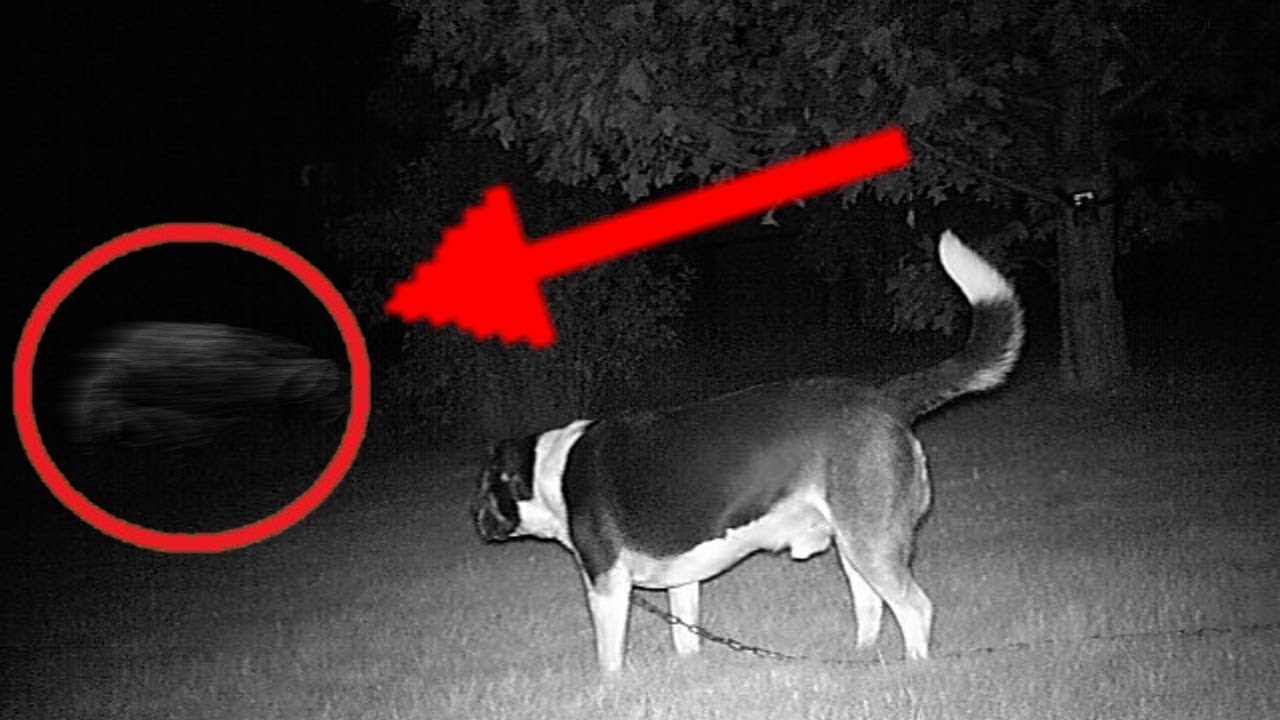
While seeing ghosts is debatable, there is one “sixth sense” that dogs are scientifically proven to have: the ability to detect disease and emotional distress.
- Sensing Illness: With their powerful noses, dogs can smell the volatile organic compounds (VOCs) that our bodies release when we have certain diseases. Trained medical detection dogs can accurately sniff out cancers, a drop in blood sugar for diabetics, and even the onset of a seizure. According to a study published in Frontiers in Veterinary Science, dogs can detect the scent of seizures with high accuracy.
- Reading Our Emotions: Dogs are masters of reading human body language. They watch our posture, our facial expressions, and listen to the tone of our voice. But they can also smell our emotions. When we are stressed or scared, our bodies produce hormones like adrenaline and cortisol, and dogs can smell these changes in our sweat and breath.
So, when you’re feeling scared or creeped out in your own house, your dog isn’t reacting to a ghost. He’s reacting to you. Your fear is real to him, and his instinct is to find the source of the threat to protect you.
So, Can Dogs See Ghosts? The Verdict
No, your dog probably can’t see the ghost of your great-aunt Gertrude floating down the hallway.
But the truth is almost cooler. Your dog is a high-tech sensory machine living in a world that is layered with more information than we can possibly imagine. The sounds are louder, the smells are richer, and the shadows are more interesting. Their reality is simply more.
What we call a “sixth sense” is really a combination of their five senses working at a level we can’t comprehend. They are our protectors, our early-warning systems, and our emotional barometers. They are so in tune with the natural world that it can often feel supernatural to us.
And in the end, does it matter if it’s a spirit or a spider? The magic is in the connection we share with them—that unspoken bond that makes us turn to them in the dark and whisper, “What is it, boy?” And for that moment, anything feels possible.
What’s the spookiest thing your dog has ever done? Have you ever been convinced they were seeing a ghost? Share your story in the comments below!

