
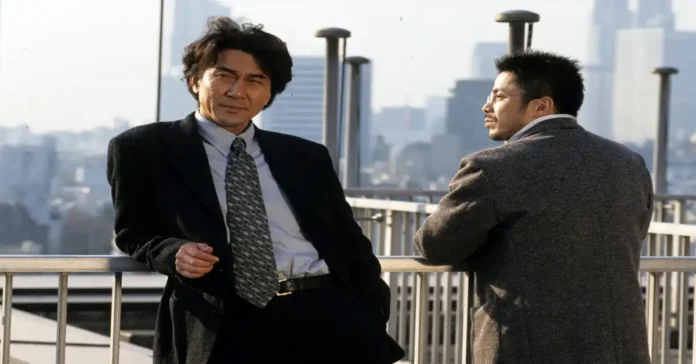
The diner scene: what actually happened to Takabe and the waitress?
Walk away from Cure for an hour, and that final restaurant sequence will still be gnawing at your brain. Why is Kenichi Takabe (played with weary brilliance by Koji Yakusho) suddenly so peaceful? Throughout the entire film, Takabe looks like a man vibrating on the edge of a nervous breakdown. His shoulders stay hunched, dark bags hang beneath his eyes, and his temper snaps at the slightest provocation.
Yet in that brightly lit restaurant, his body language transforms. He eats his meat cutlet down to the last bite. He savors a cigarette with leisurely precision. When another detective phones him to report fresh news, Takabe speaks with cool authority, hangs up, and looks completely unburdened.
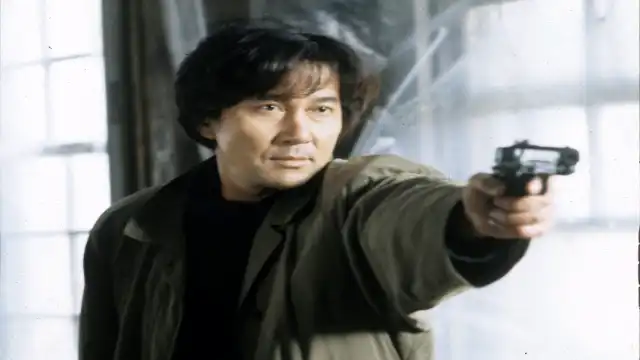
Then the camera follows the waitress.
She comes over, clears Takabe’s plate, and listens to whatever parting words he mutters. Kurosawa deliberately suppresses the audio here; we cannot hear what Takabe says to her. She turns around, walks past the counter, and heads toward the back kitchen. Watch her posture closely. Her brisk, polite customer-service stride stiffens into a hollow trance. Notice the back of her uniform? Her apron straps form a distinct X across her spine.
She pauses at the prep station, reaches for a heavy chef’s knife, grips the handle with bone-white knuckles, and begins walking toward her manager. The cut to black spares us the blood, but the horror lands anyway:
- The murders did not die with Kunio Mamiya.
- Takabe did not conquer the madness; he inherited it.
- The waitress is not acting out of spontaneous rage; she has been activated.
Takabe did not just solve the case. He became the new preacher.
Who was Kunio Mamiya? the vessel of mesmerism
To understand why the waitress grabs that blade, you have to understand the drifting phantom who started the chain reaction: Kunio Mamiya (Masato Hagiwara).
When Mamiya washes up on a bleak, overcast beach at the start of the film, he presents himself as a harmless amnesiac. He cannot remember where he is, what day it is, or even his own name. He loops the same infuriating question back at anyone trying to help him: “Who are you?”
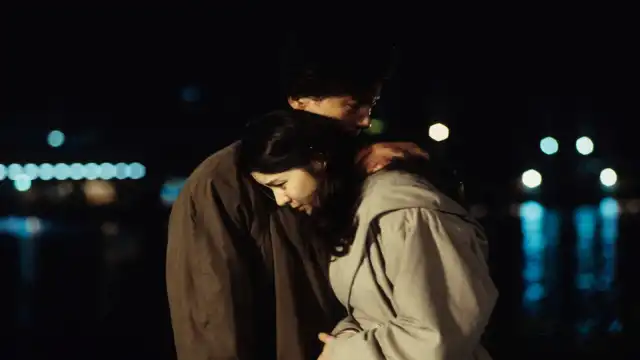
That question sounds like brain fog on first listen. In reality, it acts as a psychological scalpel.
Mamiya is a former student of psychology who uncovered forgotten late-19th-century treatises on Mesmerism — the theory of “animal magnetism” pioneered by Franz Anton Mesmer. Mesmer believed an invisible natural force flowed between all living things, capable of manipulation to heal nervous disorders. In Kurosawa’s universe, however, that concept morphs into something far more predatory.
Mamiya uses elemental triggers to induce rapid hypnagogic trances:
- The rhythmic strike of a match flame dancing in the dark.
- Water trickling continuously from a faucet or pooling across a linoleum floor.
- Repetitive, ambient vibrations echoing through pipes and radiators.
The mechanics of the hypnotic trigger
How does Mamiya convince ordinary, law-abiding citizens to butcher people they care about?
As Takabe’s psychologist friend Sakuma explains, genuine hypnosis carries a hard rule: you cannot force someone to commit an act that violates their deepest moral code unless an underlying impulse already exists. Hypnosis cannot fabricate an emotion out of thin air.

Mamiya does not inject new hatred into his victims. Instead, he dismantles the social walls holding their existing rage in check.
By relentlessly asking “Tell me about yourself” and peeling away their job titles, family roles, and polite etiquette, Mamiya hollows them out. He finds the specific person or societal demand grinding down their spirit. The moment he snaps them out of the trance, their internal censor vanishes. They slice an X into the throat of the person standing in front of them, feeling an instantaneous wave of pure, ecstatic release.
They feel cured.
The cylinder phonograph: origin of the contagion
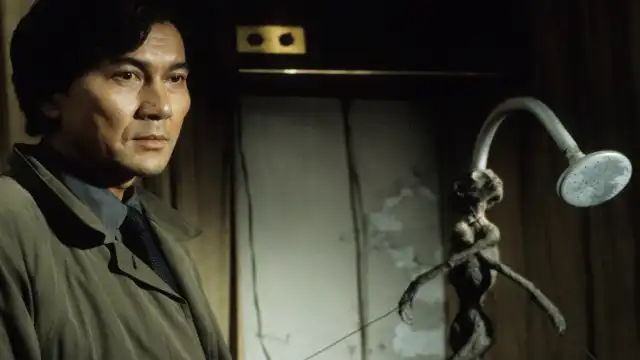
Near the film’s climax, Takabe tracks Mamiya’s historical footprint to an abandoned, rotting psychiatric asylum isolated in the countryside. Inside, half-submerged in shadows and forgotten debris, sits an antique phonograph fitted with a wax cylinder.
Takabe winds the crank, lowers the needle, and listens.
The crackling audio records an obscure Japanese mesmerist from the Meiji era. On the recording, an austere clinician speaks calmly to a female patient, using precise cadence and vocal rhythm to plunge her into an irreversible trance. The camera pans past a desiccated monkey cadaver pinned to a board, its throat split with the exact same cross-cut pattern.
Why did Kurosawa include this historical relic?
The phonograph proves that Kunio Mamiya was never a supernatural demon, a magician, or a classic criminal mastermind. Mamiya was merely Patient Zero in modern Tokyo. Decades earlier, someone else invented this hypnotic cipher. Mamiya discovered the recording during his research, played the cylinder, and allowed the hypnotic script to wipe his personal identity clean. He became an empty vessel whose only remaining purpose was to transmit the ideology forward.
When Takabe stands alone in that asylum room listening to the needle scrape against the wax, the infection claims him too. He absorbs the method. He listens to the cadence. By shooting Mamiya dead minutes later, Takabe thinks he is executing justice. In reality, Mamiya willingly sacrifices himself because the succession is complete.
The virus found a smarter, stronger host.
The fate of fumie: did Takabe kill his wife?
![Cure (1997) Original Trailer [FHD]](https://www.gsnsp.com/wp-content/cache/flying-press/e3ff3127b8933afc5672e1907e41346f.jpg)
You cannot dissect the ending of Cure without confronting the tragedy of Takabe’s wife, Fumie (Yoriko Douguchi).
Fumie suffers from severe anterograde amnesia and profound mental deterioration. She wanders away from home, gets lost in neighborhood alleys, and repeatedly reads the exact same pages of a blue-covered book. Takabe loves her deeply, but the psychological toll of caretaking is crushing him under an unbearable mountain of guilt.
Throughout the film, their apartment hums with a sickening, repetitive sound: the empty laundry dryer running in the dark.
Fumie keeps turning it on with nothing inside. The mechanical drum thumps against the wall hour after hour, serving as an unintended hypnotic metronome inside Takabe’s own sanctuary. Takabe is already living inside a domestic trance before he ever lays eyes on Mamiya.

Earlier in the movie, Takabe experiences a waking nightmare where he walks into their bedroom and finds Fumie hanging from a ceiling pipe, dead by suicide. He desperately checks her pulse, only to snap back to reality and find her standing harmlessly in the room. The desire to be free of her illness already burns inside his subconscious, even if his conscious mind recoils from the thought.
The sanitarium scene and the final cut
Toward the third act, Takabe checks Fumie into a remote sanitarium for her own protection.
Right after Takabe listens to the phonograph and executes Mamiya, Kurosawa cuts abruptly to a chilling, dialogue-free shot inside that sanitarium:
A nurse walks into Fumie’s sunlit hospital room. The white sheets are pulled back. Fumie lies dead on the mattress, a massive, bloody X carved deep across her throat.
Did Takabe personally travel to the clinic and slice her throat? Did he hypnotize the sanitarium staff during his initial visit, planting a delayed trigger? Or did he issue the command over the phone?
The movie refuses to show the physical act because the method is secondary. What matters is the psychological payoff: Takabe’s primary life burden has been permanently removed. The agonizing responsibility that made him a furious, volatile wreck is gone. When we see him next in the diner, his face shows no grief, no sorrow, and no remorse.
He has traded his human empathy for absolute tranquility.
The “Cure” as an ideological virus: Tokyo’s bleak modernity
Have you ever wondered why Kiyoshi Kurosawa chose the title Cure for a gruesome serial killer movie?
In conventional cinema, a “cure” restores a sick person to a healthy state. In Kurosawa’s cynical, late-90s vision of Tokyo, the opposite occurs. Society itself is the disease. The relentless pressure to remain courteous, conform to corporate hierarchies, suppress personal desires, and smile through emotional exhaustion traps modern citizens in perpetual psychic misery.
The hypnotic X is the cure.
It cures people of their civilized inhibitions. It cures them of moral responsibility. It cures them of the endless agony of pretending to care about social conventions. Once you kill the person who ties you to your everyday misery, the fever breaks.
Kurosawa captures this alienation through visual staging:
- Oppressive Negative Space: Characters frequently stand dwarfed in huge, empty wide shots. Large swaths of the frame remain vacant — dark hallways, peeling walls, or vacant street corners — suggesting a void ready to swallow them whole.
- Everyday Mundane Locations: The murders do not happen in gothic castles or stylized movie lairs. They occur in municipal swimming pools, scuffed public bathrooms, standard police cruisers, and dull family apartments. Horror thrives right in the open middle of civic life.
- Static, Unblinking Camera Work: When violence erupts, Kurosawa refuses to cut to frantic close-ups. The camera sits back, static and indifferent, forcing us to watch terrible acts unfold in real time without cinematic sensationalism.
- Acoustic Desolation: Instead of a sweeping musical score, the soundscape relies on industrial droning, distant traffic, dripping water, and howling wind. The city sounds like a machine slowly grinding human spirits down into dust.
The anatomy of the X-murders: how the contagion spreads
To see how cleanly this virus jumps between hosts, take a look at the five distinct acts of violence depicted throughout the film:

| Perpetrator | Social Persona | The Specific Trigger | The Victim | Unlocked Motive |
|---|---|---|---|---|
| Kuwano | Soft-spoken salaryman | Spilling water, flickering lighter flame | His wife | Resentment over domestic marital entrapment |
| Oida | Friendly, obedient patrol cop | Radiator banging, dripping tap water | His police partner | Suppressed rage against authority and institutional discipline |
| Dr. Akiko | Composed, professional physician | Water spilled in an exam tray | A male bar patron | Deep-seated disgust with male harassment and physical boundary crossing |
| Sakuma | Analytical, rational psychologist | Extended intellectual interrogation | Himself (suicide) | Complete psychological collapse after realizing the virus cannot be rationalized |
| The Waitress | Polite, subservient restaurant server | Whispered suggestion from Takabe | Restaurant manager (implied) | Hidden fury against workplace abuse and subservient customer service |
Every single killer looks bewildered right after the act, yet none of them display traditional guilt. They sit quietly next to the corpses, breathing easily, as if they finally woke up from a lifelong headache.
Takabe’s transformation: from law enforcement to apostle
Why was Detective Takabe the chosen successor from the very beginning?
Mamiya tested many people throughout Tokyo, but most were small fry. A salaryman kills his wife; a cop shoots his buddy; a doctor skins an arrogant stranger. Their violence is localized and small-scale. Once their individual trigger is pulled, their utility ends.
Takabe was different.
Takabe possessed immense intellectual discipline paired with a reservoir of volcanic, barely contained fury. He was dealing with a wife whose deteriorating mind demanded his total devotion, while working a job that daily forced him to look into the worst gutters of humanity. He was the ultimate pressure cooker.
Mamiya saw right through him during their first interrogation room encounter.
Remember how violently Takabe reacted whenever Mamiya asked him about his personal life? A secure detective would shrug off the ramblings of an amnesiac drifter. Takabe screamed, lunged across tables, threw hot coffee, and eventually locked Mamiya in an illegal, isolated basement cell. Takabe fought so hard because he knew Mamiya was poking the exact rotten beam holding up his entire identity.
When Takabe finally tracks Mamiya to that secluded lodge and pulls his revolver, Mamiya smiles. Right before the bullet tears through him, Mamiya raises his hand and traces an X into the empty air. He isn’t pleading for his life. He is ordaining his replacement.
Why the ending still haunts cinema
Most police procedurals build toward reassurance. Think of David Fincher’s Seven or Jonathan Demme’s The Silence of the Lambs. Even when those films end in devastation or moral compromise, the narrative bounds the evil. John Doe dies; Buffalo Bill gets shot; the procedural machinery does its work.
Kiyoshi Kurosawa pulls the rug out completely.
In Cure, catching the culprit solves nothing. The detective does not save the city; the detective becomes the epidemic’s most dangerous carrier. By shifting the final scene from an isolated beach (as originally written in early draft scripts) to a bustling, everyday urban restaurant, Kurosawa makes the threat infinite.
Takabe will get into his car, drive back to Tokyo police headquarters, and carry that psychological pathogen into every precinct, squad room, and street corner in Japan. Anyone harboring a sliver of unexpressed resentment is one match flick, one dripping faucet, or one quiet word away from picking up a blade.
That is why the waitress picking up the knife remains one of the most chilling final frames in cinema history. The horror isn’t that an evil monster is on the loose. The horror is that the cure is working.
For a deeper look into the film’s hidden visual cues and the original Japanese script details, check out Cure (1997) Explained: The Clues You Missed. This video explains the exact timeline of Mamiya’s mission, the phonograph cylinder’s history, and why the final restaurant scene reveals Takabe’s true inheritance.

