

The Mongolian Death Worm Mystery: Inside the Gobi Desert Legend
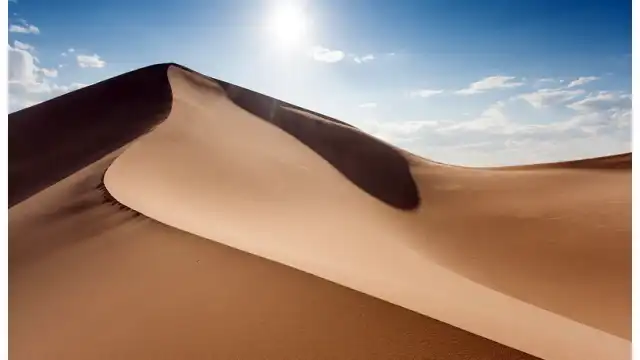
The Gobi Desert stretches out like a massive, sun-baked oven across parts of China and Mongolia. Extreme temperatures rule this desolate landscape. Water is a luxury. Simply surviving out here requires serious biological adaptations. If you ask the local nomadic tribes, they will warn you about one specific creature that adapted a little too well.
They call it the olgoi-khorkhoi. You probably know it by its terrifying Western nickname: the Mongolian Death Worm.
A fat, bright red worm slithering beneath the sand dunes. It supposedly lacks a head or legs, spits corrosive acid, and can shock you from several feet away with a lethal blast of electricity. Does this sound like a cheesy monster movie pitch? Absolutely. Yet, stories of this bizarre cryptid have persisted for centuries.
At a glance
- The Legend: Known locally as the olgoi-khorkhoi (large intestine worm), this cryptid is described as a two-to-five-foot-long, highly venomous desert dweller.
- The Powers: Nomadic folklore claims the creature kills instantly by spitting a highly corrosive yellow venom or discharging deadly static electricity.
- The Western Discovery: Famed American paleontologist Roy Chapman Andrews first introduced the creature to the Western world in his 1926 book.
- The Reality: Biologically, a soft-bodied worm cannot survive the arid Gobi Desert. Most scientists believe sightings are actually misidentified reptiles, like the Tartar sand boa or an unknown species of worm-lizard.
What is the Olgoi-Khorkhoi?
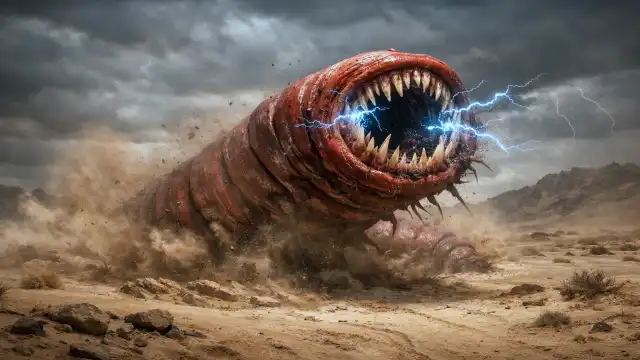
Before we dive into the science, we need to understand the myth. The name olgoi-khorkhoi translates literally to “large intestine worm.” That deeply unsettling moniker perfectly describes its alleged appearance.
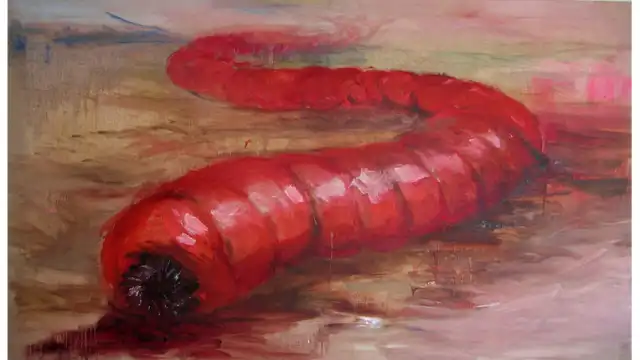
Witnesses claim the beast measures anywhere from two to five feet long. Its body is remarkably thick, fleshy, and colored a dark, blood-red. You won’t find a distinct head, eyes, or mouth on this monster. Both ends look identical. It supposedly spends the vast majority of the year hibernating deep underground, only surfacing during the rare, wet months of June and July.
Crawling around in the sand isn’t what makes this creature famous. Its offensive weapons are what truly terrify people.
According to local tales, the death worm doesn’t bite. It doesn’t need to. If a predator or an unlucky human gets too close, the worm rears up on one end. It then shoots a stream of thick, yellow saliva. This venom is allegedly so acidic that it instantly corrodes metal and kills living tissue on contact.
If the acid misses, the worm has a backup plan. Folklore insists the creature can generate a massive electrical charge, electrocuting its prey from a distance. Imagine a terrestrial electric eel wrapped in a bloody sausage casing. That is the creature haunting the Gobi.
Roy Chapman Andrews
For hundreds of years, the death worm remained a highly localized secret. The harsh isolation of Mongolia under Soviet influence kept Western researchers locked out. That changed briefly in the 1920s.
Enter Roy Chapman Andrews. He was a swashbuckling American paleontologist working for the American Museum of Natural History. Many historians actually consider him a real-life inspiration for Indiana Jones. Andrews led a massive, heavily armed expedition into the Gobi Desert searching for dinosaur fossils.

Before heading into the dunes, Andrews met with several high-ranking Mongolian officials. In his wildly popular 1926 book On the Trail of Ancient Man, he detailed a bizarre request from the Mongolian Prime Minister, Damdinbazar.
The Prime Minister begged the American explorer to capture a specimen of the allergorhai-horhai.
Andrews wrote down the official’s exact description: “It is shaped like a sausage about two feet long, has no head nor leg and it is so poisonous that merely to touch it means instant death.”
Did Andrews actually believe he was hunting a monster? Not a chance. He openly dismissed the creature as pure myth. However, he promised the officials he would grab one with long steel tongs if he happened to stumble across it. Ultimately, Andrews never saw a death worm. He did, however, discover the very first known fossilized dinosaur egg nests, completely revolutionizing paleontology.
Even though he viewed it as a fairy tale, Andrews’ writings successfully unleashed the Mongolian Death Worm onto the global stage.
The Cryptozoologists Who Chased the Myth
By the time the Soviet grip on Mongolia loosened in the early 1990s, a new generation of explorers was ready to hit the desert. They weren’t looking for dinosaur bones. They wanted the worm.
Ivan Mackerle’s Explosive Expedition
Czech cryptozoologist Ivan Mackerle became obsessed with the legend. In 1990 and 1992, he organized dedicated hunting parties into the deepest, most dangerous sectors of the Gobi.
Mackerle knew digging blindly through millions of miles of sand was totally useless. He needed to draw the creature out. Being a massive fan of Frank Herbert’s sci-fi masterpiece Dune, Mackerle borrowed a brilliant idea directly from the novel. He built a motor-driven “thumper.”
His team drove heavy metal stakes into the desert floor and used machinery to create rhythmic, pounding vibrations. The goal was to agitate the sand, simulating the heavy footsteps of prey. When the mechanical thumpers failed to produce results, Mackerle escalated his tactics. He literally buried small explosives in the dunes and detonated them, hoping the blast waves would flush a worm to the surface.
Despite his wildly creative methods, Mackerle returned home empty-handed. He did document incredible oral histories from local nomads, concluding that the sheer volume of consistent sightings meant something real was out there.

Richard Freeman and the CFZ
In 2005, a team from the British-based Centre for Fortean Zoology (CFZ) took a swing at the legend. Led by zoological journalist Richard Freeman, the group spent weeks interviewing witnesses and scouring the arid landscape.
Unlike Mackerle, Freeman approached the mystery with a heavier dose of biological skepticism. After failing to find any physical evidence, Freeman reached a highly logical conclusion. The magical powers of electricity and acid were undoubtedly apocryphal. If the creature existed at all, it was just an undiscovered, non-venomous reptile.
The Cold, Hard Science: Why It Can’t Be a Worm
Let’s put on our lab coats for a minute. Can a giant, flesh-dissolving worm actually survive in the Gobi Desert?
Biology gives us a very firm, resounding “no.”
True worms belong to the phylum Annelida. Think about an earthworm you find in your garden after a heavy rain. Their bodies lack a protective, moisture-locking exoskeleton or scaly skin. Annelids literally breathe through their moist skin. If you place a standard worm on hot, dry pavement, it rapidly dehydrates and dies.
The Gobi Desert features surface temperatures that can routinely exceed 120°F (50°C) during the summer. A giant, soft-bodied invertebrate navigating through that dry, abrasive sand would bake into a crisp within minutes. The environment is simply too hostile for massive annelids.
If the Mongolian Death Worm isn’t actually a worm, what are these terrified nomads seeing?
The Reptilian Suspects: Misidentified Animals
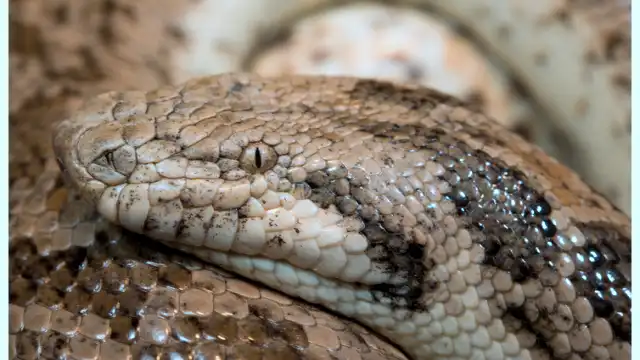
When you strip away the supernatural folklore, the physical descriptions point directly toward reptiles. Desert environments are absolutely packed with highly adapted snakes and lizards. Cryptozoologists and biologists generally point to two main suspects.
1. The Tartar Sand Boa (Eryx tataricus)
This is the most likely culprit. The Tartar sand boa is a thick, blunt-headed snake native to Central Asia.
Take a close look at its anatomy. The tail of a sand boa is extremely blunt, making it very difficult to tell the head from the tail at a quick glance. They spend their days burrowing just beneath the surface of the sand. To a frightened traveler spotting one suddenly erupting from the dunes, a thick, dusty snake could easily resemble a headless, legless intestine.

In fact, during a 1983 expedition, researchers showed a live specimen of a Tartar sand boa to a group of Mongolian locals. Several of them immediately pointed at the snake and identified it as the fabled olgoi-khorkhoi.
2. Amphisbaenia (Worm Lizards)
If you want something even weirder than a snake, look at the amphisbaenians.
These are incredibly bizarre, legless reptiles known colloquially as “worm lizards.” They feature smooth, ringed skin that looks remarkably similar to the segmented body of an earthworm. Their skulls are heavily reinforced, allowing them to ram their way through packed dirt like a living drill bit. While most known species are relatively small, it isn’t impossible that an undiscovered, larger species of worm lizard is quietly thriving in the unexplored depths of the Gobi.
Pop Culture and the Death Worm Legacy
You might never book a flight to Mongolia to hunt cryptids, but you have definitely felt the cultural impact of this legend.
The olgoi-khorkhoi serves as the ultimate blueprint for the “desert monster” trope in modern media. When Hollywood needed a terrifying antagonist for the 1990 cult classic film Tremors, they created the Graboid — a massive, underground worm that tracks prey via seismic vibrations. Sound familiar?
The video game industry loves the concept, too. Titles like ARK: Survival Evolved feature towering death worms as high-level boss enemies. Even the wildly popular anime Dandadan recently incorporated a massive Mongolian Death Worm into its chaotic storyline.
Human psychology plays a massive role here. Vast, empty spaces make us deeply uncomfortable. Whether we are staring out into the pitch-black ocean or looking across an endless sea of identical sand dunes, our brains instinctively try to populate that emptiness. We invent monsters to fill the void.
The Mystery Remains
We live in an era of satellite imagery, GPS tracking, and constant connectivity. It feels like every inch of our planet has been mapped and categorized. Yet, legends like the Mongolian Death Worm stubbornly refuse to die.
Perhaps that is a good thing. We need a few lingering mysteries to keep our sense of adventure alive. The next time you find yourself walking through a desert, pay close attention to the ground. If the sand suddenly starts to shift and ripple… you might want to start running.
What Are Your Thoughts?
Do you think the death worm is just a misunderstood sand boa, or is there an undocumented species of giant reptile still hiding out there? Would you ever take a trip into the Gobi Desert to look for it? Drop your theories, thoughts, and favorite cryptids in the comments below!

