

The 1980 Norco Bank Robbery Shootout: What Happened, Who Was Involved, and How It Changed U.S. Police Tactics
Imagine a sunny Friday afternoon in Southern California. You’re waiting at a red light, maybe thinking about the weekend. Suddenly, the air explodes. Not with a pop, but with the thunder of military-grade rifles. Glass shatters. Sirens wail. This wasn’t a movie set; it was May 9, 1980, in the sleepy horse community of Norco, California.
For decades, the 1997 North Hollywood shootout has grabbed all the headlines as the moment police realized they were outgunned. But the truth? The real wake-up call happened seventeen years earlier. The Norco Bank Robbery wasn’t just a heist gone wrong; it was a full-scale infantry battle on American streets that left a permanent scar on law enforcement history.
So, what exactly went down? Who were these guys? And how did this single event force every patrol car in America to upgrade its arsenal? Let’s dive in.
The Crew: Survivalists with a Dark Plan

This wasn’t your typical gang of career criminals looking for a quick score. The ringleader was George Wayne Smith, a seemingly ordinary guy who worked in landscaping. But beneath the surface, Smith was a charismatic, born-again Christian survivalist convinced that a nuclear apocalypse was imminent.
Smith believed he needed to build a fortress in the Utah wilderness to ride out the end of the world. But fortresses cost money.
To fund his doomsday haven, Smith recruited four others:
- Christopher Harven and Russell Harven (brothers and fellow survivalists)
- Belisario Delgado and Manuel Delgado (brothers recruited for muscle)
They didn’t just buy ski masks and handguns. They armed themselves for war. We’re talking HK91 and HK93 semi-automatic rifles, AR-15s, shotguns, and thousands of rounds of ammunition. They even built homemade fragmentation grenades.
Why does this matter? Because in 1980, the average police officer carried a Smith & Wesson Model 15 .38 caliber revolver. It was a six-shooter. The bad guys had military rifles capable of punching through engine blocks. The mismatch was catastrophic.
The Heist: 3:40 PM, May 9, 1980
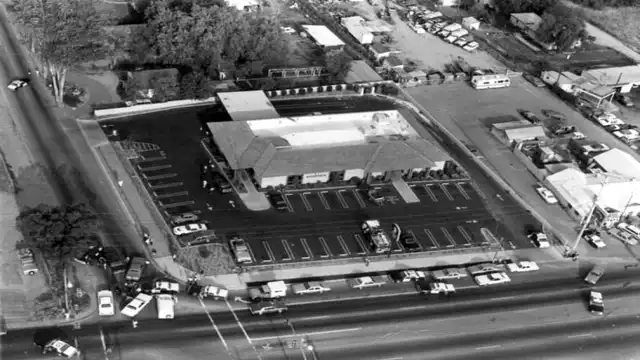
The plan was simple (or so they thought). Hit the Security Pacific Bank on Hamner Avenue, grab the cash, and vanish before the cops could finish their donuts.

Four of them stormed the bank while one waited in a stolen getaway van. But they made a crucial mistake. They were spotted entering the bank by an employee across the street. By the time they grabbed the cash a disappointing $20,000 the Riverside County Sheriff’s Department was already rolling.
The First Contact
Deputy Glyn Bolasky was the first on the scene. As he pulled into the intersection, he didn’t see nervous bank robbers surrendering. He saw men in military fatigues exiting the bank, raising assault rifles.
Before Bolasky could even put his car in park, his cruiser was disintegrated by a wall of lead. The robbers fired over 200 rounds in seconds. Bolasky, wounded and pinned down, managed to return fire with his shotgun, killing the driver, Belisario Delgado.
But the crew didn’t stop. They piled into the van, pushed the dead driver aside, and the Norco Shootout officially began.
The Chase: A 25-Mile War Zone
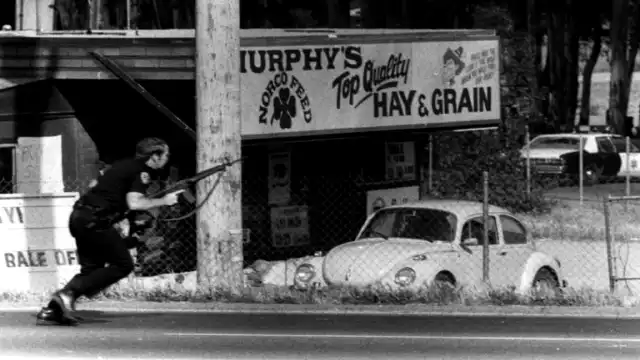
What followed was one of the most violent pursuits in U.S. history. The robbers hijacked a truck and led police on a 25-mile chase into the San Bernardino Mountains.
This wasn’t a high-speed chase; it was a rolling gun battle. The robbers threw homemade bombs out the back of the truck. They fired indiscriminately at pursuing officers and civilians.
- 33 police vehicles were destroyed or damaged.
- A police helicopter, “Air 1,” was forced to land after taking fire.
- Officers from multiple agencies (Riverside, San Bernardino, CHP) joined the pursuit, but they were helpless against the robbers’ range.
Can you imagine the frustration? Officers were firing pistols that were effective up to maybe 50 yards. The robbers were hitting them from 200 yards away with ease. It was like bringing a knife to a missile fight.
The Ambush at Lytle Creek
The chase ended on a dirt road in Lytle Creek Canyon. The robbers, realizing they had the high ground and superior firepower, stopped the truck and set up an ambush.
As deputies rounded the bend, they walked into a kill zone.
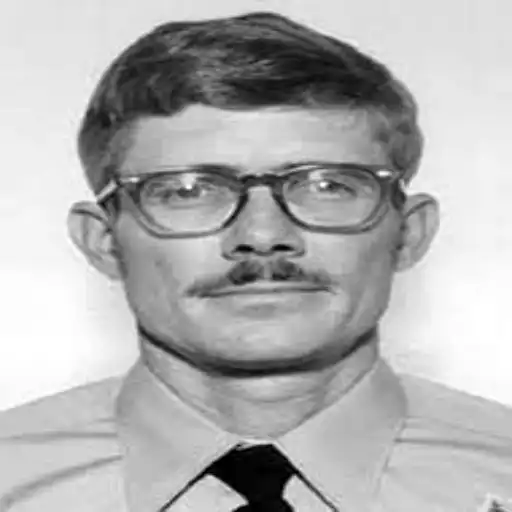
Deputy James Evans, a Vietnam veteran and father of five, was struck in the head and killed instantly. Other officers were pinned down behind their Swiss-cheese cruisers, unable to lift their heads. The situation was dire. The robbers were flanking them, ready to execute the survivors.
The Turning Point
Then, something changed. San Bernardino Deputy D.J. McCarty arrived. Unlike the others, McCarty had brought a personal weapon—an M-16 rifle (some reports say it was an AR-15 borrowed from the department armory, a rarity at the time).
McCarty opened fire.
For the first time, the robbers heard the distinct crack of a high-velocity rifle coming back at them. They realized their advantage was gone. Spooked, they fled into the woods.
The Aftermath
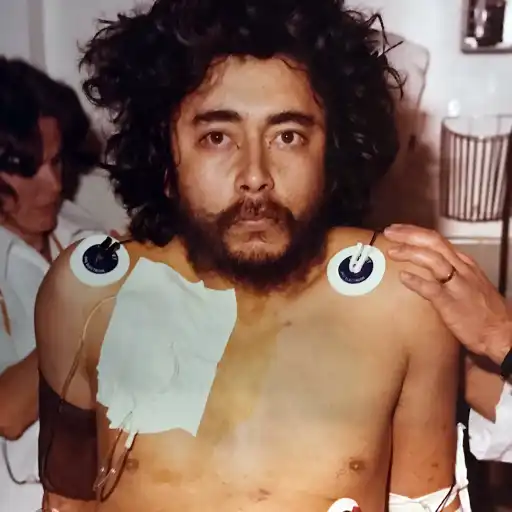
The manhunt that followed was massive.
- Manuel Delgado was killed in a shootout with SWAT.
- George Wayne Smith and the Harven brothers were captured, convicted, and sentenced to life in prison without parole.
The toll was heavy:
- 1 Deputy Killed (James Evans)
- 8 Officers Wounded
- 2 Robbers Killed
- Civilians Injured
How Norco Changed Police Tactics Forever
The Norco shootout is the “Patient Zero” of police militarization. Before this day, the idea of a patrol officer carrying an assault rifle was seen as excessive, even un-American. Police were “peace officers,” not soldiers.
But Norco proved that criminals had access to military hardware. The “six-shooter” era was dead.
1. The Birth of the Patrol Rifle
Immediately after the shootout, the San Bernardino County Sheriff’s Department ordered Ruger Mini-14 rifles for their deputies. Other departments followed suit. Today, seeing an AR-15 locked in a patrol car rack is standard. That started here.
2. “Officer Survival” Training
Training shifted from focusing on hand-to-hand combat and de-escalation to “suppressive fire” and engaging targets at distance. The mindset shifted from “catch the bad guy” to “survive the encounter.”
3. Air Support Weaponry
Police helicopters were previously just eyes in the sky. After Norco, where the chopper was shot down, departments began looking into arming their air units or at least armoring them against ground fire.
Why It Still Matters
We often talk about the “militarization of police” as a controversial topic today. But to understand why cops dress in tactical gear and carry carbines, you have to look at May 9, 1980.
The police didn’t ask for this gear because they wanted to look cool. They asked for it because George Wayne Smith and his crew pinned them down in a canyon and slaughtered them with superior weaponry. Norco taught law enforcement a bloody lesson: You cannot protect the public if you are outgunned.
Was this article helpful?
If you found this deep dive into the Norco Shootout fascinating, share it with a friend who loves true crime or history! Want to learn more about how police tactics have evolved? Drop a comment below or search for the book “Norco ’80” by Peter Houlahan for the definitive account.
Frequently Asked Questions About the 1980 Norco Shootout
How does the Norco Bank Robbery differ from the 1997 North Hollywood Shootout?
While the North Hollywood shootout is more famous due to live TV coverage, experts argue the Norco event was actually far more tactical and dangerous. In North Hollywood, the robbers walked slowly and absorbed hits. In Norco, the suspects used military infantry tactics, set up coordinated ambushes, and utilized improvised explosives during a 25-mile running gun battle. Read the “Chase” section above to see how they turned a truck into a mobile fortress.
What specific weapons gave the Norco robbers such a massive advantage?
The disparity was terrifying. The five robbers were armed with HK91 and HK93 semi-automatic rifles, AR-15s, and thousands of rounds of .308 and .223 ammunition capable of penetrating police cruisers and engine blocks. In stark contrast, responding deputies were armed mostly with .38 caliber six-shot revolvers and 12-gauge shotguns, which were ineffective at long range. Discover the moment Deputy McCarty leveled the playing field in the “Turning Point” section.
Why is the Norco Shootout called “Patient Zero” for police militarization?
Before May 9, 1980, the idea of a patrol officer carrying a high-powered rifle was unheard of. The devastation at Norco proved that the standard police issue handgun was obsolete against heavy weaponry. This specific tragedy directly forced departments, starting with San Bernardino and Riverside, to issue Ruger Mini-14s and eventually AR-15s to patrol units, fundamentally changing the look of American policing.
Did the Norco bank robbers have a specific motive beyond money?
Yes, and it wasn’t just greed. Ringleader George Wayne Smith was a radical survivalist. He wasn’t looking to buy luxury cars; he needed the cash to fund a fortified compound in Utah to survive a predicted nuclear apocalypse. The robbery was technically a “fundraising operation” for a doomsday cult scenario. Learn more about their bizarre background in “The Crew” section.
What happened to Deputy James Evans during the ambush?
Deputy James Evans is the tragic hero of this story. As the first to arrive at the ambush site in Lytle Creek, he unknowingly drove into a “kill zone” set up by the robbers. Pinned down and facing superior firepower, he was struck in the eye by a rifle round and killed instantly. His death became the catalyst for the “Officer Survival” training programs used across the US today.
References & Sources help:
- Houlahan, Peter. Norco ’80: The True Story of the Most Spectacular Bank Robbery in American History. Counterpoint, 2019.
- “The Norco Shootout.” Riverside County Sheriff’s Department Archives.
- Oberhaus, Daniel. “How a 1980 Bank Robbery Sparked the Militarization of America’s Police.” Vice, 2017.
- https://en.wikipedia.org/wiki/Norco_shootout
- https://podcastreview.org/review/norco-80/
- https://public.ntoa.org/default.asp?action=confcourse&numc=201900215&confid=12
- https://www.reddit.com/r/todayilearned/comments/dhxhrl/til_of_the_norco_shootout_in_1980_a_failed_bank/

