

Maria Montessori: Biography, 25 Inspiring Quotes & How Her Montessori Method Changed Education
You might not know her face, but you definitely know her legacy, Walk into a preschool anywhere from Tokyo to Toronto, and you’ll see tiny furniture, hands-on puzzles, and kids working quietly on their own. That wasn’t normal 100 years ago. Back then, school meant bolting children to desks and drilling facts into their heads until they complied.
Maria Montessori changed that.
She wasn’t just a teacher; she was a medical doctor, a feminist, and a scientist who looked at children and saw what everyone else missed: a genius waiting to unfold. Her method didn’t just change schools; it shaped the minds of the people who built the modern world from the founders of Google to the creator of Amazon.
So, who was this Italian powerhouse, and how did she accidentally invent the most famous educational method on Earth?
The Hustle: Breaking Glass Ceilings Before It Was Cool

Maria Montessori was born in 1870 in Chiaravalle, Italy, and she was to put it mildly a handful.
In a time when girls were expected to become nuns or wives, Maria wanted to be an engineer. Her father wasn’t thrilled. When she pivoted to medicine, the University of Rome’s medical school initially rejected her. It was an all-boys club.
She didn’t care. She persisted.
In 1896, she graduated as one of Italy’s first female doctors. But her real education was just beginning.
Her first job wasn’t in a fancy clinic. It was in the university’s psychiatric clinic, working with children labeled “feeble-minded” or “idiots.” These kids were locked in bare rooms with nothing to touch and nothing to do. While other doctors saw broken minds, Montessori saw starved senses.
She realized these children weren’t unable to learn; they were just bored out of their minds.
She created puzzles and sensory tools for them. The result? These “unteachable” children passed the state exams, scoring higher than “normal” children in traditional schools. It was a mic drop moment for the Italian educational establishment.
If this method works for children with cognitive delays, she wondered, what would it do for everyone else?
1907: The Miracle of San Lorenzo
Maria got her chance to answer that question in 1907, She was invited to open a childcare center in San Lorenzo, a poor, crime-ridden district in Rome. The developers didn’t care about education; they just wanted someone to keep the unruly kids from trashing the building while their parents worked.
She called it Casa dei Bambini (The Children’s House), What happened next is the stuff of legend.
- The kids taught themselves. There were no lectures.
- They loved order. Given the choice, the children preferred cleaning and organizing over chaos.
- They concentrated. Toddlers would focus on a task for hours without a break.
One famous story tells of a little girl so engrossed in a puzzle that Montessori literally picked up her chair with the girl in it and moved her. The child didn’t even look up.
News of the “Miracle Children” spread. By 1912, the Montessori Method had gone viral.
The Montessori Method: What is it, Really?

Forget the jargon. Here is how the Montessori method works in plain English.
1. The Prepared Environment
Everything in the room is child-sized. Shelves are low. Sinks are reachable. The idea is simple: Independence. If a child has to ask an adult for help to get a drink of water or a book, they are dependent. If they can do it themselves, they are empowered.
2. Follow the Child
There is no “everyone open your books to page 10.” One kid might be doing math with beads; another is learning to write; a third is slicing bananas for a snack. The teacher isn’t a lecturer; they are a guide, observing what the child is interested in and offering the right tool at the right time.
3. Hands-On Learning
Montessori famously said, “The hands are the instruments of man’s intelligence.” You don’t learn math by listening to a teacher talk about numbers. You learn it by holding “golden beads” that physically show you the difference between 1, 10, and 100.
Does It Actually Work? (The Science)
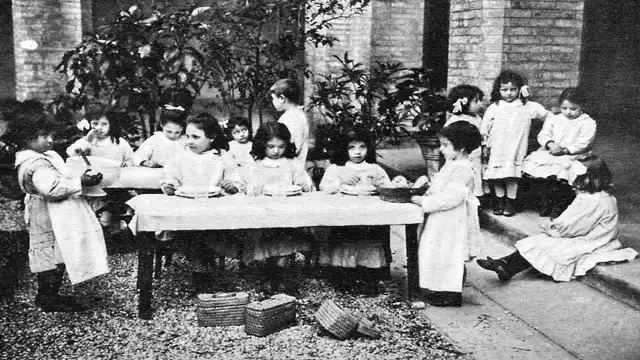
Critics used to call it “playtime.” Now, neuroscience calls it “executive function training.”
Modern research backs Maria up. A landmark study published in the journal Science (Lillard & Else Quest, 2006) compared Montessori students to those in traditional schools. The results?
- Better Social Skills: Montessori kids were more fair and willing to play with others.
- Higher Scores: They outperformed peers in reading and math.
- Executive Function: They were better at self regulation and focus.
It turns out, letting kids choose their work teaches them how to manage their time a skill most adults still struggle with.
The “Montessori Mafia”
Is it a coincidence that the people who disrupted the tech industry came from a system that encourages questioning authority and self-directed learning?
- Larry Page & Sergey Brin (Google Founders): They credit their success not to Stanford, but to Montessori. They learned to follow their curiosity rather than a curriculum.
- Jeff Bezos (Amazon): Another alumni who learned to focus deeply on problems.
- Jimmy Wales (Wikipedia): Built a platform based on self-organized knowledge.
- Will Wright (The Sims Creator): “Montessori taught me the joy of discovery.”
They are sometimes jokingly called the “Montessori Mafia.” They didn’t learn to take tests; they learned to build worlds.
25 Inspiring Maria Montessori Quotes
Maria was a prolific writer. Here are 25 of her most powerful quotes, categorized to help you find the right inspiration.
On the Potential of the Child
- “The greatest sign of success for a teacher is to be able to say, ‘The children are now working as if I did not exist.'”
- “Free the child’s potential, and you will transform him into the world.”
- “The child is both a hope and a promise for mankind.”
- “We discovered that education is not something which the teacher does, but that it is a natural process which develops spontaneously in the human being.”
- “The child has a mind able to absorb knowledge. He has the power to teach himself.”
- “Never help a child with a task at which he feels he can succeed.”
- “The child is the father of the man.”
- “Who does not know that to teach a child to feed himself, to wash and dress himself, is a much more tedious and difficult work for the mother than to feed, wash and dress the child herself? But the former is the work of an educator, the latter is the easy and inferior work of a servant.”
On Education & Learning
- “The hands are the instruments of man’s intelligence.”
- “Our care of the child should be governed, not by the desire to make him learn things, but by the endeavor always to keep burning within him that light which is called intelligence.”
- “Education is a natural process carried out by the child and is not acquired by listening to words but by experiences in the environment.”
- “One test of the correctness of educational procedure is the happiness of the child.”
- “To let the child do as he likes when he has not yet developed any powers of control is to betray the idea of freedom.”
- “Growth comes from activity, not from intellectual understanding.”
- “It is true that we cannot make a genius. We can only give to the teach each child the chance to fulfill his potential possibilities.”
- “The environment must be rich in motives which lend interest to activity and invite the child to conduct his own experiences.”
On Peace & Society
- “Establishing lasting peace is the work of education; all politics can do is keep us out of war.”
- “If help and salvation are to come, they can only come from the children, for the children are the makers of men.”
- “We shall walk together on this path of life, for all things are part of the universe and are connected with each other to form one whole unity.”
- “Everyone talks about peace but no one educates for peace. In this world, they educate for competition, and competition is the beginning of any war.”
- “The child is the forgotten citizen.”
- “Preventing conflicts is the work of politics; establishing peace is the work of education.”
- “If education is always to be conceived along the same antiquated lines of a mere transmission of knowledge, there is little to be hoped from it in the bettering of man’s future.”
- “An education capable of saving humanity is no small undertaking; it involves the spiritual development of man, the enhancement of his value as an individual, and the preparation of young people to understand the times in which they live.”
- “Peace is what every human being is craving for, and it can be brought about by humanity through the child.”
The End of the Road (But Not the Legacy)
Maria Montessori died in 1952 in the Netherlands, but not before being nominated for the Nobel Peace Prize three times.
She left behind a blueprint for treating children with respect. She taught us that kids aren’t empty vessels waiting to be filled; they are fires waiting to be lit.
Today, her method is more relevant than ever. In a world dominated by screens and standardized tests, the quiet, focused, hands-on environment of a Montessori classroom offers a radical alternative. It offers freedom.
Frequently Asked Questions (FAQ)
Why is Maria Montessori often called the “Mother of Modern Tech”?
She isn’t just an educator; she’s the architect of the mindset behind Silicon Valley. Founders of Google, Amazon, and Wikipedia attended Montessori schools. They credit the method’s focus on self-directed discovery and questioning authority for their ability to innovate where others followed rules.
Is Montessori education actually better for children with ADHD?
Many experts say yes. Unlike traditional schools that demand stillness, Montessori environments allow for freedom of movement. This lets high-energy children regulate their own bodies and focus deeply on tasks that interest them, rather than being forced to sit and listen.
Why did Maria Montessori ban “fantasy” play in her early classrooms?
She didn’t ban imagination; she prioritized reality. She observed that young children (under 6) are desperate to understand the real world—how to cook, clean, and build. She believed giving them “fake” stoves or flying fairies before they understood the physical world was confusing, not helpful.
How does the Montessori method handle discipline without timeouts?
It uses “freedom within limits.” Instead of punishment, teachers use redirection and natural consequences. If a child throws a toy, the consequence isn’t a timeout chair; it’s losing the privilege of using that specific toy until they are ready to treat it with respect.
Can I do Montessori at home without buying expensive wooden toys?
Absolutely. Montessori is a philosophy, not a shopping list. It’s about making your home accessible (low shelves, accessible snacks) and involving your child in daily chores (cooking, cleaning). The goal is independence, which costs nothing.
What is the difference between Montessori and Waldorf education?
The main difference is reality vs. fantasy. Montessori focuses on real-world skills, math, and literacy from a young age using concrete tools. Waldorf focuses heavily on art, music, and fantasy play, often delaying reading and writing until age seven.
Ready to see it in action?
Don’t just take our word for it. Visit a local Montessori school. Watch the children work. You might just see the future unfolding right before your eyes.
Was this guide helpful? Share it with a parent or teacher who needs a little inspiration today!
Source help:
- https://amshq.org/about-us/history-of-ams/about-dr-maria-montessori/
- https://www.englishmontessorischool.com/

