

The 300-Million-Year-Old Wheel: Ancient Mystery or Just Rock?
Imagine you’re nearly a kilometer underground, hacking away at coal seams that haven’t seen the light of day since giant insects ruled the Earth. You look up at the sandstone ceiling, and there it is: a perfect, chariot-style wheel embedded in the rock. Not a vague shape, but something that looks undeniably engineered.
This isn’t the plot of a sci-fi movie; it’s the account of a discovery made in 2008 in the Rostov region of Russia.
The “Donetsk Wheel” has baffled internet forums, delighted conspiracy theorists, and annoyed geologists for over a decade. The claim is simple yet earth-shattering: a manufactured wheel was found in rock strata dated to the Carboniferous period, roughly 300 million years ago. If true, it would rewrite history, biology, and physics.
But is it true? Or is nature just playing a visual prank on us?
The Discovery: Deep in the Donetsk Coal Mine
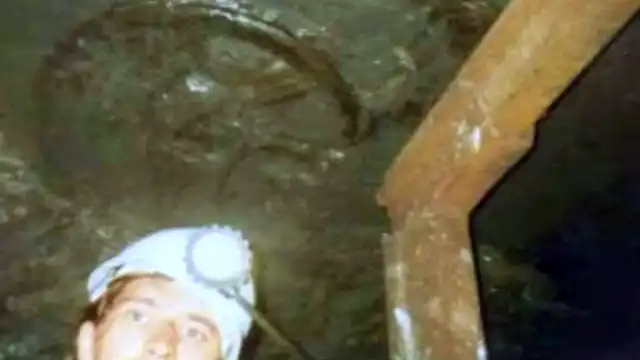
The story begins in 2008 at the “Western” (Zapadnaya) coal mine in Donetsk, located in the Rostov region of Russia (not to be confused with the city in Ukraine). A team of miners, led by foreman S. Kasatkin, was drilling the J3 “Sukhodolsky” coal seam at a depth of approximately 900 meters.
While working, they spotted something bizarre in the sandstone roof above them.
It appeared to be a circular object with a distinct rim and radial spokes – a classic wheel. The diameter was estimated to be around 60 centimeters (about 2 feet). Stunned by the anomaly, Deputy Chief V.V. Kruzhilin reportedly snapped several photographs of the imprint.
Why Didn’t They Bring It Up?
Here is where the story hits a frustrating snag. According to the accounts shared by Kasatkin, the miners attempted to extract the artifact using pick hammers. However, the sandstone was incredibly dense. They feared that further hammering would collapse the roof or destroy the imprint entirely.
Consequently, they left it in situ.
The mine’s administration allegedly dismissed the find, refusing to invite scientists for a formal inspection. Then, in a twist that feels almost too convenient, the mine officially closed in 2009. The shafts were abandoned, the pumps were turned off, and the mine flooded.
Today, the “wheel” sits nearly a kilometer underwater, accessible only to aquatic ghosts and, presumably, very confused fish.
The Science: Why 300 Million Years is Impossible

To understand why a wheel in this rock is such a wild claim, you have to wrap your head around the Carboniferous period.
We aren’t talking about “ancient” in the way the Pyramids are ancient. We are talking about deep geologic time. 300 to 360 million years ago, the Earth looked like an alien planet.
The World of the Carboniferous
- The Vibe: Hot, humid, and swampy.
- The Locals: There were no humans. No monkeys. No dinosaurs. The apex predators were giant amphibians and massive insects.
- The Tech: Zero.
During this era, oxygen levels in the atmosphere were much higher than they are today. This allowed insects to grow to terrifying sizes. Meganisoptera, a dragonfly-like creature, had a wingspan of over two feet. Arthropleura was a millipede the size of a car.
If a wheel exists in this rock, it implies one of three things:
- Giant millipedes invented public transit.
- Time travelers have a terrible track record of parking their vehicles.
- It’s not a wheel.
Scientific consensus firmly supports option three. The timeline of human evolution is well-documented. Homo sapiens have only been around for about 300,000 years. To find a wheel from 300 million years ago is roughly equivalent to finding a functioning iPhone in the stomach of a T-Rex.
The Real Culprits: What Does Geology Say?
So, if it wasn’t a time-traveling chariot, what was it?
Geologists and paleontologists have seen “wheels” in rocks before. It turns out, nature is an expert artist, and it loves geometry. The Donetsk anomaly is likely one of two common geological phenomena.
1. The Fossilized Tree Theory
The most probable explanation is that the “wheel” is actually the cross-section of a fossilized plant.
Remember those massive Carboniferous swamps? They were full of Lycopodiophyta – ancient “scale trees” like Lepidodendron and Sigillaria. These weren’t trees with solid wood like oaks or pines. instead, they had soft, spongy interiors surrounded by a hard, bark-like outer shell.
When these trees died and were buried in mud (which later became the sandstone and coal of the Rostov mine), they often flattened or preserved their 3D shape depending on the pressure.
Here’s the kicker:
A cross-section of a Lepidodendron stem often looks exactly like a wheel. The central vascular bundle looks like a hub, the radiating tissues look like spokes, and the thick outer bark resembles a tire or rim.
When the rock splits horizontally, it exposes this circular pattern. To a miner working in dim light, it looks man-made. To a botanist, it looks like a salad ingredient from the Paleozoic era.
2. The Concretion Theory
Another strong candidate is a concretion.
Concretions are hard, compact masses of matter formed by the precipitation of mineral cement within the spaces between particles. They are found in sedimentary rock or soil.
Think of them as nature’s pearls.
Water rich in minerals (like silica, calcite, or iron oxide) seeps through the sediment. It finds a nucleus – maybe a shell, a leaf, or a bubble – and starts hardening around it in layers.
- Septarian Nodules: These are a specific type of concretion that cracks internally as they dry. The cracks are then filled with other minerals (like calcite), creating a pattern that looks remarkably like the spokes of a wheel.
If you slice a septarian nodule in half, it looks undeniably engineered. However, it is purely a result of chemical processes, not ancient mechanics.
Pareidolia: Why We See What We Want to See
Why are we so quick to scream “Ancient Aliens!” instead of “Cool Rock!”?
The answer lies in our brains. Humans are hardwired for pareidolia. This is the psychological phenomenon where the mind perceives a familiar pattern where none actually exists.
It’s the same reason you see:
- Faces in clouds.
- A “man” in the moon.
- Jesus on a piece of toast.
When we see a circle with lines radiating from the center, our brain references its database and shouts, “Wheel!” It ignores the complex geological context because “Wheel” is a simpler, more exciting explanation.
Furthermore, the “Donetsk Wheel” falls into the category of OOPArts (Out-of-Place Artifacts). These objects captivate us because they challenge the status quo. We want the world to be more mysterious than it is. We love the idea of lost civilizations or hidden histories because standard history can feel a bit… dry.
The “Flooded Mine” Problem
The biggest red flag in this entire story is the lack of accessibility.
In almost every modern myth involving “forbidden archaeology,” the evidence is conveniently destroyed or made inaccessible shortly after discovery.
- The Giants of Smithsonian? “Hidden in a basement.”
- The Alien Bodies of Peru? “Confiscated by the government.”
- The Donetsk Wheel? “Underwater.”
Because the mine is flooded, no independent researchers can verify the find. We cannot take samples to test for chemical composition. We cannot analyze the microscopic structure to see if it is cellular (plant) or metallic (wheel).
We are left with a single, grainy narrative and a few low-resolution photos. In the world of science, extraordinary claims require extraordinary evidence. A blurry JPEG and a story about a flooded hole do not make the cut.
A Pattern of Hoaxes and Misidentifications
The Donetsk wheel isn’t alone. It has cousins in the world of geological misidentification.
The London Hammer
Found in Texas, this “hammer” appeared to be embedded in 400-million-year-old rock. Creationists loved it.
The Truth: It was a 19th-century miner’s hammer encased in a hard limey concretion. The rock wasn’t ancient; the chemical shell formed rapidly around the iron in a specific mineral-rich environment.
The Antikythera Mechanism
This one is actually real! It’s an ancient Greek computer found in a shipwreck.
The Difference: We have the object. We have studied it. We know it dates to around 150-100 BC. It fits within human history (albeit showing advanced craftsmanship), unlike a wheel in the time of giant bugs.
A Cool Fossil, Not a Chariot
So, what did the miners in Rostov find in 2008?
They almost certainly found a fossilized cross-section of a Carboniferous tree or a large concretion. It is a fascinating geological specimen that tells us about the lush, swampy forests that once covered Russia 300 million years ago.
It is not evidence of an ancient civilization. It is not a spaceship part. It is a reminder that nature is capable of creating geometric shapes that rival human engineering.
While the mine may be flooded, the facts are dry. The “wheel” remains a modern myth, fueled by our love for the unknown and our lack of familiarity with ancient botany.
What Do You Think?
Do you believe the official scientific explanation, or is there more to the flooded depths of the Donetsk mine? Drop a comment below and let’s argue about ancient rocks!
FAQ: The Donetsk Wheel Mystery
Q: Where was the wheel found?
A: It was found in the “Western” (Zapadnaya) coal mine in Donetsk, Rostov region, Russia.
Q: How old is the rock?
A: The rock strata belongs to the Carboniferous period, making it between 300 and 360 million years old.
Q: Can I visit the mine?
A: No. The mine was closed in 2009 and is reportedly flooded.
Q: Is there any other evidence?
A: No. Aside from a few photographs taken by the miners, no physical samples were retrieved.
Q: What is the most likely scientific explanation?
A: It is likely a fossilized cross-section of a Lepidodendron tree or a geological concretion known as a septarian nodule.

