

Who Built Nalanda University? History and Facts of the Ancient Campus
- The Origin: Emperor Kumaragupta I founded Nalanda University around 427 CE during India’s glorious Gupta Empire.
- The Glory: It was the world’s first residential university. Notably, it housed over 10,000 international students and 2,000 professors in a massive, zero-tuition educational utopia.
- The Library: The iconic “Dharmaganja” library contained roughly 9 million handwritten manuscripts, spanning three colossal buildings.
- The Destruction: In the late 12th century, Turkic general Muhammad Bakhtiyar Khilji violently attacked the campus. Consequently, his army massacred scholars and burned the library for months.
- The Rebirth: History officially came full circle in 2024. Prime Minister Narendra Modi inaugurated a sprawling, modern “Net Zero” Nalanda University campus near the original ancient ruins.
Have you ever wondered what the ultimate Ivy League school looked like 1,500 years ago? Forget Oxford or Harvard for a quick second. Instead, picture a massive, vibrant campus in ancient India where 10,000 brilliant minds gathered strictly to decode the universe. Welcome to Nalanda University.
This wasn’t just a standard school. Rather, it was an absolute powerhouse of global knowledge. Scholars from across Asia trekked through dangerous mountains just to sit in its classrooms. But how did this magnificent center of peace and learning end up as smoldering ash? Who built it, and more importantly, who ruthlessly tore it down?
Let’s travel back in time. We are going to explore the epic rise, the heartbreaking destruction, and the breathtaking modern rebirth of ancient Nalanda.
Who founded Nalanda university?

Let’s thoroughly set the scene. It is the early 5th century CE. India is currently experiencing its legendary “Golden Age” under the powerful Gupta Empire. Consequently, art, science, mathematics, and literature are exploding across the subcontinent.
During this prosperous era, Emperor Kumaragupta I (also historically known as Shakraditya) decided to build something totally unprecedented. Around 427 CE, he successfully laid the foundation for Nalanda Mahavihara. Located deeply in the Magadha region — which is modern-day Rajgir, Bihar — it didn’t stay a local secret for very long.
Over the next few centuries, later royal rulers aggressively expanded the campus. Specifically, the Pushyabhuti dynasty (including the famous King Harsha) and the Pala dynasty poured massive wealth into the institution. As a result, Nalanda transformed from a modest Buddhist monastery into the world’s very first fully residential university. It seamlessly bridged the gap between religious training and hardcore scientific inquiry.
A day in the life of an ancient scholar
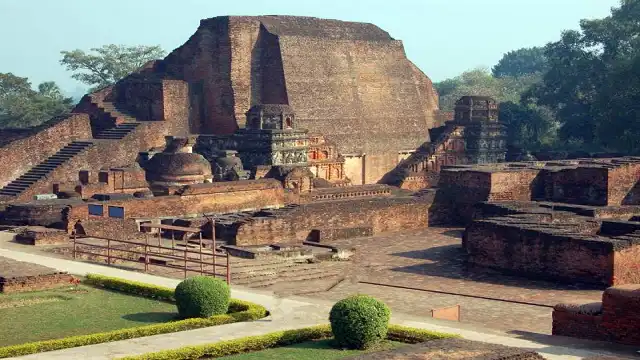
What was it actually like to study there? Honestly, it sounds incredibly intense. If you think getting into a top-tier college today is stressful, Nalanda’s ancient admission process would completely terrify you.
First, prospective students had to face a strict gatekeeper at the main entrance. This senior scholar acted as the ultimate academic bouncer. Rapidly, he fired off wildly difficult philosophical and logical questions. Reportedly, only about two out of ten applicants actually passed this brutal verbal exam!
Once inside, however, daily life was remarkably ideal. The university physically housed over 10,000 students and roughly 2,000 professors. Interestingly, education, food, medical care, and lodging were completely free. Wealthy kings and over 100 local villages totally sponsored the scholars’ daily needs. Therefore, students could focus 100% of their energy on learning.

Incredible campus architecture
Furthermore, the physical campus was an absolute architectural masterpiece. Made entirely of beautiful red bricks, the complex featured sprawling meditation halls, lush parks, and serene lakes. Excavations revealed highly advanced drainage systems and individual dorm rooms for the students. Actually, each tiny room even had its own stone bed and a carved hollow space used as a personal bookshelf.
A Mind-blowing curriculum
Scholars traveled thousands of miles from China, Tibet, Korea, Japan, and Central Asia just to walk those brick corridors. They didn’t just study ancient Buddhist theology. Actually, the curriculum was wonderfully diverse.
Students mastered complex subjects including:
- Advanced mathematics and astronomy
- Ayurvedic medicine and surgery
- Linguistics, grammar, and phonetics
- Metaphysics and heavy philosophical logic
In fact, pioneering mathematical concepts — like the early usage and refinement of zero — were heavily debated within these exact walls. Renowned Chinese monks like Xuanzang (Hiuen Tsang) and Yijing lived there in the 7th century. Ultimately, their incredibly detailed travel diaries are the main reason we know so much about Nalanda today.
Dharmaganja: The mountain of truth and Its 9 million books

Now, we must talk about the absolute crown jewel of the campus. You simply cannot discuss this institution without highlighting its legendary library. It was officially known as Dharmaganja, which translates beautifully to the “Mountain of Truth”.
This wasn’t just a single dusty room filled with old scrolls. Instead, it was a colossal complex split securely into three massive, multi-story buildings:
- Ratnasagara (The Ocean of Jewels)
- Ratnodadhi (The Sea of Jewels)
- Ratnaranjaka (The Jewel-adorned)
Specifically, the Ratnodadhi building stood a towering nine stories high. It safely housed the most sacred, irreplaceable manuscripts. Historians officially estimate this massive library held roughly 9 million handwritten books and delicate palm-leaf manuscripts.
Just pause and deeply think about that staggering number. Without modern printing presses, every single word was carefully copied by hand. Consequently, it held the collective wisdom of the entire ancient Asian world.
Why was nalanda destroyed?
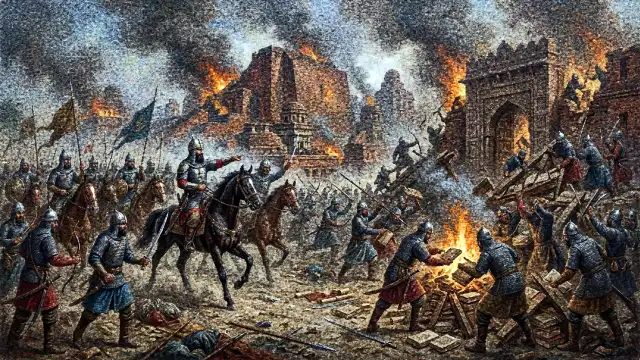
Tragically, all golden ages eventually hit a brick wall. For Nalanda, that devastating wall arrived abruptly in the late 12th century.

To be entirely historically accurate, the campus had faced violent attacks before. First, the Huns invaded and caused damage in the 5th century. Later, the Gaudas of Bengal attacked the complex in the 8th century. Yet, both times, resilient local kings quickly rebuilt the university to its former glowing glory.
However, the third major strike was completely fatal. Around 1193 CE (continuing into the early 1200s), a ruthless Turkic military general named Muhammad bin Bakhtiyar Khilji marched his army into Bihar. He was aggressively conquering new territories and systematically crushing local centers of political and cultural power.
Why did Bakhtiyar Khilji purposely destroy Nalanda? According to ancient Persian chronicles like the Tabaqat-i Nasiri, Khilji’s invading forces severely mistook the sprawling university for a heavily fortified military base. Upon violently breaching the walls, they realized it was merely a massive center of learning for unarmed monks. Nevertheless, he showed absolute zero mercy.
His army ruthlessly slaughtered thousands of peaceful Buddhist monks and innocent academic scholars. Some were tragically burned alive inside their meditation cells. Others were brutally beheaded in the courtyards.
A fire that burned for months
Then came the most heartbreaking cultural crime in human history. Khilji’s soldiers purposefully set the magnificent Dharmaganja library on fire.
Because there were over 9 million stacked manuscripts, the destruction absolutely didn’t happen overnight. In fact, the sheer volume of dry paper, bark, and palm leaves kept the intensely hot flames alive for an agonizingly long time. Historical legends and eyewitness accounts heavily suggest the massive library burned continuously for three to six entire months.
Supposedly, the thick, black smoke hung heavily over the Bihar sky for weeks on end. Essentially, centuries of irreplaceable human knowledge, scientific breakthroughs, and deep spiritual history vanished permanently into literal thin air. This single, catastrophic event dealt a massive, unrecoverable blow to Buddhism in India. Consequently, the great university was eventually swallowed by the thick jungle, entirely forgotten for centuries.
New Nalanda University of 2024

Is that the depressing end of the story? Thankfully, no. A legendary cultural name like Nalanda flat-out refuses to stay buried in the dirt.
In 1861, the renowned Archaeological Survey of India finally excavated the ancient, hidden ruins. Today, that specific historical site is a fiercely protected UNESCO World Heritage landmark. However, the Indian government clearly wanted to do much more than just guard old, broken bricks. They actively wanted to officially revive the academic spirit of the institution.
Fast forward directly to the modern era. Following a special Act of Parliament in 2010, the bold dream of a new Nalanda University slowly took shape. Academic operations quietly began in 2014 from a very small temporary location with just 14 students.

A modern masterpiece of education
Recently, history officially came full circle. On June 19, 2024, Indian Prime Minister Narendra Modi proudly inaugurated the sprawling, permanent new campus of Nalanda University in Rajgir, Bihar.
Located just a few kilometers away from the ancient ruins, this new facility is an absolute modern architectural marvel. Built at a massive cost of ₹1,749 crore, the beautiful 455-acre campus seamlessly blends ancient, rustic aesthetics with futuristic sustainability.
Furthermore, it proudly operates as a totally ‘Net Zero’ green campus. What does that mean exactly? The university runs entirely on its own massive solar plants. It recycles all of its domestic wastewater and features over 100 acres of beautiful, cooling water bodies locally known as Kamal Sagar ponds.
Once again, bright students from over 20 different countries are walking the halls. Backed heavily by 17 participating member countries of the East Asia Summit, the university focuses directly on advanced postgraduate research. They currently offer cutting-edge master’s and Ph.D. courses in:
- Ecology and Environmental Studies
- Historical Studies
- Buddhist Studies, Philosophy, and Comparative Religions
- Languages and Literature
- International Relations and Peace Studies
Nalanda is finally breathing again. It brilliantly proves that while fire can easily destroy fragile paper, it can never truly kill the human pursuit of knowledge.
Conclusion
Ultimately, the epic story of ancient Nalanda University is a massive emotional rollercoaster. It perfectly represents the absolute pinnacle of early human intellectual achievement. Conversely, its tragic, violent fall sharply highlights exactly how quickly ignorance can erase centuries of cultural progress.
Yet, standing in the vibrant city of Rajgir today, you don’t just feel profound historical sadness. Instead, you feel immense, undeniable hope. The shiny new 2024 campus stands globally as a powerful testament to human resilience. We heartbreakingly lost 9 million books to a tyrant’s fire, but the enduring, beautiful spirit of learning survived the flames.
Are you personally planning to visit the ancient ruins or the breathtaking new modern campus in Bihar? Have you ever thought about what lost scientific secrets were actually hidden inside those burning books? Drop your best thoughts in the comments below! If you found this historical true story fascinating, please share it with your fellow history buffs and help keep the legacy of Nalanda alive forever.
References:
- https://en.wikipedia.org/wiki/Nalanda_mahavihara
- https://www.pmindia.gov.in/en/news_updates/pm-inaugurates-nalanda-university-campus-in-rajgir-bihar/
- https://en.wikipedia.org/wiki/Nalanda_University
- https://www.mea.gov.in/press-releases.htm?dtl/37884/Prime_Minister_inaugurates_the_new_campus_of_Nalanda_University

