

Imagine this: You are standing on a rocky plateau, 14,000 feet above sea level. The air is thin and cold. The smell of burning juniper incense hits your nose, mixing with something metallic—blood. Suddenly, the sky goes dark.
Hundreds of massive wings blot out the sun.
You aren’t watching a horror movie. You are witnessing Jhator, the ancient Tibetan ritual known to the West as a “Sky Burial.” To an outsider, it looks like a nightmare. To a Tibetan Buddhist, it is the ultimate act of love.
But here is the one thing: You aren’t actually allowed to be there.
Since 2005, the Chinese government has strictly banned tourists from these sacred sites. Why? because people couldn’t put their phones away. But even if you can’t see it, you need to understand it. In a world obsessed with preserving our bodies in concrete vaults, the Sky Burial teaches us a lesson we are terrified to learn: We are temporary.
Let’s break down the science, the spirit, and the “scary” reality of the world’s most misunderstood funeral.
What Exactly is a Sky Burial?

“Sky Burial” is a fancy name for excarnation—the practice of removing the flesh from a corpse. In Tibet, they call it Jhator, which literally translates to “giving alms to the birds.”
It’s simple, brutal, and efficient.
When a Tibetan dies, the body isn’t pumped full of chemicals. It isn’t burned. Instead, it is carried to a designated “charnel ground” high in the mountains. There, a designated master—often called a Rogyapa or “Body Breaker”—cuts the body into pieces and offers it to a flock of waiting Griffon Vultures.
Within 15 minutes, the entire body is gone.
Bones? They get smashed with a mallet, mixed with tsampa (roasted barley flour) and yak butter tea, and fed to the birds as a second course. Nothing is left behind. No grave, no ash and trace.

The Science: Why Not Just Bury Them?
You might be thinking, “Why don’t they just bury them like normal people?”
Well, geography dictates destiny.
1. The Ground is Rock Hard
Most of Tibet sits on permafrost or solid rock. Digging a six-foot hole in the Himalayas isn’t just difficult; it is nearly impossible. You would need dynamite.
2. There are No Trees
To cremate a body, you need a lot of wood and a really hot fire. But Tibet is largely above the “tree line,” meaning trees don’t grow there. Wood is scarce and expensive. Burning a body would mean wasting fuel that the living need to survive the freezing winter.
3. It’s the Ultimate “Green Burial”
We talk a lot about “leaving no footprint.” Sky Burials are the gold standard for this.
- Western Burial: We pump bodies with formaldehyde (a carcinogen), put them in metal caskets, and bury them in concrete vaults. It takes up land and poisons the soil.
- Cremation: One cremation releases about 400 kg of CO2 into the atmosphere. That’s like driving a car for 1,000 miles.
- Sky Burial: Zero emissions. Zero land waste. The body feeds the local ecosystem.
In a harsh environment where food is scarce, a human body provides a massive meal for the vultures. It is the circle of life, stripped of all the Disney gloss.
The Spirit: Why Feed Vultures?
This is where it gets deep. To understand Jhator, you have to stop thinking of the body as “the person.”
The Empty Vessel
In Vajrayana Buddhism, the moment you die, your consciousness (or soul) leaves the body. The thing left on the ground? It’s just an empty shell. It’s no different than a discarded snake skin or an old coat.
There is no need to preserve it because “you” aren’t in there anymore.
The Final Act of Generosity (Dana)
Buddhists believe in Dana, the virtue of giving. Throughout your life, you try to be generous. The Sky Burial is your final chance to do good. By feeding your flesh to the vultures, you are saving the lives of other small animals (like marmots or rabbits) that the vultures might have hunted otherwise.
It is a sacrifice. You are saying, “I don’t need this anymore. You take it.”
The “Sky Dancers”
Tibetans don’t see vultures as dirty scavengers. They call them Dakinis (Sky Dancers). They believe these birds are holy beings that carry the soul into the heavens to await reincarnation.

If the vultures eat the whole body quickly, it’s a good sign. It means the person had good karma and the birds are eager to help them move on. If the birds refuse to eat? That’s bad news. It suggests the person had “bad meat”—spiritual baggage or unconfessed sins.
The “Scary” Reality: Meet the Body Breaker
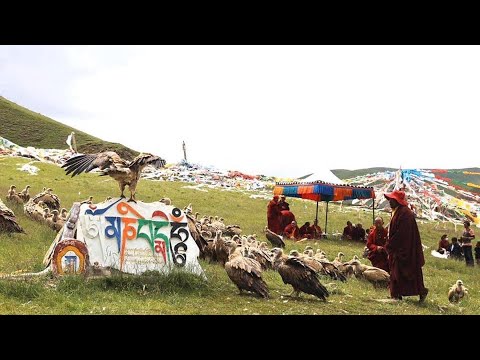
This is the part that makes Westerners squirm.
The Rogyapa (Body Breaker) has one of the toughest jobs on earth. He isn’t a doctor, and he isn’t a priest. He is a specialist in dismantling a human being.
When the body arrives, the Rogyapa doesn’t treat it with somber, weeping silence. In fact, many travelers who visited before the ban reported that the Rogyapas would laugh, joke, and chat while they worked.
Is this disrespectful? No. It’s intentional.
According to Tibetan belief, a heavy, sad atmosphere makes it harder for the soul to leave. It creates “attachment.” By keeping the mood light and treating the body like mere material, the Rogyapa helps the spirit realize, “Oh, that’s just meat. I can let go now.”
The Process (Step-by-Step)
- The Arrival: The body is brought to the mountain at dawn. Monks may chant mantras.
- The Summoning: Juniper incense is burned. The vultures smell it miles away and start circling. They know what the smoke means.
- The Preparation: The Rogyapa makes incisions to facilitate the birds’ work. (We will skip the graphic details, but it is surgical and precise).
- The Feeding: The vultures descend. A large wake of vultures can strip a body in minutes.
- The Smasher: Once the flesh is gone, the Rogyapa takes a sledgehammer to the bones. Mixing the bone dust with barley flour ensures the birds eat everything.
Why You Can’t (And Shouldn’t) Watch It
If you search “Sky Burial” on YouTube, you might find old, grainy footage. But if you book a ticket to Lhasa today hoping to see one, you will be disappointed.
It is illegal for tourists to watch.
Why? Because we ruined it.
Before the ban, tourists would flock to these sites. They would pull out huge cameras, take selfies, and treat a sacred funeral like a zoo exhibit. Imagine a busload of strangers standing next to your grandmother’s open casket, snapping photos and eating popcorn.
It was deeply offensive. The Chinese government, citing “ethnic unity” and respect for privacy, banned the practice for non-family members.
The “Tourist” Myth:
If a guide tells you they can “sneak you in” for a fee, don’t do it. You could get arrested, and worse, you are desecrating a holy moment.
The Modern Threat: The Vultures Are Dying
Here is the sad irony: This eco-friendly ritual is facing an environmental crisis.
The Himalayan Griffon Vulture is disappearing, and it’s our fault. In nearby India and Nepal, vulture populations crashed by 99% in the 1990s.
The Culprit: Diclofenac.
Diclofenac is a cheap painkiller given to cattle and yaks. It works great for cows, but it is poison for birds. If a vulture eats a yak that was treated with this drug, the bird dies of kidney failure within days.
Although the drug has been banned for veterinary use in many areas, it is still available, and populations are struggling to recover. Without the vultures, there is no Sky Burial. The bodies would just rot, spreading disease.
Sky Burial vs. The West: A Quick Comparison
| Feature | Tibetan Sky Burial | Western Burial | Modern Cremation |
| Cost | Almost Free (Donations) | $7,000 – $12,000+ | $1,000 – $4,000 |
| Environmental Impact | Positive (Feeds ecosystem) | Negative (Chemicals in soil) | Negative (Carbon emissions) |
| Land Use | Zero | High (Cemeteries are forever) | Low |
| Philosophy | “The body is a vessel.” | “Preserve the person.” | “Ashes to ashes.” |
| Speed | Gone in < 1 hour | Decades to decompose | 2-3 hours |
What We Can Learn
Sky Burials are unlikely to catch on in New York or London. (Your neighbors might complain about the vultures). But the philosophy behind them is spreading.
We are seeing a rise in “Human Composting” (legal in several US states) and “Green Burials” (biodegradable shrouds, no chemicals). We are finally catching up to what the Tibetans have known for thousands of years:
We come from the earth, and we owe a debt to it.
The Sky Burial isn’t “barbaric.” It is brave. It forces you to look death in the face and say, “I am not this body. I am something more.” It turns a moment of loss into a moment of giving.
So, the next time you see a vulture circling high above, don’t look away in disgust. Look up with respect. They are just doing their job—keeping the cycle spinning, one meal at a time.
Are you interested in “Green Death” practices? Would you choose a Sky Burial if it were legal in your country? Let me know in the comments below.
Note: This article is for educational purposes. Please respect Tibetan laws and culture by not seeking out these rituals if you travel to the region.
Sources:
- https://en.wikipedia.org/wiki/Sky_burial
- https://en.chinaculture.org/

