

What Happened to Doreen Lioy, the Wife of “Night Stalker” Richard Ramirez?
Imagine sitting in your living room in the summer of 1985. Southern California is paralyzed by a suffocating grip of pure terror. Sales of deadbolts, window bars, and firearms are completely shattering records. Citizens are sleeping with loaded shotguns under their beds, terrified of a phantom the media dubbed the “Night Stalker.”
Then, police finally catch him. Richard Ramirez, a brutal serial killer responsible for at least 15 horrific murders, is beaten by an angry mob in East Los Angeles and dragged into custody. The entire state exhales a collective sigh of relief. The monster is caged.
Most people looked at his televised mugshot and saw pure, unadulterated evil. Doreen Lioy looked at that exact same television screen and saw something entirely different. She saw vulnerability. She saw a man she wanted to marry.
How does a successful, highly educated magazine editor fall deeply in love with one of the most sadistic killers in American history? Where did that dark romance lead her? And most importantly, what happened to Doreen Lioy after the cameras stopped flashing?
Let’s unpack one of the most baffling, unsettling true-crime mysteries of the last four decades.
Quick read
- A baffling romance: Doreen Lioy was a normal, educated magazine editor who initiated contact with Richard Ramirez by writing him 75 letters after his 1985 arrest.
- Hybristophilia is real: Her intense attraction highlights a documented psychological condition where individuals are sexually or romantically drawn to violent criminals.
- The 2009 breaking point: DNA evidence linking Ramirez to the 1984 murder of a 9-year-old girl completely shattered Lioy’s illusion of his innocence, leading to their silent separation.
- A total vanishing act: Following Ramirez’s death in 2013, Lioy completely erased her public identity. As of 2026, her exact whereabouts remain a fiercely guarded mystery.
The Making of an Unlikely Fanatic

To understand the sheer absurdity of this relationship, you have to look at who Doreen Lioy was before the trial.
She was not a career criminal. She had no history of violence. Lioy was a freelance magazine editor living a quiet, unassuming life in Burbank, California. She held a bachelor’s degree in English literature. Friends described her as intelligent, articulate, and completely ordinary.
Everything changed in August 1985. Police interrupted standard television programming to broadcast Ramirez’s face to the public. Lioy was simply sitting on her couch. Instead of feeling the disgust shared by millions of Americans, she felt an instant, overwhelming pull.
She began writing to him immediately. We aren’t talking about a single curious postcard. Over the span of just a few years, Lioy flooded his prison cell with more than 75 highly emotional letters.
Ramirez wrote back. A bizarre courtship blossomed through the thick plexiglass of the San Quentin State Prison visiting room. Lioy became a permanent fixture at the facility. She visited him four times a week. She famously packed breath mints before every visit, telling a reporter she wanted to “be able to kiss with confidence.”
She was completely hooked.

“Hometown Girl Makes Bad”
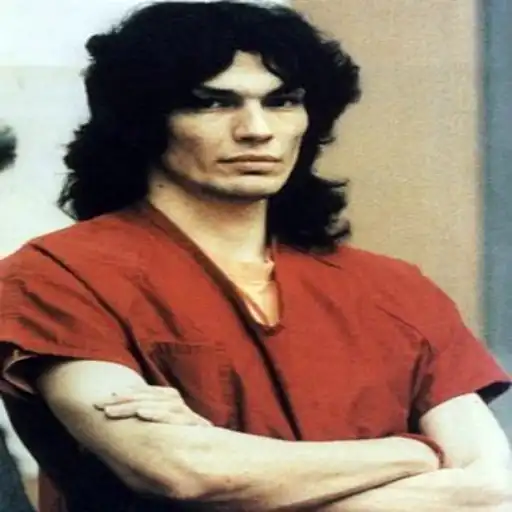
By 1989, a jury officially sentenced Ramirez to die in California’s gas chamber. He reacted by flashing a devilish grin and telling the courtroom, “Big deal. Death always went with the territory. See you in Disneyland.”
Did this lack of remorse push Lioy away? Not a chance. It seemingly pulled her closer.
She became his fiercest public advocate. Lioy genuinely believed he was innocent, claiming he was a gentle soul who had been deeply misunderstood by a corrupt justice system. She frequently clashed with journalists, fiercely defending a man who openly bragged about worshipping Satan.
On October 3, 1996, the unbelievable actually happened. Lioy and Ramirez officially tied the knot in the visiting room at San Quentin.
The visual contrast was absolutely jarring. Lioy wore a short white dress. Ramirez wore his standard-issue blue prison denim. She bought him a thick platinum wedding band. Since death row inmates couldn’t consummate their marriages, they settled for holding hands and sharing vending machine snacks.
When reporters asked her why she would actively choose to marry the Night Stalker, she rolled her eyes. She smirked and delivered a quote that became legendary in true-crime circles: “Hometown girl makes bad.”
Her family was utterly devastated. Many of her relatives completely cut ties with her. Lioy didn’t care. She was Mrs. Richard Ramirez, and she wore the title like a badge of honor.
The Dark Psychology of Hybristophilia

Why do perfectly normal women pledge their lives to men locked in maximum-security cages?
You are probably asking yourself this exact question. It defies all logic. It breaks every single survival instinct hardwired into the human brain. Yet, it happens constantly. Ted Bundy married Carole Ann Boone during his murder trial. Erik Menendez married his pen pal. Kenneth Bianchi, the Hillside Strangler, secured a wife from behind bars.
Psychologists actually have a clinical term for this phenomenon: Hybristophilia.
Sometimes casually called “Bonnie and Clyde Syndrome,” hybristophilia is a paraphilia where an individual is sexually or romantically attracted to someone who has committed an outrageously violent crime. The attraction operates on several complex psychological levels:

- The “Savior” Complex: Many of these women genuinely believe they are uniquely equipped to “fix” the broken man. They see the killer as a wounded little boy trapped inside a monster’s body. They think their pure love can unlock his humanity.
- The Ultimate Safe Relationship: Think about it logically. A man on death row cannot cheat on you. He cannot come home drunk and abuse you. He is locked away 24/7. The woman gets to experience the intense emotional high of a dramatic romance while retaining complete physical control over her own daily life.
- Fame by Association: Marrying a notorious killer instantly rips a person out of obscurity. Suddenly, journalists want to talk to you. True crime junkies know your name. For someone feeling invisible in their daily life, the spotlight of a high-profile trial is an incredibly potent drug.
Lioy fit the profile perfectly. She consistently painted Ramirez as a victim of a terrible upbringing. She ignored the mountain of bloody fingerprints, stolen jewelry, and surviving victim testimonies. Her mind simply refused to process the reality of his actions.
Until the reality became entirely impossible to ignore.
Breaking Point: Murder of Mei Leung

For over a decade, Lioy proudly stood by her husband. She routinely told the press that Richard would never hurt a child. That was her absolute line in the sand.
In 2009, that line washed away entirely.
Advances in cold-case DNA testing allowed San Francisco police to revisit a horrific, unsolved crime from 1984. A 9-year-old girl named Mei Leung was found brutally murdered in the basement of a hotel. She had been sexually assaulted and beaten to death. The timeline placed this crime right at the very beginning of the Night Stalker’s rampage.
Investigators ran DNA found at the old crime scene. It was a direct, undeniable match to Richard Ramirez.
This revelation fundamentally broke something inside Doreen Lioy. She could mental-gymnast her way out of adult burglaries and adult homicides. She could buy into the conspiracy that the police framed him for the main 1985 spree. But science does not lie. The DNA evidence regarding a child was the ultimate wake-up call.
No official divorce papers were ever made public. However, shortly after the Mei Leung connection hit the news cycle, Lioy completely vanished from San Quentin. The weekly visits stopped. The defiant media interviews ended. The fierce, loyal wife simply packed up her emotional baggage and walked away in silence.
The illusion had finally shattered.
A Lonely Death in 2013
By early 2013, Ramirez was dying. Decades of heavy drug use prior to his arrest, combined with a brutal prison environment, finally caught up with him. He developed B-cell lymphoma, a severe form of blood cancer.
On June 7, 2013, the Night Stalker took his final breath at Marin General Hospital. He was 53 years old.
Normally, when an inmate dies, their next of kin steps forward to claim the body and arrange for a funeral. State officials waited. And waited. Nobody came.
Doreen Lioy entirely refused to claim his remains. She did not release a statement. She did not hold a press conference to mourn the man she once called her soulmate. The state of California eventually cremated Ramirez quietly, tossing his ashes into an undisclosed location to prevent true-crime fanatics from turning his grave into a twisted shrine.
Her total silence spoke absolute volumes. She was finally free, but the stigma of her choices would follow her forever.
Where is Doreen Lioy Now?

We live in an era where everyone leaves a digital footprint. You can usually find anyone with a few quick social media searches. Yet, as of now, Doreen Lioy remains a complete ghost.
She hasn’t given a single interview in over fifteen years. She did not participate in Netflix’s massive Night Stalker documentary. She declined any involvement in Peacock’s recent Richard Ramirez: The Night Stalker Tapes.
So, what actually happened to her?
True-crime forums and Reddit sleuths constantly debate her whereabouts. A few prevailing theories exist regarding her current status:
- The Name Change: This is the most likely scenario. Carrying the last name “Ramirez” or remaining “Doreen Lioy” makes securing a job or renting an apartment incredibly difficult. She almost certainly changed her legal identity and quietly integrated back into normal society.
- Hiding in Plain Sight: Some reports suggest she simply relocated. Moving away from the dense media hub of Los Angeles to a quiet, rural town would allow her to age in complete peace. She would be in her late 60s or early 70s today.
- Deep Regret: Psychologists note that when individuals wake up from the delusion of hybristophilia, the resulting shame is often crippling. The realization that you devoted the best years of your life to a monster — while completely alienating your own family — causes intense psychological trauma. Silence is often the only coping mechanism left.
We don’t know exactly what zip code she lives in. We don’t know what name is printed on her driver’s license. Frankly, she has every right to disappear.
The Haunting Legacy of a Toxic Romance
The saga of Doreen Lioy serves as a chilling reminder of how deeply the human mind can deceive itself. Love is famous for being blind. In Lioy’s case, love wasn’t just blind; it was completely detached from reality.
She looked at a man who inflicted unspeakable pain on dozens of innocent families and decided he was worthy of her unconditional devotion. She paid a massive price for that decision. She lost her family, her career, and decades of her life to a cold prison waiting room. In the end, the very monster she tried to save shattered her heart just like he shattered his victims’ lives.
We remain endlessly fascinated by women who marry killers because it forces us to confront an uncomfortable truth. Monsters do not just hide in the shadows. Sometimes, they wear wedding rings.
What is your take on the psychology of people who marry convicted killers? Is it severe delusion, a thirst for fame, or something much deeper? Drop your thoughts in the comments below, and share this article with the biggest true-crime fanatic in your life!

