

The Fountain of Youth Myth: Why Ponce de León Really Explored Florida
We drop hundreds of dollars on vitamin C serums, retinol creams, and cold plunges hoping to freeze time. Five hundred years ago, people supposedly took it a step further. They hopped on wooden galleons, sailed across terrifying oceans, and hacked through tropical jungles to find a magical spring that could turn back the clock.
If you grew up going to American schools, you definitely heard the story. Juan Ponce de León, a daring Spanish conquistador, sailed through the treacherous waters of the Caribbean. He wasn’t looking for trade routes. He wasn’t mapping the stars. No, he was hunting for the legendary Fountain of Youth. He missed the enchanted water but accidentally stumbled upon Florida in 1513.
It makes for a fantastic story. Unfortunately, it is a complete lie.
Ponce de León never searched for glowing skin or eternal youth. His real motivation was much more predictable: money, power, and petty political revenge. The myth you learned in history class actually originated as a smear campaign designed by a rival to make him look like a gullible fool. Here is the gritty, historically accurate truth about why Ponce de León really explored Florida.
Key takeaways
- The Myth: Juan Ponce de León did not discover Florida while looking for the Fountain of Youth. The magical spring never appears in any of his surviving contracts or letters.
- The Real Motive: He explored Florida to find gold, conquer new land, and secure his political legacy after losing his governorship of Puerto Rico to a bitter rival.
- The Origin of the Lie: A Spanish court writer named Gonzalo Fernández de Oviedo invented the story 14 years after Ponce de León’s death as a political hit piece.
- The Irony: The conquistador famous for seeking eternal youth died a violent death at just 47 years old after being shot by a poisoned arrow.
- The Tourist Trap: The famous “Fountain of Youth” in St. Augustine, Florida, was created in the early 1900s by a savvy real estate promoter looking to cash in on the fable.
Where the Myth Actually Began
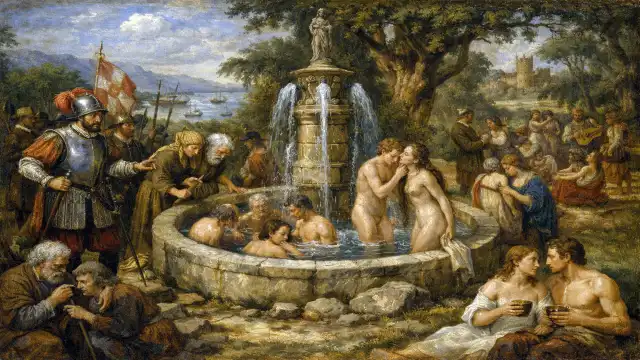
To understand why this specific rumor worked so well, you have to realize that the Fountain of Youth was not a new concept in the 1500s. Europeans had been obsessing over the idea for centuries.
The myth actually traces its roots back to ancient Eurasia, not the Americas. Greek historian Herodotus wrote about a magical spring in the 5th century BC that gave Ethiopians exceptional longevity. Later, Middle Eastern folklore surrounding Alexander the Great featured a miraculous river of immortality. By the Middle Ages, Europeans were passing around the legendary letters of Prester John. He was a mythical Christian king who supposedly ruled a utopian land containing a spring that reversed the aging process.
In other words, the Fountain of Youth was the medieval equivalent of an urban legend. Everyone knew the story, but nobody took it literally.
Suggesting that a seasoned, battle-hardened military commander was actually out there looking for a fairy-tale puddle was deeply insulting. Which was exactly the point.
Power, Politics, and Gold
If he wasn’t looking for magical water, why did Ponce de León sail into the uncharted abyss? The answer involves a heavy dose of 16th-century political drama.

Juan Ponce de León arrived in the Americas on Christopher Columbus’s second voyage in 1493. Born into a poor but noble Spanish family, he possessed incredible ambition. He quickly established himself as a ruthless and effective leader, eventually suppressing an indigenous rebellion in Hispaniola. His military success earned him the governorship of Puerto Rico in 1509.
Life was fantastic. He amassed massive wealth through farming, mining gold, and brutally exploiting enslaved Taíno people.
Then, Diego Columbus entered the chat.
Diego was the son of Christopher Columbus. He firmly believed his family held the exclusive right to rule all the lands his father had mapped. The Spanish court ultimately agreed with Diego’s legal team. They officially stripped Ponce de León of his title and handed control of Puerto Rico over to the Columbus family.
King Ferdinand of Spain felt slightly bad about the demotion. To soften the blow, the King offered Ponce de León a lucrative consolation prize. He granted the ousted governor a royal contract to explore and conquer an unmapped island to the north called Bimini. If the explorer funded the trip entirely out of his own pocket, he could become governor of whatever he found, keep a massive cut of the gold, and expand the Spanish empire.
You can read the actual surviving historical contracts today. They meticulously outline the division of wealth, the subjugation of native populations, and the claiming of real estate. Know what they don’t mention anywhere? A fountain.
The “Discovery” of La Florida
Determined to win back his glory and secure his bank account, Ponce de León launched three ships — the Santa María de la Consolación, the Santiago, and the San Cristóbal — in March 1513.
A month later, his crew spotted a lush, flat coastline. Thinking it was just another massive Caribbean island, they dropped anchor near present-day Melbourne or St. Augustine. Because the landing coincided with the Easter season — known in Spain as Pascua Florida, or the Feast of Flowers — he named the territory La Florida.
The expedition spent weeks mapping the geography. They sailed down the eastern coast, navigated through the treacherous Florida Keys, and traveled up the western coast toward Charlotte Harbor.
They did not find empty land. Florida was heavily populated by complex native societies, including the powerful Calusa tribe. The Calusa were a sophisticated maritime empire who quickly realized the Spanish were not friendly tourists. Fierce skirmishes broke out along the beaches. Finding absolutely zero mountains of gold and facing heavy, organized military resistance, the Spanish fleet eventually retreated to Puerto Rico.
Ponce de León definitely put Florida on the European map. However, the crown viewed his first expedition as a commercial failure. There was no gold, no easily conquerable civilization, and certainly no magical spring.
The Greatest Prank in History: The 16th-Century Smear Campaign
How did a failed gold rush turn into a quest for a magical skincare routine? Blame a man named Gonzalo Fernández de Oviedo y Valdés.
Oviedo was an influential Spanish court chronicler. More importantly, he was fiercely loyal to Diego Columbus. Oviedo absolutely despised Ponce de León. He viewed the former governor as arrogant, dull-witted, and overly ambitious.
When writing his massive Historia general y natural de las Indias in 1535 — fourteen years after Ponce de León had died — Oviedo decided to settle a petty political score. He wrote that the explorer had gone tramping around the Caribbean looking for the waters of Bimini to cure his aging, failing body, having been tricked by local indigenous tribes.
According to historians at the Smithsonian Institution, this was a deliberate literary device. Oviedo used the widely known urban legend of the magical spring to paint his political enemy as an egotistical buffoon. It was the 16th-century version of a malicious viral tweet.
The fake news stuck. Other historians read Oviedo’s work and repeated the claim verbatim. Over the next century, the satirical insult slowly morphed into accepted historical fact.
Timeline of a Historical Lie
- 1513: Ponce de León lands in Florida looking for gold and political power. No mention of a fountain.
- 1521: Ponce de León dies in Cuba.
- 1535: Oviedo publishes his history book, inventing the Fountain of Youth rumor to mock Ponce de León.
- 1600s: European writers repeat Oviedo’s claim without checking the sources.
- 1900s: Florida real estate promoters use the myth to sell tickets to tourists.
The Gritty End of a Conquistador
Perhaps the darkest irony of this entire legend is how Ponce de León’s life actually ended.
In 1521, he returned to the west coast of Florida with 200 settlers, horses, and farming equipment. He was determined to establish a permanent colony. The Calusa, who had successfully defended their homeland eight years earlier, were not interested in sharing their territory. They ambushed the colonizers shortly after they began building.
During the chaos of the battle, a Calusa warrior shot an arrow deep into Ponce de León’s thigh. The arrow was tipped with poison — likely sap from the highly toxic manchineel tree, which causes severe blistering and systemic organ failure.
The Spanish panicked, abandoned the nascent settlement, and fled to Cuba. The poison did its brutal work. A few days later, the man forever associated with eternal youth died in sheer agony. He was only 47 years old.
Why Won’t the Fountain of Youth Myth Die?
If modern historians have known the truth for decades, why is the Fountain of Youth still a core part of American folklore? The answer comes down to two things: romance and capitalism.
People intrinsically want to believe in miracles. The idea that a magical cure for aging exists out there in the wild is intoxicating. It taps directly into the universal human fear of mortality. It also fits perfectly into the mythos of America — a young, undiscovered country where absolutely anything is possible.
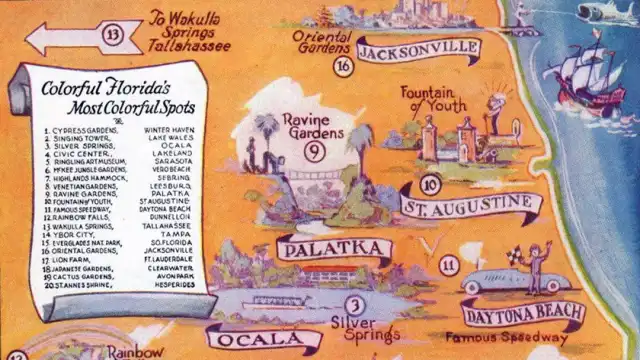
More practically, the legend is extremely profitable. Fast forward to the early 1900s in St. Augustine, Florida. A former Klondike gold rush doctor named Louella Day McConnell — affectionately known around town as “Diamond Lil” — purchased a piece of property containing a small natural spring.
Realizing the massive tourist potential, she fabricated a story that Ponce de León himself had laid a stone cross near the water. She began charging visitors a fee to take a sip.
Today, the Fountain of Youth Archaeological Park remains one of Florida’s most popular historical attractions. Millions of people have happily paid for a cup of sulfur-tasting well water. The park itself is genuinely historically significant, marking the site of early indigenous settlements and later Spanish missions, but the water won’t shave a single day off your chronological age.
History is Messier Than Fiction
History is rarely as clean, romantic, or magical as the stories we tell our children. The real saga of Juan Ponce de León is a gritty tale of blind ambition, political backstabbing, fierce indigenous resistance, and fake news that spiraled wildly out of control.
The fact that we still associate his name with a magical puddle proves a fascinating point. A well-placed lie, wrapped in a beautiful fantasy, can easily outlive the truth by centuries.
What do you think? Did you learn about the Fountain of Youth in school, or did your teachers give you the real story about the Spanish explorers? Drop your thoughts in the comments below, and share this article with a history buff who loves a good myth-busting!

