

Arianism vs. Nicene Creed: The Debate That Shaped Christianity
Imagine a world where street vendors, shopkeepers, and bathhouse attendants are screaming at each other. They aren’t fighting over politics or sports. They are fighting over the nature of Jesus.
“He is created!” shouts one.
“He is eternal!” screams the other.
This wasn’t a fictional drama. This was Alexandria, Egypt, in the early 4th century.
Today, most people assume the core beliefs of Christianity specifically the Trinity were always just “there.” But they weren’t. In fact, the church almost tore itself apart trying to figure out exactly who Jesus was. The resulting brawl is known as the Arian Controversy, and it led to the most famous meeting in church history: the Council of Nicaea.
This wasn’t a boring boardroom meeting with guys in robes sleeping in the back. It was a cage match for the soul of Western religion.
So, what was the beef? Why did the Emperor get involved? And how did a single Greek letter change history? Lets break it down.
Arius and the “Created” Christ
In the blue corner, we have Arius.
Arius was a presbyter (priest) from Alexandria, which was basically the New York City of the ancient intellectual world. He was charismatic, intelligent, and believe it or not a pop songwriter. He wrote catchy tunes (called the Thalia) to teach his theology to the common people (dock workers, sailors, farmers).
“There was a time when He was not.”
Arius looked at the logic of fathers and sons. In human biology, a father always exists before the son. The father generates the son. Therefore, Arius argued, if God is the Father and Jesus is the Son, God must have existed before Jesus.

His logic went like this:
- God the Father is the only one without a beginning (Unbegotten).
- Jesus is the Son, meaning he was “begotten” (born/created).
- Therefore, Jesus is a creature.
To Arius, Jesus was the greatest creature. He was the superhero of the universe, the first thing God made, and the tool God used to make everything else. But, he was not God Almighty. He was a “little g” god.
For many people, this made sense. It protected the idea that there is only one God (Monotheism) and kept things logical.
Alexander (and Athanasius)
In the red corner, we have Bishop Alexander of Alexandria and his young, bulldog-ish assistant, Athanasius.
They realized that if Arius was right, Christianity was broken.
“Salvation is at stake.”
Alexander and Athanasius argued that if Jesus is a creature no matter how high or holy he is part of the creation. And a creature cannot save other creatures. Only God can save humanity.
Furthermore, they argued that “Father” and “Son” are eternal titles. God is eternally the Father, which means the Son must be eternally the Son. They used the analogy of the Sun and its light.
- The Sun is the source.
- The rays are the light.
- You cannot have the Sun without the light shining from it. They happen simultaneously.
To them, Arius wasn’t just wrong; he was destroying the bridge between humanity and God.
Emperor Constantine
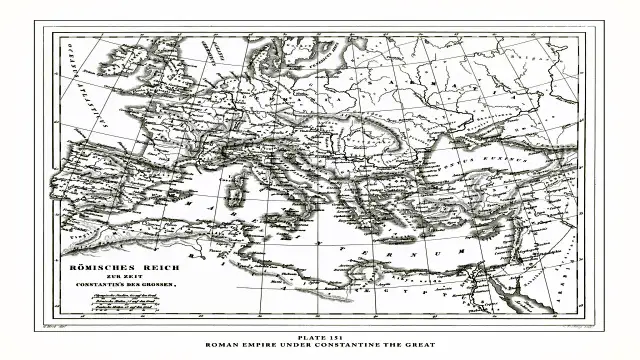
While these priests were shouting at each other, the Roman Empire had a new boss. Emperor Constantine had recently legalized Christianity (Edict of Milan, 313 AD).
Constantine didn’t really care about the theological nuances. He wasn’t a theologian; he was a general. He wanted a unified empire, and he looked to Christianity to be the glue that held it together.
But instead of glue, he got a cracking foundation.
The riots in Alexandria were getting bad. People were literally fighting in the streets. Consequently, Constantine did what any good manager does: he called a mandatory all-hands meeting.
In 325 AD, he summoned over 300 bishops to the city of Nicaea (modern-day Iznik, Turkey). He paid for their travel, fed them, and sat on a golden throne to oversee the proceedings.
The Council of Nicaea (325 AD)
This was the first “Ecumenical” (worldwide) council. The vibe was intense. Many of these bishops had the scars of persecution on their bodies—missing eyes, limps, burn marks—from the days when Rome tried to kill them. Now, the Emperor was buying them dinner.
The debate raged for weeks. Arius (who wasn’t a bishop, so he had to have others speak for him) presented his case. Legend says that St. Nicholas (yes, the real Santa Claus) got so angry at Arius’s blasphemy that he walked across the room and slapped him in the face.
Whether Santa actually threw hands is debated by historians, but it captures the mood: emotions were high.
The Battle of the Iota: Homoousios vs. Homoiousios
Eventually, the council needed a word to define Jesus’s relationship to the Father. This is where the Greek language gets technical.
- Homoousios: This means “of the same substance” (consubstantial). This was the Athanasian/Orthodox view. Jesus and God are the same “stuff.”
- Homoiousios: This means “of a similar substance.” This was the compromise/Arian-adjacent view. Jesus is like God, but not the same as God.
Notice the difference? It’s a single letter “i” (iota).
To the modern eye, this looks like splitting hairs. But to the Council, that “i” was the difference between worshipping God and worshipping a creature (which would be idolatry).
The Nicene Creed
Constantine, seeing which way the wind was blowing (and prodded by his advisor Hosius), threw his weight behind Homoousios (Same Substance).
The Council drafted a statement of faith: The Nicene Creed. It was designed specifically to shut Arius down. Look at the phrasing used in the version we have today (from 381 AD, expanding on the 325 original):
“We believe in one Lord Jesus Christ… God from God, Light from Light, true God from true God, begotten, not made; of the same essence as the Father.”
See that? “Begotten, not made.” That is a direct sniper shot at Arius. “True God from True God.” Another shot.
Arius was condemned, his books were ordered to be burned, and he was exiled. It seemed like a total knockout victory for the Trinitarians.
Plot Twist: The Empire Strikes Back
If you think the story ends there, you’re wrong.
In reality, the Council of Nicaea didn’t stop Arianism immediately. In fact, things got messier.
- Constantine Flip-Flops: A few years later, Constantine started thinking maybe he was too harsh. He allowed Arius to return.
- Athanasius in Trouble: Athanasius, who became the Bishop of Alexandria, was exiled five different times by various Emperors who favored Arianism. He spent years hiding in the desert with monks. There is a famous phrase, “Athanasius Contra Mundum” (Athanasius against the world), because at times, it felt like he was the only one holding the line.
- The Barbarians Loved It: While Rome eventually settled on the Nicene view, Arian missionaries went north and converted the Germanic tribes (Goths, Vandals). So, when the Barbarians eventually sacked Rome, they were actually Christians… just Arian ones.
It took another council (Council of Constantinople in 381 AD) to finally put the nail in the coffin of Arianism within the official Roman Empire.
Why Does This Matter Today?
You might be wondering, “Why should I care about ancient Greek grammar?”
Here is the bottom line. The Council of Nicaea set the guardrails for what “Christianity” is.
- It defined Orthodoxy: It established that consensus (Councils) determines truth, not just one guy with a new idea.
- It focused on the Trinity: It solidified the idea that God is three persons in one essence. If Nicaea had gone the other way, Christianity would likely have evolved into a strictly monotheistic faith more similar to Islam or Unitarianism, where Jesus is a prophet or an angel, but not God.
- Church and State: It was the moment the government got in bed with the church. For the next 1,000+ years, Emperors and Kings would think it was their job to police theology.
The Final Word
The Arian controversy proves that ideas have consequences. What started as a debate between a bishop and a priest in Egypt escalated into a political crisis that involved the Emperor and shaped the Western world.
The Nicene Creed isn’t just a boring poem people mumble in church. It is a peace treaty signed after a brutal theological war. It is the document that decided that, for Christians, Jesus wasn’t just a superhero or a good teacher—He was God.
Did you know that St. Nicholas (Santa Claus) was reportedly at the Council of Nicaea? Share this article with a friend who loves history (or Christmas) and ask them whose side they would have been on: The Logician Arius or the Defender Athanasius?
Want to learn more about the hidden history of the ancient world? Subscribe to our newsletter for weekly deep dives!

