

How the Roman Army Evolved From a Neighborhood Watch Into a World-Conquering Juggernaut
You think you know the Roman army.
You’ve seen Gladiator. You’ve seen the ranks of identical, red-crested soldiers, marching in perfect lockstep, the iconic scutum shield in one hand and a gladius in the other. They are the symbol of unstoppable power, of empire.
But that’s not how it started. Not even close.
The Roman army that conquered the world wasn’t born in a day. It was forged, broken, and reforged over a thousand years. It began as a scrappy “neighborhood watch” of part-time farmars and ended as a professional, globe-spanning military machine that was the state.
This isnt just a history lesson. It’s the story of the most successful, terrifying, and influential organization in ancient history. It’s the story of how a small, muddy village on the Tiber river figured out how to kill everyone else, more efficiently, for longer than anyone else.
So, how did they do it? How did they go from a tiny levy of citizen-farmers to the legions that crushed all of Europe?
It was a slow, brutal process of adaptation. They learned, they stole, and they perfected.
1. The Beginning: The King’s Neighborhood Watch (c. 753–509 BCE)
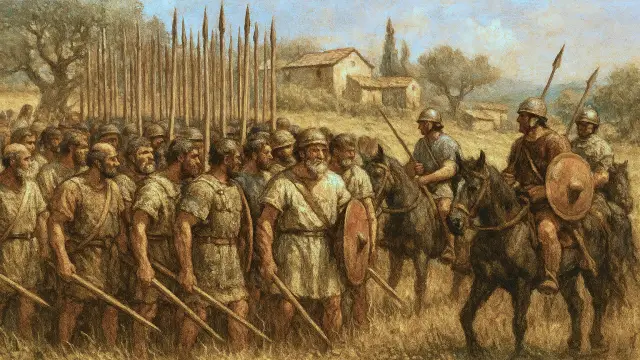
In the beginning, during the Roman Kingdom, there was no “army” as you’d think of it. If Rome was threatened by a rival village, the King would call a levy.
This was a part-time gig. You were a farmer first, a soldier second.
This early “legion” was basically a citizen militia, a levy (which is what legio means) of all able bodied, property-owning men. Why property owners? Because you had to buy your own gear. The richer you were, the better your armor. The richest guys, the equites, could afford a horse and served as cavalry. The rest of the infantry, the adsidui, were organized based on the equipment they could afford.
- Tactic: They fought in a phalanx formation, a big, dense block of spearmen.
- Source: They totally ripped this off from the Greeks (by way of their neighbors, the Etruscans).
- Goal: Fight a quick battle, protect the farms, and get back to the harvest before the crops spoiled.
This was the army of a city, not an empire. It was clunky, slow, and totally unsuited for fighting in the hills of Italy. Every time they lost (and they did), they learned a painful lesson. And the Romans, it turns as out, were very good students of failure.
2. The Big Leap: The Flexible Republic (c. 509–107 BCE)
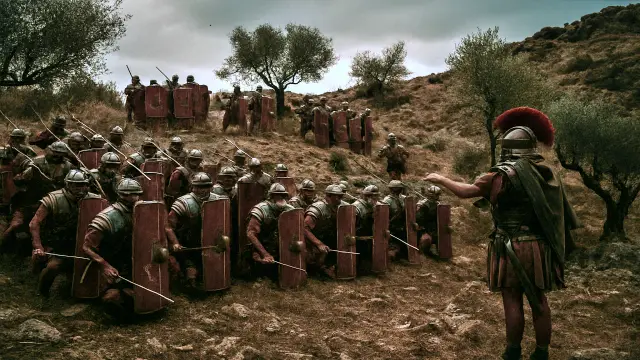
After the Romans kicked out their kings and founded the Republic, they started to fight wars that were farther away, lasted longer, and were fought in rugged, hilly terrain.

They quickly figured out that the Greek phalanx was awesome on a flat, open field… and a total disaster in the mountains. A riged block of spears is easily outflanked and broken on uneven ground.
Their wars against the Samnites in the mountains of the Apennines beat a crucial lesson into them: flexibility wins.
So, they invented something new. Something brilliant. They invented the Manipular Legion.
The “Checkerboard” of Death
Instead of one giant block, the Romans broke their legion into three distinct lines, arranged in a checkerboard pattern. Each line was made of small, tactical units called maniples (meaning “a handful”) of about 120 men.
This was a system based on age and experience, not just wealth.
- The First Line: Hastati
- Who: The youngest, poorest, and least experienced. These were the guys in their late teens and early 20s.
- Gear: A large scutum shield, a gladius (their famous short sword, probably “stolen” from the Spanish), and two pila (heavy javelins).
- Job: Hit the enemy first. They’d run up, hurl their pila to shatter shields and break the enemy’s charge, and then rush in for close-quarters combat with their swords. They were the “shock troops.”
- The Second Line: Principes
- Who: The men in their prime, 20s to mid-30s. They were more experienced and had better gear (mail shirts, bronze helmets).
- Job: The main battle line. If the Hastati couldn’t break the enemy, they would fall back through the gaps in the Principes‘ line. The Principes would then charge forward, presenting a fresh, unbroken, and heavier line of killers.
- The Third Line: Triarii
- Who: The grizzled, hardened veterans. The oldest, most trusted soldiers.
- Gear: They still carried the old-school, long thrusting spear (the hasta), a throwback to the phalanx.
- Job: They knelt in reserve as the ultimate defensive line. The Hastati and Principes could both fall back through them. If the battle was going so badly that the Triarii had to stand up and fight, it was a “last stand” situation. This is where the Latin phrase ad Triarios redisse (“it has come to the Triarii”) comes from—meaning, “we are in deep, deep shit.”
Why was this so revolutionary?
- Flexibility: The “checkerboard” formation meant it could fight on any terrain.
- Endurance: It was a “wave” system. By rotating fresh troops to the front, a Roman legion could out-last anybody. While their enemy was exhausted after 30 minutes, the Romans were just sending in their second wave of fresh, screaming maniacs.
This army—the Polybian Army (named after the historian Polybius)—was still a part-time, citizen-militia. You still had to own property to serve. But it was this army that defeated Hannibal (eventually) and conquered the entire Mediterranean.
3. The Pivot: Gaius Marius Breaks the System (107 BCE)
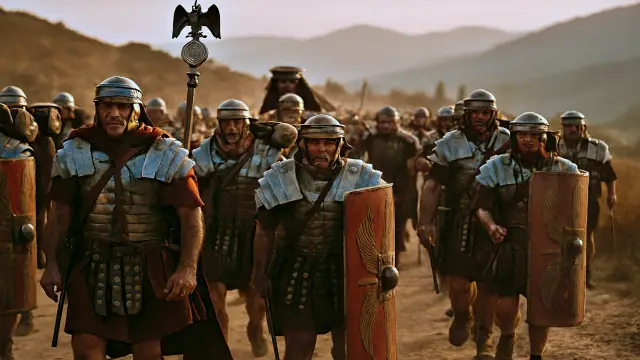
The “Rise to Empire” part of the story… this is it. This is the moment.
By the late 2nd century BCE, Rome had a problem. It had a huge empire, but its army system was built for a small Republic.
- Wars were now years long, not months. They were in Spain, in Africa, in Greece.
- This ruined the citizen-farmer. If you were a soldier, you were gone for 5-10 years. Your farm back home? It failed, went into debt, and was bought up by a rich senator.
- This created a “recruitment crisis.” The number of land-owning men eligible to serve was shrinking, while the number of landless, unemployed, angry poor in Rome (the capite censi, or “head count”) was exploding.
Rome was getting its ass kicked by German tribes (the Cimbri and Teutones). They were desperate. They needed an army.
Enter Gaius Marius.
Marius was a brilliant general and a savvy politician. He saw the problem and came up with a “solution” that changed the world forever. His reforms were so profound, they’re called the Marian Reforms.
- He abolished the property requirement. He opened the army to everyone. He went to the capite censi—the angry, landless poor—and said, “You have nothing? Fine. The state will give you everything. Your weapons, your armor, your training, your pay.”
- He created a professional, standing army. This was no longer a part-time gig. This was a career. You signed on for a 16 (later 20-25) year term.
- He standardized everything. Gone were the Hastati, Principes, and Triarii. Now, every legionary was a heavy infantryman, equipped and trained in exactly the same way.
- He created the Cohort. He reorganized the legion. Instead of 30 small maniples, the new unit was the cohort (about 480 men). A legion was now 10 cohorts. This was a bigger, heavier, and more powerful tactical unit.
- He gave them the Eagle. Each legion was given a silver eagle standard, the Aquila. To lose the eagle was the ultimate disgrace. This built an insane, almost religious esprit de corps.
His soldiers, carrying all their gear on their backs (earning them the nickname “Marius’ Mules”), were the toughest, meanest, and most professional fighting force the world had ever seen.
The Side Effect That Killed the Republic
But Marius’s reforms had an unforeseen, fatal side effect. He solved the recruitment crisis, but he forgot one thing: a retirement plan.
The Senate refused to pay or give land to these new, poor soldiers when they retired. So, who did the soldiers look to for their retirement?
Their general.
Suddenly, the loyalty of the Roman army shifted. It was no longer loyal to the Senate and People of Rome (SPQR). It was loyal to the man who led them, paid them, and promised them a nice farm when they were done.
This is why the Republic fell.
Marii’s reforms created the tool for its own destruction. A general like Sulla could convince his army to march on Rome. A general like Julius Caesar could cross the Rubicon river, bringing his fiercely loyal legions with him to start a civil war, because his men loved him more than they loved the state.
The Marian legion was the perfect tool for building an empire, but it was incompatible with a republic.
4. The Final Form: The Imperial Juggernaut (c. 27 BCE onwards)
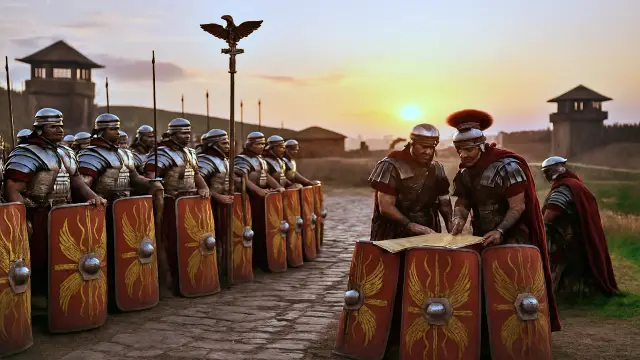
After decades of bloody civil war, Caesar’s heir, Augustus, finally “restored” the Republic (wink, wink) and became the first true Emperor.
Augustus was a genius administrator. He looked at the chaos Marius had unleashed and put a stop to it. He kept the cohort-based, professional army, but he made one crucial change.
He made the state (meaning, himself) the paymaster.
- A Standing, Permanent Force: Augustus reduced the 60+ legions from the civil wars down to 28. These were permanent, numbered legions, stationed on the frontiers of the empire.
- The Military Treasury (Aerarium Militare): He created a dedicated state treasury, funded by new taxes, specifically to pay for the army’s salary and retirement.
- A Real Retirement: After 25 years of service, you were guaranteed a large cash payout or a plot of land. Your loyalty was now, officially, to the Emperor.
This was the final, stable form of the Roman army. This was the army of the Pax Romana, the force that built Hadrian’s Wall, patrolled the Rhine, and kept the peace for 200 years. It was less an army of conquest and more a border patrol, an engineering corps (they built all the roads), and a police force.

This system was so stable and so effective, it lasted for centuries.
The Army’s Evolution: A Quick-Look Table
| Era | The Kingdom (c. 753 BCE) | Mid-Republic (Polybian) (c. 300 BCE) | Late Republic (Marian) (c. 107 BCE) | Early Empire (Imperial) (c. 27 BCE) |
| Main Unit | Phalanx | Maniple | Cohort | Cohort |
| Who Fights? | Property Owners (Militia) | Property Owners (Militia) | Landless Poor (Professional) | Professional Soldiers |
| Gear | Self-Funded (Varies) | Self-Funded (Class-based) | State-Supplied (Standardized) | State-Supplied (Standardized) |
| Loyalty | The King / The City | The Republic (SPQR) | The General | The Emperor |
| Service | Temporary (One campaign) | Temporary (One campaign) | Career (16-20 years) | Career (20-25 years) |
FAQs: Your Roman Army Questions, Answered
Let’s clear up a few common questions.
It changed over time.
1. How big was a Roman legion?
Mid-Republic (Polybian): About 4,200 infantry and 300 cavalry.
Late Republic/Empire (Marian/Imperial): Nominally about 4,800 to 5,200 heavy infantry, split into 10 cohorts. This didn’t include the attached cavalry (equites) and non-citizen specialist troops (auxilia), which could double a legion’s total manpower in the field.
2. What was a Centurion?
A centurion was the backbone of the army. He was a veteran officer who commanded a century (about 80 men, not 100). These were the drill sergeants, the disciplinarians, and the battlefield leaders. They were promoted from the ranks based on courage and skill. The Primus Pilus (“First File”) was the highest-ranking centurion in the entire legion, a hugely respected and influential position.
3. What’s the difference between the Legion and the Praetorian Guard?
The Legions were the main army, stationed on the frontiers (in Germany, in Britain, in Syria) to fight foreign enemies.
The Praetorian Guard was created by Augustus as the Emperor’s personal bodyguard. They were an elite force stationed in or near Rome. They got double the pay, served a shorter term (16 years), and rarely saw a real battle… until they started deciding they didn’t like the current emperor and would, you know, just kill him and install a new one. They were a dangerous, double-edged sword.
4. What made them so good at building stuff?
The Roman legionary wasn’t just a soldier; he was a laborer and an engineer. The army was the Roman state’s #1 public works department. When not fighting, legions built their own forts, bridges, siege engines, and the thousands of miles of paved Roman roads that still exist today. The famous saying was that the Roman soldier “conquered with his gladius, but also with his dolabra (pick-axe).”
The Legacy: The Machine That Built a World… and Then Broke It
The rise of the Roman army is a story of ruthless, practical evolution. They started as farmers, got beaten, and adapted. They fought in the mountains, so they abandoned the phalanx and created the flexible maniple. They ran out of farmers, so Marius created a professional army of the poor.
This new army was loyal only to its generals, so it tore the Republic apart.
Augustus, in his genius, tamed this monster by putting it on a permanent state payroll, turning it into the engine of the Empire.
The Roman army didn’t just conquer the world; it built it. The roads, the laws, the forts that became modern cities (like London and Paris)—all of it was carried on the backs of “Marius’s Mules.” It was a machine for conquest, and then a machine for order. And for centuries, it was the most terrifying, effective, and world-changing organization on the planet.
What’s your take? Was the army’s shift from citizen-militia to professional force a brilliant move or the single biggest mistake the Republic ever made? Let me know your thoughts in the comments below!

