

Did Climate Doom the Vikings? The Real Story of the Norse Collapse
It’s one of history’s greatest ghost stories.
In 985 CE, Erik the Red-a killer, an outlaw, and one hell of a marketing guy—led a fleet of Norse settlers to a vast, forbidding island. He called it “Greenland,” a brilliant piece of branding to lure people to a land of ice. And for a while, it worked.
They built farms, established two main settlements (the “Eastern” and “Western” Settlements), raised livestock, & built stone churches that still stand today, defient against the wind. At their peak, a few thousand Norse lived there.
Then, they vanished.
The Western Settlement was abandoned by 1350. The last written record from the Eastern Settlement is a wedding in 1409. When a ship finally returned in the 1700s, they found only ruins. No people. No bodies. No final, bloody battle. Just silence.
So, what happened?
The simple, go-to answer you learned in school is: “The climate changed, and they froze to death.”
That’s the popular theory. The Little Ice Age hit, the farms failed, and the Vikings, too stubborn to change, were wiped out. It’s a clean, simple, and terrifying story.
It’s also wrong.
The truth is far messier and, frankly, more fascinating. The Norse weren’t just hapless victims of the cold. They were players in a complex, global system. Their disappearance wasn’t a sudden doom; it was a slow, agonizing choice, driven by a perfect storm of climate change, a broken economy, and a devastating identity crisis.
The Greenland Experiment: A Farmer at the End of the World
To understand the collapse, you have to understand the setup. When Erik the Red arrived in 985 CE, his timing was impeccable. It was the peak of the Medieval Warm Period (MWP) (roughly 900-1250 CE). This was a time when global temperatures were warmer. Greenland was a bit greener. The southern fjords were plausible, if marginal, places to try and replicate the only life the Norse knew: European farming.
They were farmers. This is the most important fact. Their entire identity, social structure, and worldview were built on raising livestock. They brought cattle, sheep, and goats from Iceland. Their chieftains’ power came from owning the best pastures.
They weren’t just living in Greenland; they were trying to be Norwegians in Greenland.
They built their settlements on the inland edges of the deepest fjords, not for the best hunting, but for the best pasture. This single-minded focus on being farmers, on a land that was 90% ice, was their first, critical vulnerability.
When the Climate Turned
The “climate doom” theory isn’t wrong; it’s just incomplete. The Little Ice Age (LIA) (roughly 1250-1850 CE) was the catalyst. It was the giant, existential push that exposed every crack in their society.
But “getting cold” wasn’t even the worst part. The LIA was a multi-front assault.
1. The Real Killer: Sudden Drought
For a long time, we assumed colder meant wetter. New research (published in Science Advances in 2022) analyzing sediment from a lake near a Norse farm tells a different story. The cooling climate actually made the region much, much drier.
For a society built on farming, drought is a death sentence.
- Less rain meant less grass growth.
- Less grass meant not enough hay could be cut for the winter.
- Not enough hay meant the livestock died.
Their core way of life, their main source of food and status, was strangled not just by cold, but by thirst.
2. The Mind-Blowing Twist: Sea-Level Rise
This is the part that sounds impossible. How does a new ice age, which locks up water in ice, make the sea level rise?
It’s a crazy, counter-intuitive bit of geophysics. This 2023 study published in PNAS explains it:
- The Ice Sheet Grew: The LIA made the massive Greenland Ice Sheet expand.
- Land Sinks: This unimaginable weight of new ice (called Glacial Isostatic Adjustment, or GIA) pushed the land down—the entire island’s crust literally sank under the pressure.
- Water Pulls: A giant ice sheet has its own gravity. It pulls the ocean toward it.
The Norse, living in the fjords, got hit with a “double whammy.” The land they were standing on was sinking at the exact same time the sea was being pulled up around them.
The study estimates this caused up to 3.3 meters (that’s nearly 11 feet!) of local sea-level rise. This wasn’t a slow, gentle creep. It was a relentless flood. Their best coastal pastures, their farms, and their vital routes were swallowed by the sea.
So, yes, the climate did doom them. But it was a far more complex and insidious killer than just a cold snap. It was a one-two punch of drought and flood.
Walrus Tusks & a Broken Economy
So, farming failed. The pastures were either dry or underwater. Why not just adapt? Why not hunt?
Well, they did. Isotope analysis of Norse skeletons shows that as the centuries wore on, their diet shifted dramutically. From a diet of farm-raised animals, they ended up getting 50% to 80% of their protein from the sea.
They were eating seals. A lot of seals.
But this wasn’t just about survival. They weren’t just feeding themselves. They had to trade. Greenland had no trees for building and no iron for tools. To get this stuff, they had to trade with Europe (Norway and Iceland).
And they had exactly one “cash crop” that Europe wanted: Walrus ivory.
Walrus tusks were the luxury good of the medieval world, used for carving crucifixes, chessmen (like the famous Lewis Chessmen), and other high-status art. The Norse Greenlanders were, essentially, the exclusive supplier of this “Arctic ivory” to all of Christendom.
And then, their entire business model collapsed.
- New Competition: In the 13th century, trade routes with Africa and Asia re-opened. Cheaper, bigger, and—in the eyes of Gothic artisans—better elephant ivory flooded the European market.
- Fashions Changed: The new Gothic art style preferred the smooth, consistent texture of elephant ivory. Walrus tusks were suddenly seen as a cheap, old-fashioned substitute.
- The Price Tanked: The value of their only export plummeted.
The Norse were caught in a trap. To make ends meet, they had to hunt more walruses for less reward. DNA analysis of walrus ivory in Europe shows that as time went on, they were hunting farther and farther north, in more dangerous waters, for smaller and smaller animals.
Their climate was attacking their farms, and the global market was killing their economy.
Why They “Chose” to Fail
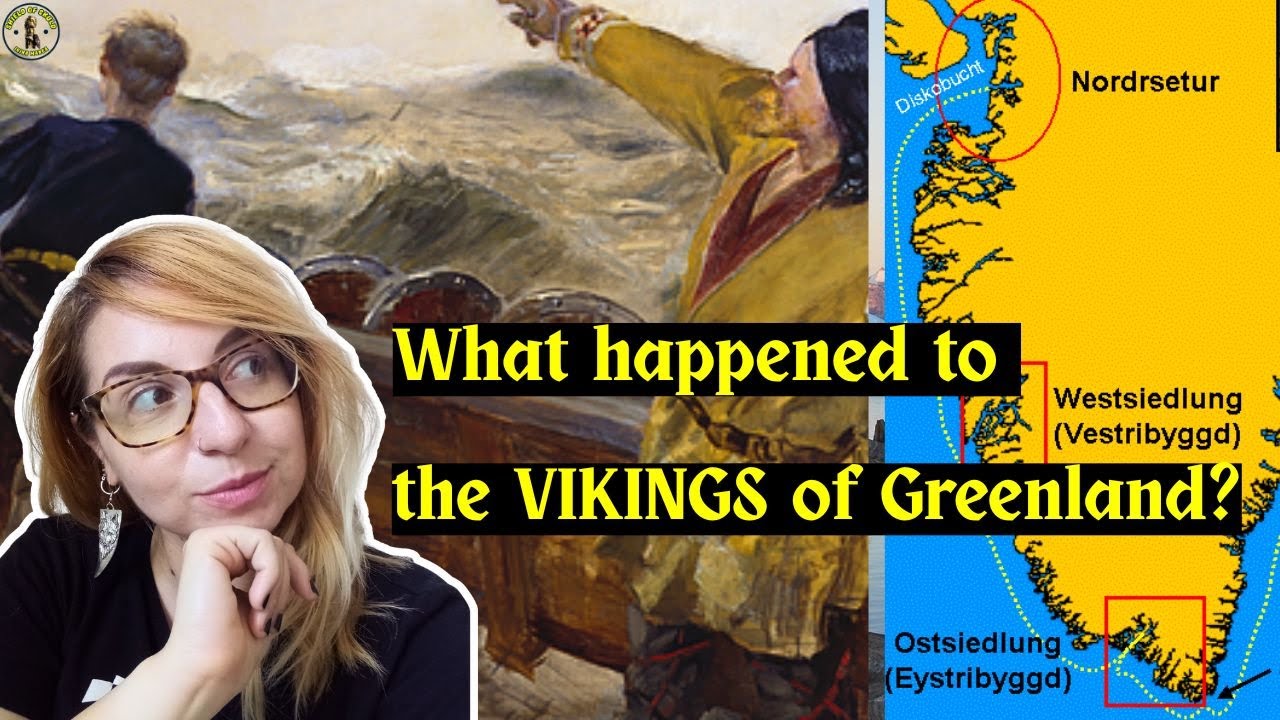
This video explores the reasons behind the Norse disappearance from Greenland, touching on the trade that sustained them.
The Real Reason Vikings Disappeared from Greenland
This is the most human, and most tragic, part of the story.
The Norse were not alone in Greenland.
Around the 12th or 13th century, a new group of people swept into Greenland from the north: the Thule people (ancestors of the modern Inuit). The Norse called them Skrælingar (the same word they used for the Indigenous peoples in Vinland).
The Thule were masters of the Arctic. The Little Ice Age? It was great for them. It expanded the sea ice, which was their prime hunting platform. They had a sophisticated technology toolkit perfectly adapted for this world:
- Skin-covered kayaks and umiaks for open-sea hunting.
- Toggled harpoons for hunting seals, walrus, and even whales.
- Dog sleds for winter travel.
- Snow houses (igloos) for temporary shelter.
The Thule thrived while the Norse died.
And here’s the kicker: The Norse knew them. They lived in the same fjords for over 200 years. They traded (archaeologists find Norse iron in Inuit sites and Inuit-carved items in Norse sites). They also, according to Icelandic sagas, fought. An annal from 1379 reports an Inuit attack that killed 18 Norsemen.

But even with the solution to their survival living right next door, the Norse refused to adopt their technology.
Why? Because of identity.
To the very end, the Norse Greenlanders were Europeans. They were Christians. They were farmers. Their social status was based on how much land and cattle you owned.
To adopt the Thule lifestyle—to use a harpoon, to live in a skin tent, to hunt seals as your main pursuit—was to stop being a Norseman. It was to become a “Skræling,” a “heathen.” It was to admit that your entire world, your God, and your culture had failed.
In the words of archaeologist Jette Arneborg, “The Norse could adapt, but how much they could adapt without giving up their identity was limited.”
They were eating like the Inuit—a diet of 80% seal—but they were doing it with less efficient European methods, clinging to a “mental self-image” of being farmers while the world collapsed around them.
The “Collapse” Was a Slow, Sad Exit
So, did climate change doom them? No. It pushed them. It made their way of life impossible.
The final evidence doesn’t point to a dramatic, Hollywood-style end.
- Not Starvation: The skeletons from the final decades don’t show widespread, acute malnutrition. They were eating something (seals).
- Not Massacre: The “war with the Inuit” theory is largely dismissed as the primary cause. The 1379 skirmish was likely just that—a skirmish, not a war of extermination.
- Not Plague: The Black Death that devastated Europe and Iceland seems to have missed Greenland entirely.
The most likely, and most logical, answer is that the “collapse” was just a managed decline. It was a peaceful abandonment.
Analysis of the graves from the final period shows a strange lack of young women—a classic, tell-tale sign of an emigrating population. They saw the writing on the wall. The farms were flooded, the hay was gone, their only export was worthless, and they’d rather leave than “go native.”
They just… packed up. They got on the last boats and went back to Iceland and Norway, where life was still hard, but at least it was familiar.
The lesson of the Norse Greenlanders isn’t that climate change is a monster that can kill you. It’s that climate change is a catalyst that reveals who you are. It’s a force that shatters rigid, inflexible societies.
Their doom wasn’t a sudden, icy death. It was a slow, heartbreaking realization that the world had changed, and they were not willing to change with it.
What’s your take? Is our modern, globalized society, with our own specialized economies and fixed identities, just as vulnerable to a “perfect storm” as the Vikings were? Share your thoughts in the comments below.

