

Table of Contents
Whispers from the Deep: Could Lost Worlds Await Rediscovery?
The ocean, eh? Vast, mysterious, and holding onto its secrets with a grip tighter than a clam at high tide. For centuries, we’ve stared out at the waves, wondering what truly lies beneath. Sunken ships, sure. Strange creatures, definitely. But what about entire civilizations? What about echoes of a past so profound it could rewrite history as we know it? It’s a tantalizing thought, isn’t it? The idea that somewhere down there, in the crushing dark, remnants of lost worlds are just… waiting.
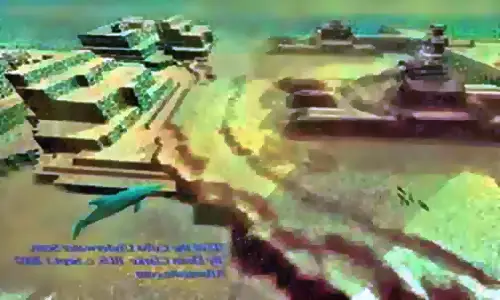
One of the most mind-bending tales, one that really gets the ol’ imagination firing, is the story of Dr. Ray Brown. Back in 1970, this chap was diving near the Berry Islands in the Bahamas. Not looking for lost cities, mind you, just doing his thing. And what does he stumble upon? Get this: a pyramid. Not just any pyramid, but one “shining like a mirror,” as he put it. He reckoned it was about 120 feet tall, though he could only see the top 90 feet peeking out from the seabed. Can you even picture that? A colossal, gleaming structure where no such thing should be.
This pyramid, according to Brown, even had a distinctly colored capstone and was surrounded by the ghostly ruins of other buildings. It’s like something straight out of an adventure novel! He described swimming into a chamber (braver than me, I tell ya) and finding a crystal. Not just any crystal, but one held aloft by two metallic hands. Suspended above this crystal, from the center of the ceiling, hung a brass rod tipped with a red, multifaceted gem.
Brown said he took the crystal – a controversial move, perhaps – which allegedly pulsed with strange, mystical powers. Now, Brown’s story, it does sound a bit fantastical, don’t it? Too spectacular, some might say. But true or not, it plants a seed. It makes you wonder… what else is down there?
A Cuban Conundrum: Sonar Signals a Sunken Metropolis?
Fast forward a few decades, and the plot thickens, this time in the deep waters off Cuba. In May 2001, the world perked up its ears when Reuters, the big London news agency, reported something truly astounding. A Canadian scientific research team, led by Soviet-born ocean engineer Paulina Zelitsky, president of Advanced Digital Communications (ADC), announced they’d located what looked like a “sunken city.” We’re talking deep waters here, off the west coast of Cuba, the Caribbean’s largest island. This wasn’t just a bloke with a wild tale; this was a hi-tech operation.
Using all the bells and whistles – satellite-integrated ocean bottom positioning systems, echo sounders, and fancy high-precision side-scan sonar – they detected “shapes.” And these weren’t just any old lumps and bumps. They were shapes that, get this, “resemble pyramids, roads and buildings.” The regularity of these formations, their almost deliberate layout, screamed “urban development.” Symmetrical architecture, they called it. Imagine seeing that on your sonar screen after months of staring at… well, mostly sand.
This potential deep-sea city, as reported by Reuters, sits on a massive land plateau roughly 2,200 feet (that’s around 700 metres, folks) below the waves. Paulina Zelitsky herself, in an interview, suggested this complex might belong to the “pre-classic period” of Central American history.
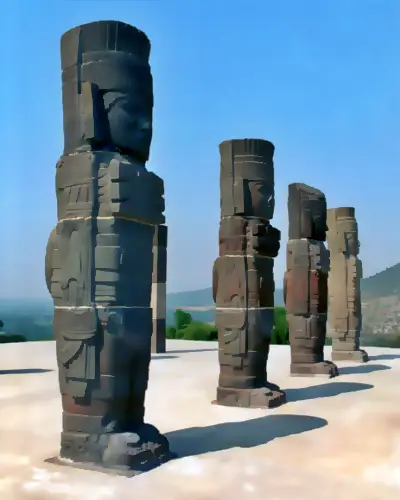
She even ventured that it was populated by “an advanced civilization similar to the early Teotihuacán culture of Yucatán.” “It is stunning,” she confessed. “What we see in our high-resolution sonar images are limitless, rolling, white sand plains and, in the middle of this beautiful white sand, there are clear man-made large-size architectural designs.” She painted a picture, didn’t she? “It looks like when you fly over an urban development in a plane and you see highways, tunnels and buildings.”
Now, Paulina was no fool. She was cautious, admitting, “We don’t know what it is, and we do not have the videotaped evidence of this yet, but we do not believe that nature is capable of producing planned symmetrical architecture, unless it is a miracle.” That’s the kicker, isn’t it? Nature can do some wild things, build mountains, carve canyons, but create a grid of streets and pyramids? That would be a miracle. She was excited, naturally, but held back from wild speculation, preferring to wait for a joint investigation with the Cuban Academy of Sciences and the National Geographic Society. Those explorations were planned for that summer. The anticipation must have been immense!
The initial discovery happened the previous summer, while ADC’s Cuban research vessel, the Ulises, was doing its deep-sea survey thing. The sonar images, across several miles, showed these extensive structures in varying shades. Intriguingly, the site is near the edge of the Cuban shelf, which drops off sharply. And it’s on one of these shelves, in that 600-700 meter depth, that these rectilinear features lay. Adding another layer to the mystery, these shapes are reportedly near an “extinct volcano, geological faults and a river bed.” A river bed? That alone tells you this land was once above water, doesn’t it? Water, a critical element for any civilization.
Paul Weinzweig, Paulina’s husband and an ADC director, chimed in, “Whenever you find a volcano, there is often a settlement associated with it.” He acknowledged the proximity of the features to the volcano, fault lines, and river, noting, “They’re quite close to one another.” When pressed on whether the sonar images really depicted “pyramids, roads and buildings,” Paul confirmed they’d been scrutinizing the images for months. “We keep a picture on the wall showing pyramids in the Yucatán,” he said, “and let’s just say they kept reminding us of these structures.
They really do look like an urban development.” And what about the three-dimensional aspect? “There’s a lot of symmetry, apart from actual shapes, and some suggestion of structure. Some American geologists have looked at them and said that the darker shadings are suggestive of metal roofing.” Metal roofing? Underwater? The mind boggles. ADC wasn’t stopping at sonar; they were gearing up to send down remote robot video cameras and even a one-man submersible. The world waited with bated breath for what they’d find.
From Treasure Galleons to Lost Cities: An Unexpected Turn
Funny thing is, ADC wasn’t initially on the hunt for Atlantis or any other sunken metropolis. Their mission in the deep waters off Cuba was part of a joint venture with the Cuban government, specifically its state partner Geomar. What were they really after? Treasure, me lads! Billions of dollars in bullion and lost riches spewed from Spanish galleons since the days of the Conquest. As Paul Weinzweig candidly put it, “Cuba has the richest galleon cemetery in the world.” Can you imagine? Hundreds, maybe thousands, of ships lost over 500 years due to dodgy navigation, swashbuckling pirates, and those terrifying Caribbean storms.
Other companies, like Visa Gold out of Havana’s Marina Hemingway, had already pulled up thousands of objects – jewelry, diamonds, pistols – from wrecks like the Palemon, lost off Cuba’s northern coast in 1839. Their next target? The Atocha y San Jose, a Spanish vessel that went down in Havana Bay in 1642. This renewed gold rush, so to speak, came about because Fidel Castro’s government, bless their cotton socks, recognized they didn’t quite have the deep-ocean expertise or, frankly, the inclination for such scientific operations.
Their divers? World-class, no doubt, and they’d been treasure hunting for decades. But deep-ocean tech and science? That’s where ADC, with their 80-metre research vessel Ulises and its high-tech kit, came in. It were their eagle-eyed sonar software analysts who spotted those underwater anomalies in the Yucatán Channel.

Eddy Fernandez, vice president of Geomar, summed it up nicely: “These projects are very important in helping us rescue things from history, which contribute to our national patrimony.” He also admitted, “As you know, we have financing problems. This is a very expensive activity. They give us technology and financing. We provide historical and ocean expertise.” A pragmatic partnership, wouldn’t you say?
The “A” Word: Could Cuba Hold the Key to Atlantis?
Now, let’s talk about the elephant in the room, or rather, the lost continent in the ocean. The implications of ADC’s finds off Cuba were, and still are, massive. An online poll by MSNBC back in May 2001 showed that a whopping 73 percent of over 1800 voters believed the find “could be something big: Next stop, Atlantis.” See? People want to believe. NBC itself was already mulling over the Atlantis connection.
This was particularly juicy news for folks like Andrew Collins, author of GATEWAY TO ATLANTIS. In his book, published in 2000, he’d audaciously proposed Cuba as the most likely spot for Plato’s sunken empire – a first, apparently. Collins argued that Plato’s descriptions in the TIMAEUS and CRITIAS hinted that tales of Atlantis reached the ancient world via Phoenician and Carthaginian seafarers who, get this, were supposedly crossing the Atlantic before Plato’s time. A bold claim!
Plato’s description of Atlantis’s great plain – 3000 by 2000 stadia (that’s about 552 by 368 kilometers) – well, it matches up pretty darn well with Cuba’s great western plain. Before sea levels shot up after the last Ice Age, this plain stretched south across the Bay of Batabanó to the mysterious Isle of Youth. Collins had originally thought the Atlantean city might be chilling in the shallows of the Bay of Batabanó.
So, news of a potential sunken city in the Yucatán Channel, between Cuba and the Yucatán peninsula, was, to put it mildly, exciting for him. And guess what? ADC had plans to explore the Bay of Batabanó the following year. Oh, to be a fly on the wall of that research vessel!
More Than Just Rumors? The “Mother Lode” and Other Whispers
The idea of underwater structures around Cuba and the Bahamas wasn’t entirely new, you know. Way back in September 1972, American oceanic explorer J. Manson Valentine, flying over the Bahamas with his associate Jim Richardson, spotted a whole mess of rectilinear and curvilinear features in the shallow waters on the south-western edge of what’s now the Great Bahama Bank. Valentine dubbed this “the mother lode.” These features seemed to face out across the Old Bahama Channel, like some ancient port that once served the Cuban mainland. Fancy that!
Even earlier, in the 1950s, light-aircraft pilots reported seeing “stonework” underwater, “well within Cuban waters.” There were similar sightings “north of Cuba” of an alleged “submerged building complex covering over ten acres.” Some unconfirmed scuttlebutt even suggested the Cuban government, possibly with Soviet submarine assistance, explored this complex back in the 1960s. Makes you wonder what they might have found, and why it was all so hush-hush. It’s a bit ironic, then, that these more recent Cuban discoveries were spearheaded by a Russian-born Canadian oceanographer. The world works in mysterious ways, don’t it?
Even Leicester Hemingway, brother of the famous writer Ernest, got in on the action. During a flight into Cuba, he noticed, beyond its northern coast, “an expanse of stone ruins, several acres in area and apparently white, as if they were marble.” Marble ruins beneath the waves? The exact location of these remains a bit murky, unfortunately. Only time, and more exploration, will tell if Paulina Zelitsky and ADC’s discoveries truly point to Plato’s Atlantis. If they do, well, that would finally pin down its location to the Bahamas and Caribbean, settling a debate that’s raged for centuries.
The Deep Dive: Scientific Hurdles and Historical Puzzles
But hold your seahorses. Finding a lost city at 600-700 meters throws up some serious scientific curveballs for the Atlantis debate. Plato wrote that his island empire was obliterated by “earthquakes and floods” in “one terrible day and night.” He gives dates around 8570 BC in the TIMAEUS and about 9421 BC in the CRITIAS. This timeframe, interestingly, coincides with the end of the last Ice Age. We know sea levels rose pretty rapidly then as the colossal ice sheets covering North America and Europe melted away. It’s a known fact.
In GATEWAY TO ATLANTIS, Collins proposed a comet impact around 8500 BC (+/- 500 years) as the destructive mechanism. This impact, he theorized, devastated America’s eastern Atlantic coast, creating the 500,000 elliptical craters known as the Carolina Bays. Fragments of this comet crashing into the Western Atlantic basin, north of the Bahamas, could have generated tsunamis hundreds of meters high. Imagine the devastation! These monster waves would have swamped large parts of the Bahamas, the Caribbean, and low-lying areas of the eastern US. Indigenous myths from the Bahamas and Caribbean, collected when the Spanish first arrived, speak of just such a cataclysm – waters rushing in, drowning a great landmass, and breaking it into the islands we see today.
While tsunamis alone probably couldn’t fragment landmasses that way, the gradual sea-level rise after such a cataclysm would have permanently submerged low-lying regions, creating the archipelagos. Yet, here’s the rub: over the thousands of years it took for the ice to melt completely, sea levels rose “only” about 300 meters, though some estimates push it to 400 meters. If this Cuban “city” is genuinely at 600-700 meters, we need a pretty hefty geological mechanism to explain how it got so deep after 9000 BC. Or, we need to reconsider the timeline, figuring out when that land plateau, with its volcano, fault lines, and river, was actually above sea level. The geology must make sense.
Paulina Zelitsky’s suggestion that the “city” might belong to “the pre-classic period” of Mesoamerican history, populated by a civilization like the early Teotihuacán culture, is another tricky puzzle. The Teotihuacán culture thrived in Central Mexico from around 400 BC to AD 500. Their origins? Still a mystery to archaeologists. What we do know from Totonac legends is that the founders of Teotihuacán, with its awe-inspiring Pyramids of the Sun and Moon, supposedly arrived on the Gulf coast from an island homeland across the sea. This homeland was Chicomoztoc, the Seven Caves, where the first humans emerged.
There are Caribbean connections to Teotihuacán – purely Caribbean seashells carved on the walls of the Temple of Quetzalcoatl, for instance. This suggests they saw their ancestral home as linked to the Caribbean. Collins, in his book, even identified the original Seven Caves complex as the Punta del Esté caves on Cuba’s Isle of Youth. One of these caves, Cueva #1, is described as a “veritable Sistine Chapel of the prehistoric world,” adorned with abstract, celestial petroglyphs by unknown ancient artists. Its a fascinating place.
Interestingly, Paulina Zelitsky reportedly visited Cueva #1 in the summer of 2000, just before her team made their dramatic underwater discovery. Coincidence? Or perhaps inspiration? That place, it seems, has a certain magic, stirring thoughts about Cuba’s indigenous origins and their knowledge of ancient cataclysms. Even so, any sunken city off Cuba’s northern coast, sitting in 600-700 meters of water, would have to be thousands of years older than the Teotihuacán culture. The timelines are hard to reconcile.
The Unfolding Enigma: A New Chapter in Prehistory?
So, what does it all mean? If Paulina Zelitsky and her ADC colleagues are right, if those sonar blips truly represent pyramids, roads, and buildings nestled deep off Cuba’s western shore, then our understanding of Caribbean prehistory, and its influence on Mesoamerican civilization, is in for a massive shake-up. It could rewrite entire chapters of human history!
Could it be? Could the greatest historical enigma, the mystery of Atlantis, finally be about to unfold in the most spectacular way imaginable? The questions far outweigh the answers right now. But the search, the curiosity, the sheer audacity of looking for lost worlds beneath the waves – that’s what drives us forward. The ocean guards its secrets well, but every now and then, it offers a glimpse, a whisper, a possibility. And we, as curious humans, can’t help but lean in and listen, can we? The next sonar ping, the next dive, could change everything. What do you think is really down there?

