

Harry Price: The Ghost Hunter Who Fooled the World (Or Did He?)
Before Ghost Adventures or The Conjuring, before the Warrens, before TV crews ever thought to pack an EMF meter and a night-vision camera, there was one man.
A man who was a household name. A man who brought the dusty, cobwebbed world of psychical research out of the Victorian seance room and into the flashbulb glare of the 20th century.
His name was Harry Price.
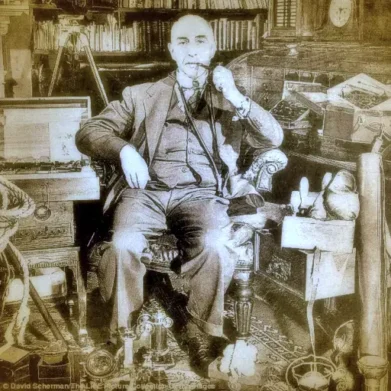
He was, by his own account, the world’s first “ghost hunter.” He was a scientist, an author, a publicist, and a celebrity. He investigated haunted houses, exposed fraudulent mediums, and even tested fire-walkers. His most famous case, Borley Rectory, was dubbed “The Most Haunted House in England,” and the story made him an international superstar.
But there was one, nagging problem.
Was any of it real?
Price was a man of staggering contradictions. He was a skilled magician who knew every trick in the book. He was a meticulous researcher who also had an unquenchable thirst for fame. He was a skeptic who exposed frauds, and he was a showman who, many believe, became the biggest fraud of them all.
So, what’s the real story? Was Price a pioneer who brought scientific rigor to the study of the unknown? Or was he the 20th century’s greatest paranormal con man?
The Man Before the Hauntings: A Skeptic with a Trick Up His Sleeve
To understand the ghost hunter, you have to understand the magician.
Harry Price was born in London in 1881. He wasn’t a dusty academic or a wild-eyed mystic. He was a sharp, savvy businessman in the paper manufacturing trade. But his real passion, his first love, was magic.
From a young age, he was a skilled amateur conjurer. He joined the Magic Circle, devoured books on sleight-of-hand, and understood the art of illusion inside and out.
Like his contemporary, the great Houdini, Price’s knowledge of magic gave him a unique superpower: he knew, better than anyone, how to spot a fake.
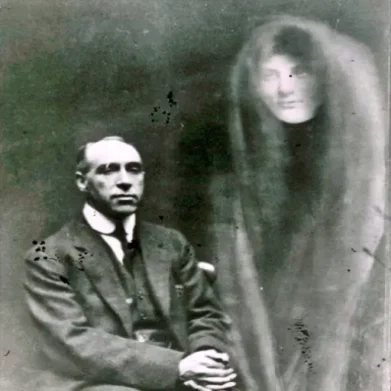
In 1920, he joined the Society for Psychical Research (SPR), and he came in hot. He made his name not by finding ghosts, but by busting frauds. His most famous takedown was the “spirit photographer” William Hope. Hope claimed he could take your portrait and the image of your dead loved one would appear beside you. Price, using his expertise, proved Hope was simply using pre-exposed photographic plates—a classic conjuring trick.
He was a hero to the skeptics. But Price wasn’t satisfied just debunking. He wanted to investigate. He believed that some phenomena might be real, and he was the only man with the scientific tools and magician’s-eye to find out.
He just needed a lab.
Building the Brand: The “Ghost Hunter’s Kit”
In 1926, Price founded the National Laboratory of Psychical Research. This wasn’t just a spooky club; it was a state-of-the-art facility designed to put the supernatural under a microscope.
His goal, he said, was “to investigate in a dispassionate manner and by purely scientific means every phase of psychic or alleged psychic phenomena.”
He was the first to create the “ghost hunter’s kit” that is now standard. His lab and his travel bags were filled with:
- Remote-control cameras
- Electrical-rigged seance tables and chairs (to detect movement)
- Pressure pads for floors
- Thermometers and barographs (to record atmospheric changes)
- A portable “tele-kinetoscope” to see if objects could move in a vacuum
- Plaster and wax for taking “spirit” molds
Price was no longer just a magician. He was a scientist. And he was about to find the case that would define his life, his legacy, and his infamy.
Price’s Greatest Hits: The Cases That Built the Legend
Price investigated hundreds of cases, but three stand out. They perfectly illustrate the three sides of his personality: the showman, the fraud, and the skeptic.
1. The Main Event: Borley Rectory, “The Most Haunted House in England”
This was Price’s masterpiece. It was the case that made him, and the case that ultimately threatened to destroy his reputation.
The Setup: A large, gloomy Victorian rectory in a desolate corner of Essex. The legends were already there: a spectral nun (supposedly bricked up in the walls after an affair with a monk), a phantom carriage, and unexplained footsteps.
Phase 1 (1929): The Daily Mirror newspaper, knowing Price’s flair for publicity, sent him to investigate. On his very first visit, the phenomena exploded. Stones were thrown. A glass candlestick hurled itself. “Spirit messages” were tapped out on a mirror. Price was hooked. The story went national.
Phase 2 (1937): After the last residents were driven out, Price did something brilliant: he rented the rectory for one year.
He placed an ad in The Times recruiting a team of 48 “unbiased official observers.” He gave them his “Blue Book” of instructions. They were to live in the house, in shifts, and meticulously log everything. This was Ghost Hunters, 1930s-style.
He literally created a scientific protocol for a 24/7 ghost hunt. The team reported a blizzard of activity:
- Unexplained footsteps and bell-ringing
- Objects being thrown
- “Wall writing” that appeared out of nowhere
- Apparitions, including the famous spectral nun
In 1939, the house mysteriously burned to the ground. Price was there, of course, taking photos and even conducting digs in the cellar, where he found a few bones (which he claimed belonged to the nun).
He published two best-selling books, The Most Haunted House in England (1940) and The End of Borley Rectory (1946). He was the most famoas ghost hunter on Earth.
The “Gotcha”: It all came crashing down after Price died in 1948. In 1956, the Society for Psychical Research (the very group he’d left) published a scathing report titled The Haunting of Borley Rectory. Three investigators, Eric Dingwall, Kathleen Goldney, and Trevor Hall, re-interviewed witnesses and went through Price’s files.
Their conclusion? Price was a fraud.
They claimed he faked almost everything. He was “an expert at throwing bricks.” They said he’d “salted the mine,” faking phenomena himself to get the story going. Witnesses recanted, claiming Price had pressured them. The “wall writing” looked suspiciously like his own.
Price wasn’t there to defend himself. His reputation was, like the rectory, in ashes.
2. The Smoking Gun: The “Rosalie” Seance
If Borley was the long-con, “Rosalie” was the smoking gun.
In 1937, Price was invited to a seance to contact the spirit of a six-year-old girl named Rosalie. The seance was a success, and Price’s team, using a special camera with infrared-sensitive plates, captured what looked like a small, ethereal, childlike figure. It was one of the only “spirit photographs” Price ever claimed was genuine.
The Debunk: This one is bad for Price. After his death, his own photographer, Mr. Titterton, confessed. He claimed Price had come to him before the seance with a glass plate that already had the “spirit” image on it. Price allegedly asked him to discreetly substitute this fake plate for the blank one during the seance.
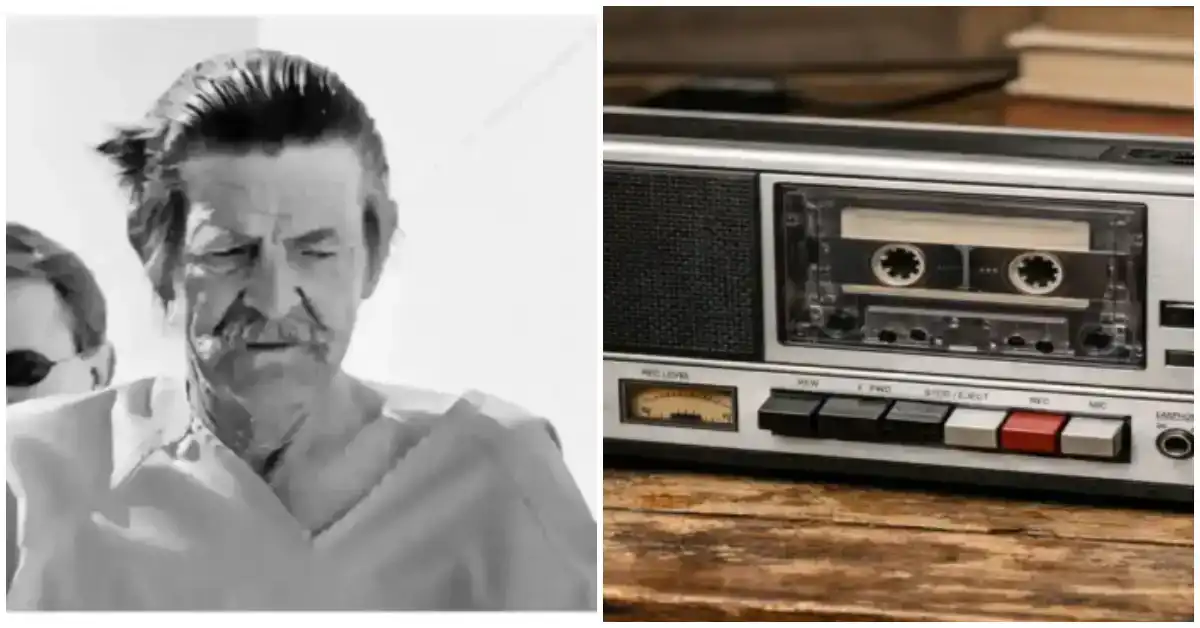
Ouch. This is as close to a smoking gun as you can get. It proved Price had the means and the will to fake evidence to get a good result.
3. The Other Side of the Coin: The Skeptic at Work
But here’s the confusing part: Price was, at other times, a brilliant skeptic.
- Gef the Talking Mongoose: This is one of the weirdest cases in paranormal history. In 1935, a family on the Isle of Man claimed to be haunted by a “man-weasel” named Gef. Gef could talk, sing songs, and spy on the neighbors. It was a tabloid sensation. Price went to investigate. He was deeply skeptical and suspected the family’s 13-year-old daughter was a gifted ventriloquist. He collected hair samples (which were inconclusive) and left, unconvinced. This was Price the scientist, not the showman.
- Fire-Walking: Price wasn’t just about ghosts. He tested all claims. In 1935, he arranged for a fire-walker named Kuda Bux to be tested for the University of London Council for Psychical Investigation. In a controlled scientific setting, Price’s team filmed and took temperature readings as Bux walked across a 12-foot trench of embers at 800°F. His conclusion? It was not a miracle. He concluded it was a matter of physics (low thermal conductivity of the embers) and psychology (a confident, quick step).
So, which one was he? The man who debunked fire-walking or the man who faked a ghost child?
Pioneer, Fraud, or Something Else?
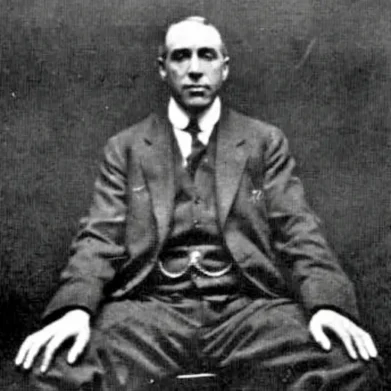
So, what’s the truth? Was he a con man, or was he a trailblazer?
Here’s the thing. He was both.
The Case for Price as a FRAUD:
- The “Rosalie” photograph is almost indefensible.
- The 1956 SPR report on Borley is a devastating, meticulous takedown.
- His background in magic gave him the means and method to fake poltergeist activity (like throwing bricks) without being detected.
- He was an undeniable self-publicist, obsessed with his own fame.
The Case for Price as a PIONEER:
- He did expose numerous, very real frauds, like William Hope.
- He was the first to bring a “lab” mentality to ghost hunting.
- He created the very template for paranormal investigation that is still used today (archival research, high-tech equipment, multi-night vigils, witness logs).
- His fire-walking investigation was a perfectly executed piece of scientific skepticism.
The truth is, Harry Price was a P.T. Barnum of the paranormal. He was a showman who wanted to believe, but he also knew that a good story was more compelling than boring data.
He was a man who understood, decades before anyone else, that the public didn’t just want a dry, academic report. They wanted a ghost story. And if the ghosts were being shy that night? Well, his magician’s hand might just have to give them a little… help.
His legacy isn’t that of a pure scientist, nor of a simple fraud. His legacy is the job of the “ghost hunter” itself. He created the very idea of the celebrity paranormal investigator. Every time you watch a ghost-hunting show, you’re watching a performance that Harry Price wrote the script for, nearly 100 years ago.
He fooled some of the people, all of the time. He may have even fooled himself.
What do you think? Was Harry Price a genuine seeker of truth, or was he a master illusionist who pulled off the greatest trick of his career? Let me know your theory in the comments below.

