

You know the A-listers. Peter, the rock. John, the “beloved disciple.” Matthew, the tax guy. And of course, Judas, the betrayer. Their stories are baked into the DNA of Western culture.
But here’s a question. When Jesus picked his “12” he wasn’t just starting a club. He was, in his own words, commissioning them to “go into all the world.”
So… did they?
We tend to think of the apostles as a tight-knit group that huddled in Jerusalem. But what about the rest of the crew? The “B-team”? What happened to Bartholomew? Or Andrew? Or the other Judas (Thaddeus)?
This is where history gets thin and the legends get wild.
Their stories aren’t in the Bible. They’re found in the apocryphal acts the “non-canonical” sequels—and in a wildly popular medieval “bestseller” called The Golden Legend. These tales are a high-octane mix of folklore, miracle-working, and Game of Thrones-level martyrdoms. They are the stories that bueilt nations, inspired masterpieces, and reveal more about human faith than any dry history book.
We’re going to follow the blood-soaked, dragon-slaying, globe-trotting trail of the apostles you don’t know.
Where Do These Stories Even Come From?

First, let’s be super clear. We are now officially outside the Bible. We’re in the realm of tradition and legend.
The New Testament is surprisingly silent on the deaths of 11 of the 12 apostles (it only mentions the death of James, son of Zebedee, who was beheaded by Herod).
Most of these stories come from:
- Apocryphal “Acts” (2nd-4th Centuries): These were like the fan-fiction of the early church. The Acts of Thomas, Acts of Andrew, and Acts of Philip were action-adventure stories detailing their travels and miracles.
- The Golden Legend (c. 1260 AD): This book, compiled by Jacobus de Voragine, was the medieval equivalent of the Marvel Cinematic Universe. It collected all the saints’ stories into one epic volume, and everyone read it.
These stories aren’t “history” in the way we think of it. They are theological folklore, designed to inspire faith and explain how Christianity spread from a tiny corner of Judea to the ends of the known world.
Now, on to the legends.
The Doubter Who Became a Globe-Trotter: St. Thomas in India
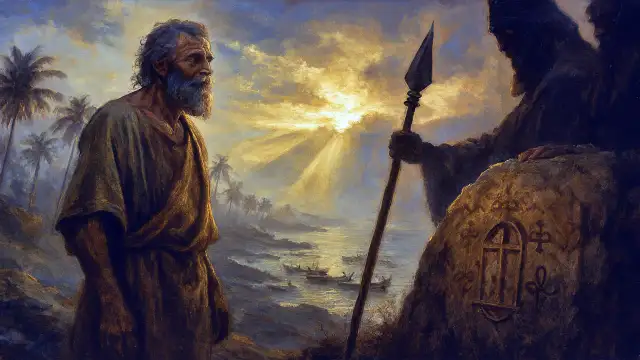
We all know “Doubting Thomas.” He’s the guy who wouldn’t believe Jesus was resurrected until he could literally poke his fingers in the wounds.
But the “untold” part of his story is what happened next. The apocryphal Acts of Thomas paints a picture of a man whose faith became so strong, he took on the most remote mission imaginable.
The Legend:
When the apostles were divvying up the world, Thomas drew the short straw: India.

He flat-out refused. “I am a Hebrew man; how can I go among the Indians to proclaim the truth?”
So, the story goes, Jesus appeared to him in a vision and sold him as a slave to a merchant who was heading to India. No, really. The merchant was looking for a master carpenter, and Jesus said, “I have a slave, a carpenter, whom I desire to sell.”
Thomas, now owned by the merchant, was shipped to the kingdom of Gondophares in modern-day India.
- The king gave Thomas a ton of money to build him a magnificent palace.
- Thomas took the money… and immediately gave it all to the poor and the sick.
- When the king returned, he asked, “Where is my palace?”
- Thomas replied, “I have built it for you in heaven. It is a palace not made with hands, but it is eternal.”
The king was not amused. He threw Thomas in prison. But then, the king’s brother died, saw the magnificent “palace” Thomas had built for the king in heaven, and was miraculously brought back to life to tell the tale. The king and his brother instantly converted.
His Martyrdom:
Thomas traveled all the way to the southeastern coast of India, in what is today Kerala and Tamil Nadu. He established one of the oldest Christian communities in the world (the Mar Thoma or Saint Thomas Christians, who still thrive today).
His success angered local priests, who condemned him to death. Tradition holds he was impaled with a spear on a hill near modern-Cromapet in Chennai.
The X-Man: St. Andrew and the Making of Scotland
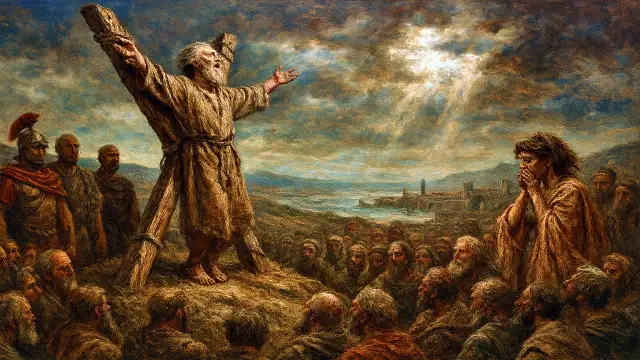
Andrew was Peter’s brother. He was the first apostle called by Jesus. And his legend is just as rugged.
The Mission:
Early traditions say Andrew was a serious traveler. He went north, preaching in Scythia (modern-day Ukraine and southern Russia) and along the Black Sea. He is still the patron saint of Ukraine, Romania, and Russia.
But his final stop was Patras, in Greece.
His Martyrdom:
In Patras, he converted the wife of the Roman proconsul, Aegeates. This was a classic “angerthe-ruler” move. Aegeates ordered him to be crucified.
Here’s the twist. Andrew, feeling unworthy to die in the same manner as Jesus, requested a different kind of cross. He was bound—not nailed to a crux decussata, an X-shaped cross. The legend says he hung there for two days, preaching to the crowds the entire time before he died.
The Scottish Connection… So, How’d He Get to Scotland?
This is where legend gets really fun. How did a guy who died in Greece become the patron saint of Scotland?
- The Story: Centuries after his death, a Greek monk named St. Regulus (or Rule) had a vision. An angel told him to take Andrew’s relics (a tooth, a kneecap, etc.) and flee, as the Emperor Constantine was coming to seize them.
- Regulus put the bones on a ship and sailed until he was shipwrecked… on the coast of Fife, Scotland.
- The Pictish king at the time, Óengus II, adopted Andrew as the kingdom’s patron, and the town of St. Andrews was born.
That “X” on the Scottish flag (the Saltire)? That’s St. Andrew’s cross. It’s a 1,000-year-old hat-tip to a gruesome execution in Greece.
The Most Metal Martyrdom: St. Bartholomew (Nathanael)

Bartholomew is the apostle we’re pretty sure is the same guy as “Nathanael,” the one Philip introduced to Jesus. His legend is short, brutal, and has had a massive impact on art.
The Mission:
Like Thomas, Bartholomew’s mission field was in the East. He is said to have preached in Mesopotamia, Persia, and, most famously, Armenia.
His Martyrdom:
In Armenia, he pulled the classic “convert-the-royalty” move, converting the king, Polymius. This enraged the king’s brother, Astyages.
Astyages ordered the apostle’s execution. And he didn’t just order a quick beheading. The legend is specific and horrifying: Bartholomew was flayed alive.
He was skinned, head to toe, and then crucified (or beheaded, depending on the story).
This visceral, skin-crawling death made him the patron saint of tanners, butchers, and… glove-makers. How metal is that?
It also led to one of the most famous, creepy “Easter eggs” in art history. In Michelangelo’s The Last Judgment in the Sistine Chapel, St. Bartholomew is shown holding his own flayed skin… and the face on the skin is a self-portrait of Michelangelo himself.
The Dragon Slayer: St. Philip
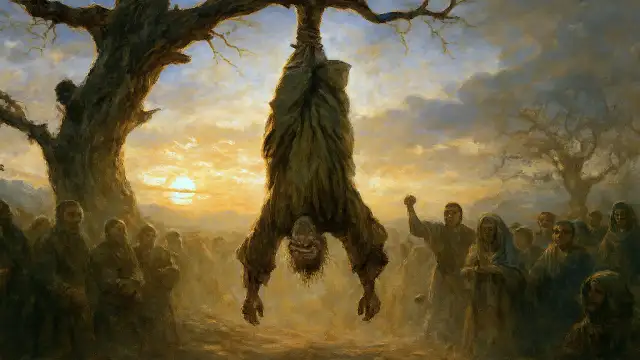
Not to be confused with “Philip the Evangelist” (who is a different guy), the Apostle Philip’s legends are pure monster-movie fun.
The Mission:
Philip preached in Phrygia, in the city of Hierapolis (a real, amazing Roman ruin in modern-day Turkey).
The Legend:
When Philip arrived, he found the city in the grip of a pagan cult that worshipped a giant serpent or dragon (the text calls it an echidna). The creature lived in a temple, and its toxic breath was making the entire city sick.
Philip, full of righteous fury, entered the temple. He held up a cross and commanded the dragon to vanish. The creature (sometimes said to be a demon named Asmodeus in its form) immediately shriveled up, but as it died, it let out one last blast of venomous breath, killing the proconsul’s son and several priests.
The proconsul, enraged at his son’s death (even though Philip later resurrected him), ordered Philip and his companion (sometimes said to be Bartholomew) to be arrested and crucified.

His Martyrdom:
Philip was hung by his ankles from a pillar or tree (a form of crucifixion) and then stoned by the crowd.
The “Tag Team”: Simon the Zealot & Jude (Thaddeus)
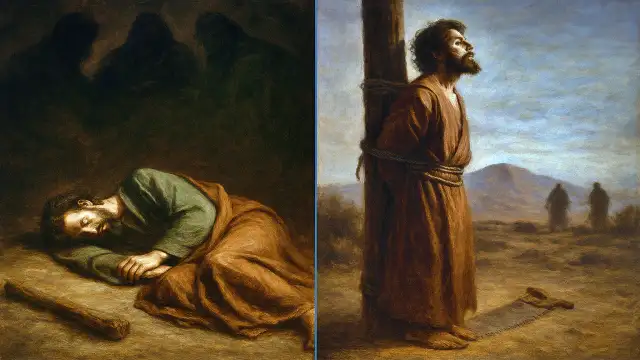
These two are the “deep cuts.” They are almost always paired together in legend.
- Simon is called “the Zealot,” which hints he might have been part of a Jewish political movement that wanted to overthrow the Romans by force.
- Jude (or Thaddeus) is the “other Judas,” and is now famous as the Patron Saint of Lost Causes.
Their Mission:
Tradition says this duo formed an inseparable “tag team.” They traveled and preached together through Syria, Mesopotamia (Iraq), and, finally, Persia (Iran).
Their Martyrdom:
In Persia, they ran afoul of the local pagan priests, who gave them an ultimatum: sacrifice to the sun and moon gods, or die.
They refused. Their deaths are, once again, gruesomely specific.
- Jude (Thaddeus) was beaten to death with a club.
- Simon the Zealot was executed by being sawn in half.
This is why, in art, you can always spot them. If you see a saint holding a club, it’s Jude. If he’s holding a saw… that’s Simon.
Why Are These Stories So Wild? (The Real “Secret”)
So, what’s the deal? Why are these legends so creative and so violent? Were the apostles really flayed, sawn, and fed to dragons?
Probably not.
The truth is, these stories weren’t meant to be 100% historically accurate. They served a purpose.
- Theological Branding: In a world without social media, a saint needed a “brand.” The story of their martyrdom became their logo. The X-Cross is Andrew. The flayed skin is Bartholomew. The spear is Thomas. This unique, gruesome detail made them instantly recognizable in art, song, and story.
- The Power of Relics: A story gives power to a relic. A random bone in a church is just a bone. But a bone that belonged to the man who was sawn in half in Persia? That’s a holy object with miracle-working power.
- The Ultimate Inspiration: The core message of Christianity is that faith triumphs over death. What’s the most powerful way to show that? By telling a story where a hero faces the most creative, horrifying death imaginable… and isn’t afraid. It’s the ultimate “I dare you” to the empires of the world.
These legends aren’t just “untold.” They are the unforgettable, larger-than-life tales that show how a dozen men from Galilee—or at least, the idea of them—truly did go out and change the world, one terrifying, miraculous story at a time.
Call to Action
We’ve only scratched the surface. The legends of Matthew in Ethiopia, Matthias and the cannibals, and James the Less being thrown from the temple are just as wild.
Which of these “untold” legends blew your mind the most? Do you have a local story or tradition about one of the apostles visiting your own part of the world?
Let me know in the comments below!

